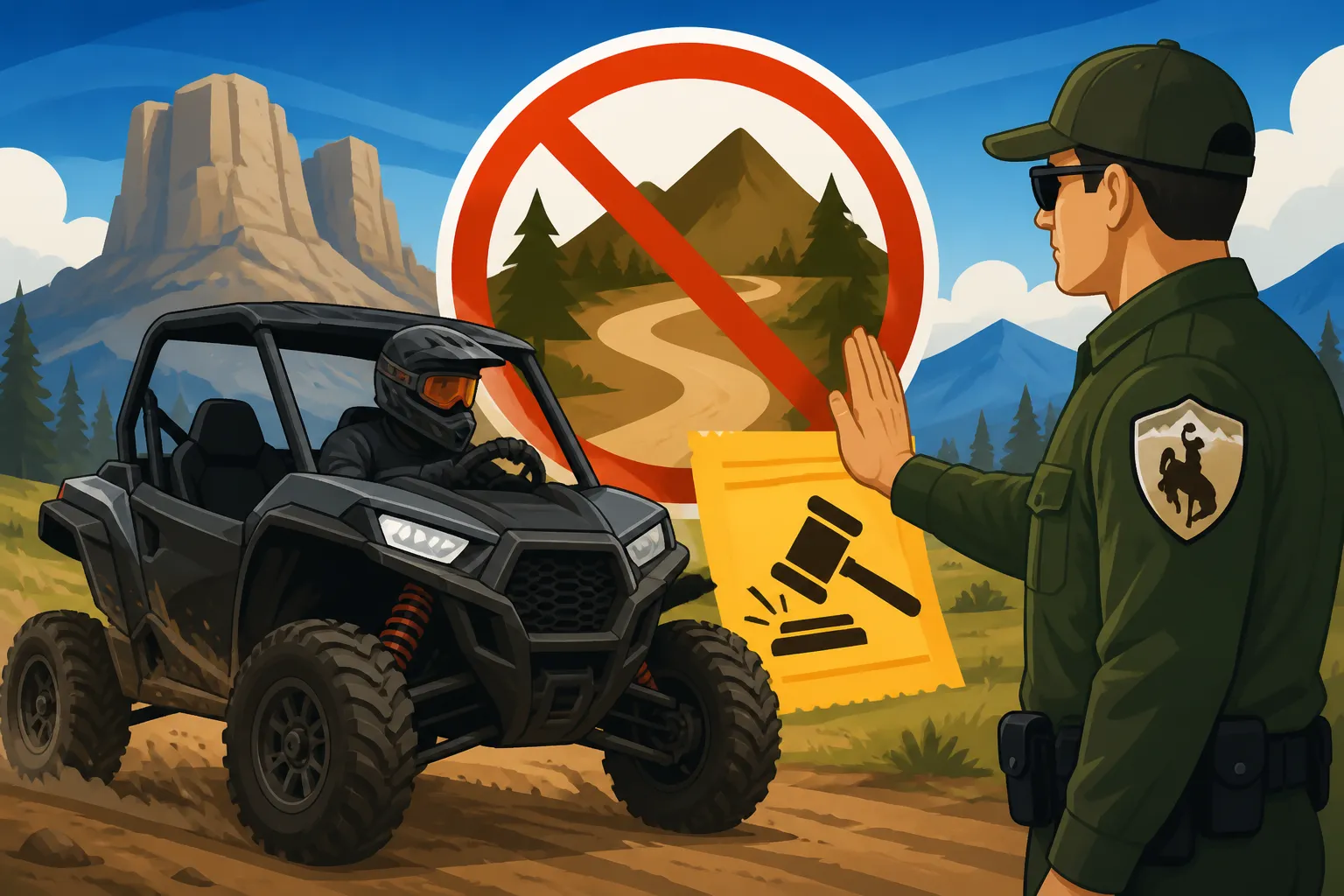
Wyoming Fines for Riding a Closed Route
A route that looks open on the ground may be closed by a seasonal order, a sign, or a land manager’s current map. In Wyoming, riding past a closure can bring a citation even if your ATV or UTV has a valid permit. Here’s how to understand the risk, check a route before riding, and respond if you receive a ticket.
What It Means to Ride a Closed Route in Wyoming
A closed route is one you are not authorized to use at that time. The restriction may apply to a trail, road, or segment, and it can be temporary or year-round. A route may close for wildlife protection, unsafe conditions, maintenance, fire restrictions, or other land-management reasons. A route that was open on a previous trip is not necessarily open now.
The key distinction is between permission to ride a machine and permission to use a particular route. A Wyoming ORV permit does not make a closed route legal. Likewise, an out-of-state registration or permit does not override a closure. Permit requirements are a separate issue; see Wyoming Fines for Riding Without a Permit and Wyoming Rules for Riding a Designated Route for related questions.
Closures may come from the agency or other authority responsible for the land or route. That could mean a route on federal, state, county, or other land has different rules from a nearby route. A map that shows a road or trail does not, by itself, mean it is open to your machine. Look for the route’s current status and any restrictions on vehicle type, width, season, or direction of travel.
Some closure signs are placed at trailheads or route entrances. Others may mark the specific segment where a restriction starts. A closure can also be communicated through current land-manager notices or maps, even if a sign is missing, hard to see, or damaged. For practical map and sign checks, see Wyoming Trail Closures to Check First, When a Sign on the Ground Says Closed, and When a Map and a Sign Disagree.
| What you see or know | What it means for your ride |
|---|---|
| A sign says the route is closed | Do not enter or continue past the closure unless the sign clearly allows your use. |
| A current map or notice shows a closure | Treat the restriction as active and confirm the route status with the responsible land manager if unclear. |
| The route was open on an earlier visit | Past access does not establish that it is open today. Check for updated closures. |
| Your machine has a valid permit | The permit does not authorize travel on a closed route. |
| A map shows a road or trail but no status | The mapped line is not proof that the route is open to your machine. Verify before riding. |
When route status is uncertain, stop before entering the questionable segment. Check the map legend and date, read notices at the staging area, and contact the land manager if you can. If you are already on the route and encounter a closure, do not ride farther to see where it leads. Turn around where it is safe and legal to do so.
What Fines and Other Consequences May Follow
There is no single fine amount that can safely be applied to every closed-route situation in Wyoming. The possible penalty depends on the specific rule, who manages the land, where the violation happened, and how the citation is processed. A citation issued on one kind of land may not follow the same process as one issued elsewhere. Check the citation and the relevant official authority for the applicable amount, deadlines, and instructions.
A citation may involve a fine or other costs, and it may require a response or appearance through the process identified on the paperwork. Do not assume that paying an amount listed on a citation is the only available step, or that ignoring it will make it go away. Read the notice closely and follow its instructions. If you are unsure which authority issued it, use the contact information printed on the citation to ask where questions or disputes should go.
A rider may also face consequences separate from the amount of a fine. Depending on the circumstances and applicable rules, an incident can lead to a request to leave the area, additional scrutiny of the ride, or consequences connected to damage or other violations. Do not assume these outcomes apply in every case; the citation, the responsible authority, and the facts matter.
A closed-route citation is also different from a permit violation. A machine can carry a current decal and still be cited for entering a closed segment. Conversely, a rider could have both a permit issue and a route-use issue, but they are not interchangeable. What a Ticket for Riding a Closed Segment Costs discusses why the citation details matter, while Wyoming Fines for Riding Off a Route covers the related but distinct issue of leaving an authorized route.
The officer or ranger may ask where you came from, what route you used, and whether you saw a sign or checked a map. A roadside encounter is not the time to argue aggressively or guess at the rule. Be calm, provide required information, and avoid making claims you cannot support. What a Wyoming Trooper Checks Roadside offers more context on a roadside check.
If you receive a citation, keep the paperwork and make a note of what happened while the details are fresh. Record the route name or location, the date and approximate time, the direction you were traveling, and any signs or barriers you saw. If there were other riders or witnesses, note their contact information. Preserve relevant map versions, closure notices, and photographs if you already have them. Do not enter a closed area again to take pictures or gather evidence.
How to Check a Route and Handle a Citation
A reliable pre-ride check is more than looking at a route line on a general navigation app. Use current information from the agency or authority that manages the route, and compare it with signs at the trailhead. A paper map or downloaded map can help when cell service is weak, but check its date and closure information before relying on it.
Before setting out:
- Identify the land manager for the area and find its current route information or closure notices.
- Check whether the route is open on the date of your ride, not just whether it appears on a map.
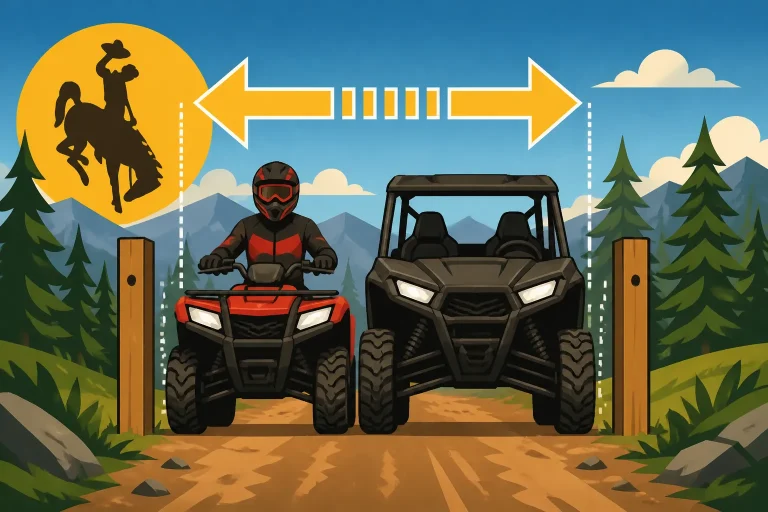
- Confirm that your ATV or UTV meets any route-specific limits, including width or vehicle-class restrictions.
- Read signs at the access point and at any junction or closure barrier.
- If the sources conflict or the status is unclear, choose another route until you can confirm access.
A posted closure may apply only to a segment, or it may cover a larger area. Do not assume that a route becomes open again just because you can see a connecting road ahead. Turn around before the restricted section, and do not bypass gates, barriers, or signs by riding around them. Where an Enrolled Segment Ends and Who Decides When a Wyoming Trail Reopens can help explain why route boundaries and reopening decisions matter.
If you believe a citation was issued in error, use the instructions and deadlines on the citation to ask questions or challenge it. A practical response is to identify the exact location and rule involved, then provide relevant facts and records. For example, you may have evidence that a sign was obscured or that an official closure notice described a different segment. That does not guarantee a citation will be dismissed; it gives the reviewing authority specific information to consider.
Keep your account factual. Separate what you personally saw from what someone else told you, and avoid editing or removing useful records. If the citation has a deadline, do not miss it while trying to contact an agency informally. The official process and the citation’s instructions control. For more on the response process, see Appealing a Trail Citation.
The most dependable way to avoid a closed-route citation is to verify the route’s current status and obey restrictions on the ground. When information is uncertain, take a different route. A valid permit is important, but it cannot substitute for checking whether the trail or road is open to your machine.
Disclaimer
This article is for general informational purposes only and does not constitute professional advice. Laws, prices and regulations vary by location and change over time. Consult a qualified professional for guidance on your specific situation.