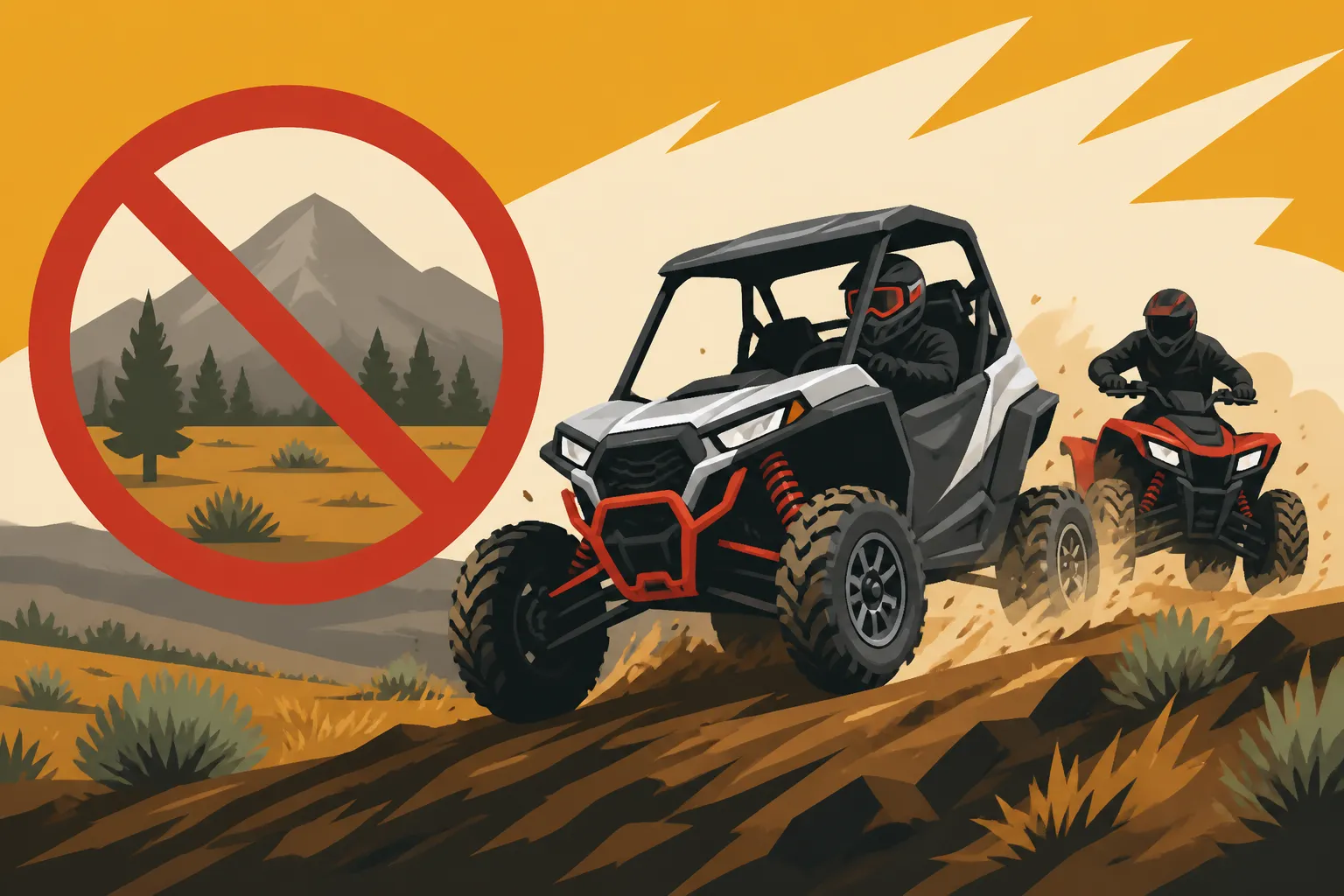
Riding Cross-Country Where It Is Barred
It can be tempting to leave a trail and ride across open-looking ground, especially when a route seems to end or your map is unclear. In Wyoming, though, a permit does not give you permission to travel wherever terrain allows. This article explains how to tell where riding is allowed, what to do when a route is closed or uncertain, and how to choose a legal alternative.
A permit does not authorize cross-country travel
An ORV permit is a registration requirement, not a general license to ride across public land. According to Wyoming State Parks, Historic Sites, & Trails, ORVs may be operated only on roads, trails, or areas designated as open by the appropriate local land manager, such as the Forest Service or BLM. The same agency says ORV travel must remain on enrolled roads and travel routes or enrolled trails.
That distinction matters when a rider reaches a trail boundary, a closed segment, or a gap between mapped routes. Having a current decal does not make nearby terrain an approved route. Nor does seeing tire tracks, an old roadbed, or an open-looking hillside establish that motorized travel is allowed there. Check the land manager’s current information and follow closures and on-the-ground signs.
A Wyoming ORV permit is required for enrolled roads, routes, and trails of 50 inches or less designated for ORV use, according to Wyoming State Parks, Historic Sites, & Trails. The Forest Service also limits off-highway vehicles on its trails to a maximum width of 50 inches at the widest point. A permit and a machine that fits the trail’s width limit are still not enough if the route is closed or the rider leaves the designated corridor.
| Situation | What to do |
|---|---|
| The route is designated and marked open | Stay on the route and meet its permit and vehicle requirements |
| A sign says the route is closed | Do not ride past the closure or around it |
| A map and the signs do not match | Stop and check with the land manager before continuing |
| The route ends or is unclear | Turn back or use a confirmed open route |
| You want to ride away from a designated route | Do so only in an area specifically designated for that kind of riding |
“Cross-country” can mean different things. A designated riding area may allow riding within its boundaries, while an enrolled trail may require riders to remain on its marked path. Do not assume that permission to use one area means you can ride across adjoining land. The appropriate land manager’s designation controls where motorized travel is allowed.
Some areas are not open to motorized use at all. Wyoming State Parks, Historic Sites, & Trails identifies designated Wilderness Areas including Encompassment River, Huston Park, Platte River, and Savage Run as permanently closed to motorized vehicles and mechanized equipment. Riders should not treat a trailhead, nearby road, or route on the edge of such an area as permission to enter it.
For more on how route status works, see Wyoming Rules for Riding a Designated Route. If you are trying to interpret a map or sign, When a Map Marks a Route Open and When a Sign on the Ground Says Closed address the kinds of situations that can lead to a wrong turn.
Confirm the route before you ride
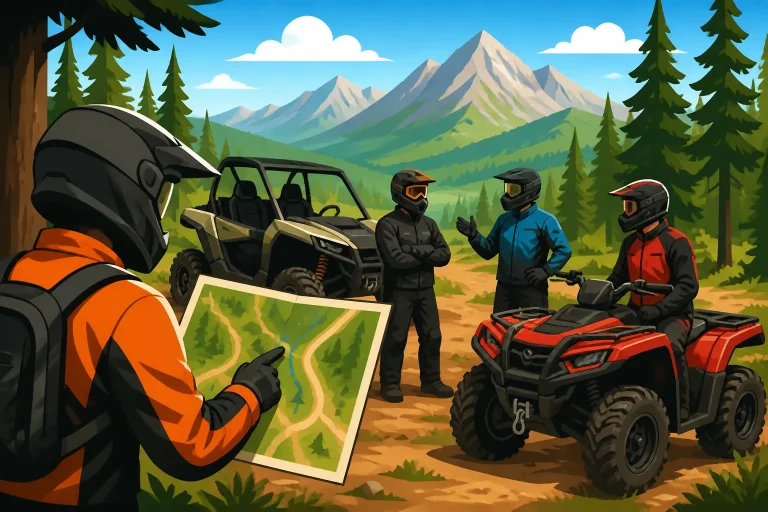
The safest time to resolve a route question is before leaving the trailhead. A general recreation map may show roads and trails without showing whether a specific segment is open to motorized use. A designated-route map or travel management map is more useful for that decision, but riders should still check for current closures and signs.
In the Bighorn National Forest, the Forest Service advises visitors to obtain a Bighorn Motorized Vehicle Use Map to identify open roads and trails. The Forest Service permits motorized travel on designated roads and trails across the forest; that does not mean every visible track or connecting strip of ground is open. Use the map to plan a route, then watch for signs and follow any closure information from the land manager. For map-reading help, see Wyoming Trail Maps and MVUMs.
A practical route check can help prevent an accidental departure from an approved trail:
- Identify the land manager. Routes may be managed by different agencies, and the responsible manager’s designation is what matters.
- Use a map intended for motorized travel. Look for the specific road or trail, its status, and any limits that apply to the machine.
- Check for current closures. A route shown as open on a map may have a temporary restriction or a closure sign on the ground.
- Compare the map with signs at the route. If the sign indicates closure, do not continue on the assumption that the map overrides it.
- Plan a return route. Avoid depending on an unverified shortcut or an unmarked connection to get back to the trailhead.
- Turn around when uncertain. Ask the land manager for clarification rather than testing whether an unclear track is open.
A phone map can be useful for navigation, but it is not a substitute for an official motorized-use map or a route designation. Keep the map available even if you have a downloaded copy, and make sure you can identify where a route begins and ends. If a route appears to continue beyond its designated segment, do not assume the continuation is open.
The Bighorn National Forest has designated motorized routes such as the Adelaide Trail, Bald Ridge ATV Trail, Bighorn Reservoir Trail, and Bishop Mine Trail, according to the Forest Service. These named routes illustrate the kind of defined trail option to look for instead of crossing unapproved ground. Confirm current access and applicable restrictions before setting out; a trail name alone is not confirmation that it is open on the day of your ride.
If the map and signs conflict, use the more cautious interpretation until the land manager clarifies the route. A sign may reflect a closure or restriction that is newer than a map, while a map may cover a wider area than the sign at a particular junction. Do not ride around a barrier, detour through vegetation, or continue down a questionable track to find out where it goes. Asking Which Roads Are Enrolled can help when the route’s status is not clear.
Permits and vehicle rules still matter on open routes
Once you have confirmed that a route is open, make sure the machine and rider meet the rules for that type of route. A permit does not replace route approval, and route approval does not remove permit or operating requirements.
Wyoming has no reciprocity for out-of-state ORV or OHV registrations, according to Wyoming State Parks, Historic Sites, & Trails. Non-residents must obtain a Wyoming ORV permit when operating in the state. The state permit applies equally to residents and non-residents and is valid for a calendar year, according to the same agency. For visitor-specific details, see Wyoming ORV Permit for a Visiting Rider.
All ORVs must display the Wyoming permit while operating on public lands and other designated roads, trails, or areas, according to Wyoming State Parks, Historic Sites, & Trails. Designated trails enrolled in the ORV program require a state ORV sticker even if the machine is street legal. The Forest Service likewise requires riders on its designated routes to possess a current Wyoming off-road vehicle registration decal.
The requirement differs on roads. According to Wyoming State Parks, Historic Sites, & Trails, enrolled roads require a vehicle to be street legal or to display a state ORV sticker while meeting the applicable ORV definition requirements. An ORV displaying only a Wyoming permit may operate only on roadways identified as part of the Wyoming ORV Program. On roads that are not designated for ORV travel and are not enrolled in the program, the machine must have a current license plate and be street legal.
Riders should not confuse a permit with a road license. According to Wyoming State Parks, Historic Sites, & Trails, a person operating on a roadway with only an ORV sticker must have a valid driver’s license or permit. On roads identified as part of the Wyoming ORV Program, operators must also have a valid operator’s license and carry proof of liability insurance. Rules for an unenrolled road are different and include street-legal equipment, a current plate, and the required license or permit and insurance. See Why an ORV Permit Is Not a Road License before planning to use a roadway as a connector.
A few points to check before riding:
- Machine width: The Forest Service limits off-highway vehicles on trails to 50 inches at their widest point. Check the trail’s machine limits before arriving.
- Permit display: The Wyoming decal must be current and displayed as required. A receipt or another state’s registration is not a substitute for the Wyoming permit.
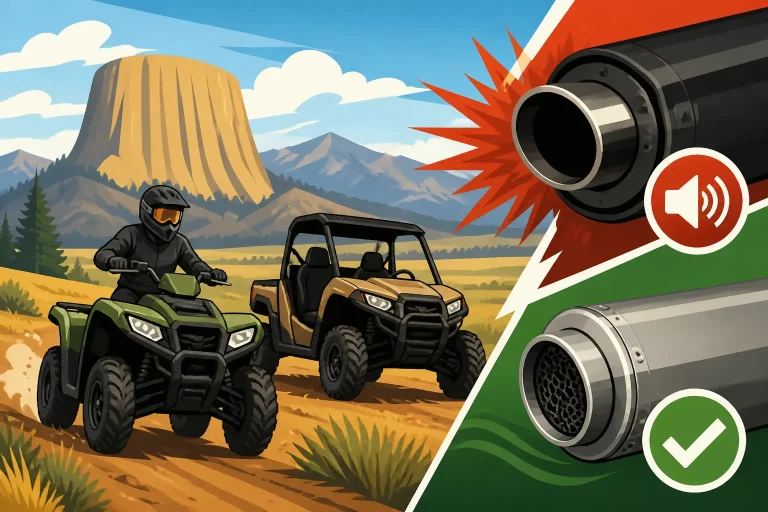
- Sound and spark arrester: Wyoming State Parks, Historic Sites, & Trails requires ATVs and trail bikes to have approved, operating spark-arresting mufflers and comply with sound regulations. See Wyoming Spark Arrester Requirement.
- Night operation: Wyoming State Parks, Historic Sites, & Trails requires a working headlamp, taillights, and brake light when operating from one-half hour after sunset to one-half hour before sunrise.
- Riders under 18: Operators and riders under 18 years old must wear an approved helmet, according to Wyoming State Parks, Historic Sites, & Trails.
Permits are available online and in person, and local selling agents include ATV and motorcycle dealers, local businesses, selected Forest Service and State Park offices, and some county treasurer offices, according to Wyoming State Parks, Historic Sites, & Trails. Check the program’s current instructions before heading out so the permit is obtained and attached properly. The registration program is administered by the Wyoming Department of State Parks and Cultural Resources.
What to do when a route is closed or you have already left it
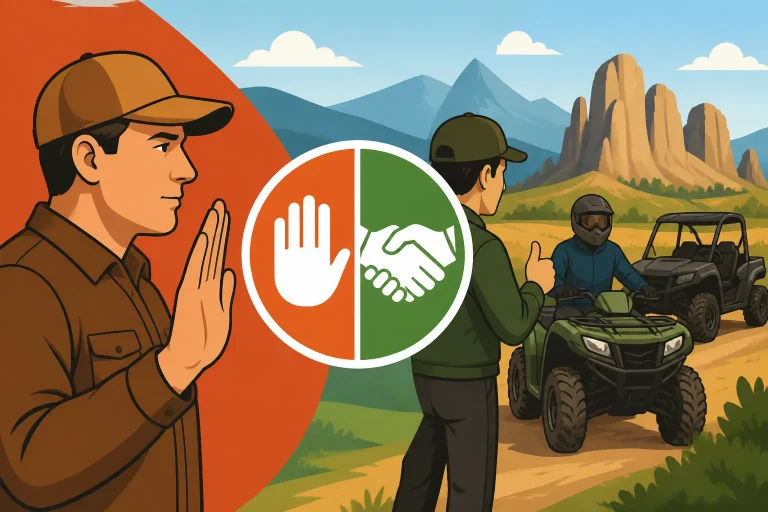
When you encounter a closure, stop before entering the restricted segment. Do not assume the closure applies only to full-size vehicles, or that your smaller machine can pass. Do not ride around the end of a gate or barrier, and do not create a new track through the surrounding terrain. A blocked or signed route should be treated as closed unless the land manager confirms otherwise.
If you realize that you have left a designated route, avoid extending the off-route travel. Return by the safest practical path to the point where you left the route, provided doing so does not require entering a closed area. If you cannot do that without making the situation worse, stop and seek direction from the responsible land manager. Do not use a closed trail as a shortcut back to an open route.
Wyoming State Parks, Historic Sites, & Trails says riders who violate rules may be required by a ranger to park the ORV, leave, or receive a citation. Riding away from a designated route can also create problems beyond the immediate enforcement risk: it may damage ground outside the travel corridor or lead to a more serious mistake, such as entering an area closed to motorized use. Wyoming Fines for Riding Off a Route explains the citation issue.
If you are traveling with younger riders, take extra care to keep everyone on the approved route. According to Wyoming State Parks, Historic Sites, & Trails, operators without a driver’s license or permit, typically those 15 years old and under, may operate an ORV only on enrolled trails, designated riding areas, and private property with permission. Operators over the age of 15 with a permit or driver’s license may ride on roads, routes, and trails designated for ORV travel, as well as on non-designated roads if the ORV is street legal. These distinctions do not turn an unapproved cross-country path into a legal route.
For a ride in the Bighorn National Forest, combine the Forest Service motorized-use map with current signs and route information. In other areas, check the map and guidance from the appropriate land manager. If the route cannot be confirmed as open, choose a known designated road, trail, or riding area instead. A short detour on an approved route is safer than trying to save time by cutting across land where motorized travel is barred.
Sources
- Wyoming State Parks, Historic Sites, & Trails — Wyoming State Parks, Historic Sites, & Trails – ORV Permits – Trails (checked November 3, 2026)
- Wyoming State Parks, Historic Sites, & Trails — Wyoming State Parks, Historic Sites, & Trails – ORV Rules & Regulations – Trails (checked November 3, 2026)
- Wyoming State Parks, Historic Sites, & Trails — Wyoming State Parks, Historic Sites, & Trails – ORV F.A.Qs (checked November 3, 2026)
- Wyoming State Parks, Historic Sites, & Trails — Wyoming State Parks, Historic Sites, & Trails – ORV Requirements – Trails (checked November 3, 2026)
- Wyoming State Parks, Historic Sites, & Trails — Wyoming State Parks, Historic Sites, & Trails – OHV (Off-Highway Vehicle) Partnership Grants (checked November 3, 2026)
Disclaimer
This article is for general informational purposes only and does not constitute professional advice. Laws, prices and regulations vary by location and change over time. Consult a qualified professional for guidance on your specific situation.