Which Gates You Are Required to Close
A gate on a Wyoming ATV or UTV route can look like a small detail, but what you do at it matters. A gate may control livestock or mark a route closure, and an open gate does not automatically mean the road beyond it is legal to ride. The safe rule is straightforward: obey closures, don’t tamper with fences, and leave each gate as you found it.
The basic rule: close gates behind you
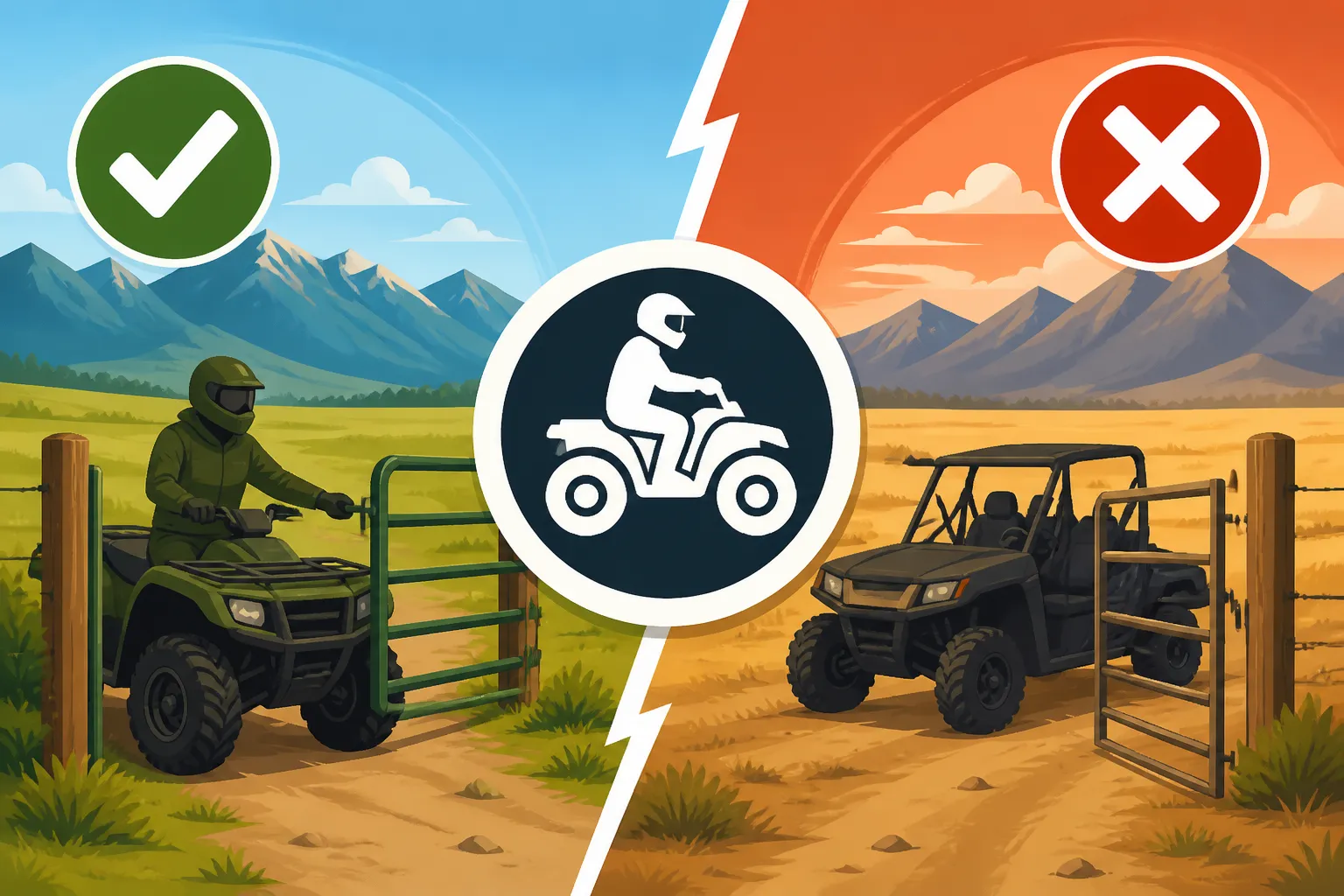
When you ride through an open gate, close it after you pass. Don’t leave it open for the next rider, even if your group is still coming through. An open gate can let livestock wander, disrupt a land manager’s work, or create a problem for the next person using the route. If you’re riding with others, make sure the last person through closes and secures it.
Wyoming’s trail guidance says riders on public lands must obey gate closures and respect signs on the ground. Closed gates and signs take precedence over maps, and tampering with fences or leaving gates open is prohibited, according to the Wyoming Division of State Parks, Historic Sites, & Trails and the Bureau of Land Management. This is the practical rule to follow whether you’re on a public route or crossing land where you have permission.
A gate does not need a separate “keep closed” notice for you to take care with it. If it is open and the route is open, pass through without damaging the gate or fence, then return the gate to its prior closed position. Use the latch if there is one. Don’t tie the gate open, wedge it with a rock, or assume the next rider will close it.
| What you find | What to do |
|---|---|
| A closed gate or a sign saying the route is closed | Stop. Do not open the gate, ride around it, or cross the fence. |
| An open gate on a route that is clearly open | Pass through carefully and close and secure the gate behind you. |
| An open gate with a sign instructing riders to keep it closed | Follow the sign, then close the gate behind you. |
| A map showing a route as open but a gate or sign showing it closed | Treat the on-the-ground closure as controlling and do not proceed. |
| A gate you cannot close or latch without forcing it | Don’t damage or alter it. Leave it as safely as you can and report the problem to the responsible land manager or landowner. |
For a closer look at the practical steps at a gate, see Wyoming Rules for Opening a Gate. The central point is not complicated: don’t treat gates as obstacles to defeat. They are part of how the route and surrounding land are managed.
Decide whether the route is open before you ride through
Closing an open gate correctly is only one part of riding responsibly. First, confirm that the route itself is open to motorized travel. Wyoming requires ORVs to stay on roads, trails, or areas designated as open by the appropriate local land manager, such as the Forest Service or BLM. A route that appears on a map—or continues beyond a gate—is not necessarily open to your machine.
Check the current map or route information for the area before setting out, then pay attention to signs and closures when you arrive. For Bighorn National Forest riding, the Forest Service directs visitors to obtain a Bighorn Motorized Vehicle Use Map to identify open roads and trails. That map is useful for planning, but it does not override a closure sign or closed gate in the field. For more on preparing, see Wyoming Trail Maps and MVUMs and When a Map and a Sign Disagree.
A gate can be closed for reasons that are not obvious from the trail. The land manager may be limiting access, protecting a resource, or controlling movement through an area. Don’t guess that the closure is temporary, that it applies only to other vehicles, or that you can continue by going around the gate. If the route’s status is unclear, stop and seek current direction from the land manager rather than making your own route around the barrier.
The same caution applies when a map and the ground seem to tell different stories. If a map shows an open route but a gate is closed, don’t open it just because the map suggests you should be able to continue. If the gate is open but a nearby sign says the road or trail is closed, follow the sign. A route may have changed since a map was prepared, or a closure may be temporary. Either way, the field restriction is the one to respect.
A gate is not proof of permission to cross private property, either. A road or track that looks rideable may still require permission from the landowner. Wyoming’s rules for riding private land and Wyoming Rules for Crossing Private Land are useful background if your route approaches or crosses private ground. When you don’t know who controls the land or whether access is allowed, don’t use an open gate as your permission slip.
Pay particular attention near livestock
Gates often sit where roads cross grazing land or connect sections used to manage livestock. If you find cattle near a gate, slow down, keep your distance, and avoid startling or chasing them. Don’t leave the gate open while waiting for animals to move. If the animals block the route or you can’t pass safely without disrupting them, wait or turn back rather than pushing through.
Where a road crosses grazing land, riders should not assume that a fence line or gate is an invitation to explore the surrounding area. Stay on the authorized route and close the gate behind you. For related advice, see Wyoming Rules for Riding a Grazing Allotment and Wyoming Rules for Riding Near Cattle.
What to do when a gate is locked, damaged, or unclear
A locked gate is a clear reason not to continue by that route. Don’t cut a chain, climb the fence, squeeze your machine through a gap, or ride around the gate across the adjacent ground. Those actions can damage property and may take you onto land or a route where riding is not permitted. If a sign identifies an alternate route, follow its directions; otherwise, turn around and check with the responsible land manager.
If a gate is open but a sign says the area is closed, obey the sign. If the gate is closed and there is no sign, don’t assume that the absence of a notice means you may open it. The Wyoming rule is to respect closed gates on public lands and follow signs on the ground, with closures taking precedence over maps. When you cannot tell whether the gate is meant to be open to riders, the safer choice is to stop and ask rather than force a decision at the fence.
A broken or difficult latch calls for care, not improvisation. Avoid using your ATV or UTV to push, pull, or bend a gate. Don’t remove hardware or change the fence so the gate will stay open. If you can close it without forcing it, do so. If you cannot, don’t make the damage worse; let the land manager or landowner know what happened and where you found it.
On a group ride, plan for gate handling before the group reaches the barrier. Have riders pass through one at a time, and make sure someone is responsible for closing it after the last machine. Don’t let a gap in the group create the assumption that the gate can remain open. The person who closes it should check that the gate is back in its closed position and that the latch is engaged, when possible.
If you’re unsure who manages a route, use the area’s official travel information to identify the appropriate contact. Forest Service and BLM routes can have different local restrictions, and a gate closure may apply to a particular segment rather than an entire area. For a wider overview of staying on authorized routes, see Wyoming Rules for Riding a Designated Route. If an officer or land manager asks you to stop or leave, follow that direction; What to Expect at a Trailhead Warden Checkpoint explains what riders may encounter during a check.
Permits and other rules still apply at gates
A correctly handled gate does not replace the permit and vehicle rules for the route beyond it. Wyoming State Parks, Historic Sites, & Trails requires a Wyoming ORV permit on enrolled roads, routes, and trails of 50 inches or less designated for ORV use. There is no reciprocity for out-of-state ORV or OHV registrations, so visitors must obtain a Wyoming permit when one is required. More details are available in Wyoming ORV Permit for a Visiting Rider.
A current permit also does not make a closed route open. Riders must follow the route designations and any signs or gates that restrict access. The permit is about registration; the land manager’s route designation determines where motorized travel is allowed. If you need help distinguishing registration from route access, Wyoming ORV Permits Explained covers the broader permit rules.
Vehicle status can affect which roads you may use, but it does not give you permission to bypass a gate. Wyoming State Parks, Historic Sites, & Trails says a street-legal ORV needs a Wyoming permit when it operates on an enrolled trail that is 50 inches or less wide. For other enrolled routes, requirements depend on whether the vehicle is street legal and how the route is designated. Check the specific route and machine requirements before riding, particularly if you plan to move between trails and roads.
Before leaving the staging area, confirm that your permit is current and displayed as required, check that the route is open, and make sure your group knows to close gates behind the last rider. Visitors may find Wyoming’s Enrolled Roads and Trails helpful for understanding the route system. A little preparation can prevent a wrong turn at a gate from becoming trespass, fence damage, or a ride into a closed area.
The simplest habit is also the most reliable: stop at the gate, follow the sign and current land-manager direction, pass only if the route is open, and close the gate behind you. If you cannot establish that you’re allowed to continue, turn back and check before riding farther.
Sources
- Wyoming State Parks, Historic Sites, & Trails — Wyoming State Parks, Historic Sites, & Trails – ORV Rules & Regulations – Trails (checked November 3, 2026)
- Wyoming State Parks, Historic Sites, & Trails — Wyoming State Parks, Historic Sites, & Trails – ORV Requirements – Trails (checked November 3, 2026)
Disclaimer
This article is for general informational purposes only and does not constitute professional advice. Laws, prices and regulations vary by location and change over time. Consult a qualified professional for guidance on your specific situation.