Riding Off a Route to Retrieve Game
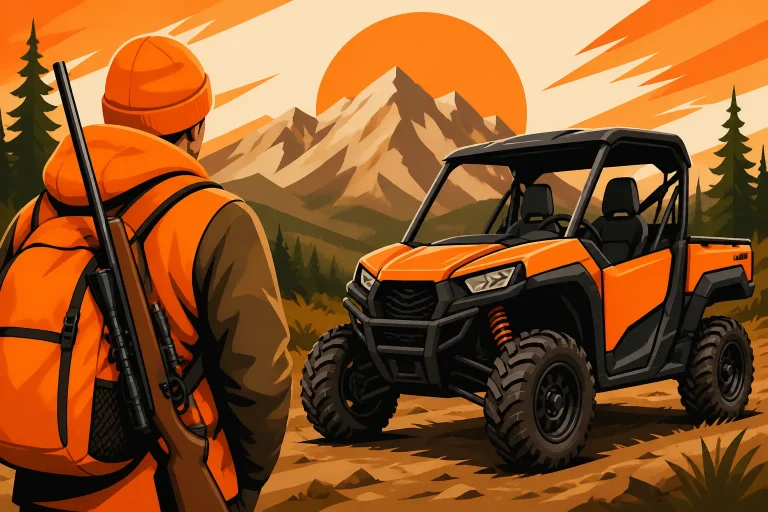
Retrieving a legally harvested animal can mean a long, difficult carry, but riding off a marked route is not automatically allowed because you are hunting. In Wyoming, the answer depends on the land, the route rules and any applicable hunting regulations. Here’s how to check before using an ATV or UTV—and what to do when the rules are unclear.
Does retrieving game let you ride off route?
Do not assume that a hunting purpose creates a general exception to motorized travel restrictions. A permit for your ATV or UTV does not, by itself, authorize off-route riding, and the right to hunt an area does not necessarily include the right to drive across it.
The key distinction is between permission to hunt and permission to use a motor vehicle in a particular place. Those permissions may come from different rules or land managers. Public land can have designated roads and trails, seasonal closures, vehicle-width limits and other restrictions. Private land requires the landowner’s permission for access, and that permission may be limited to a particular route or purpose.
A route can also be open to one type of use but not another. A motorized trail might have width or vehicle-class restrictions, while an access road may be closed to public travel or open only during certain seasons. A map, trail sign or posted closure can affect whether you may ride there, even if you have a valid hunting license and your machine has the required Wyoming decal.
Before a hunt, review the rules that apply to both activities:
- Check the hunting regulations for your species and hunt area, including any conditions on recovering harvested game.
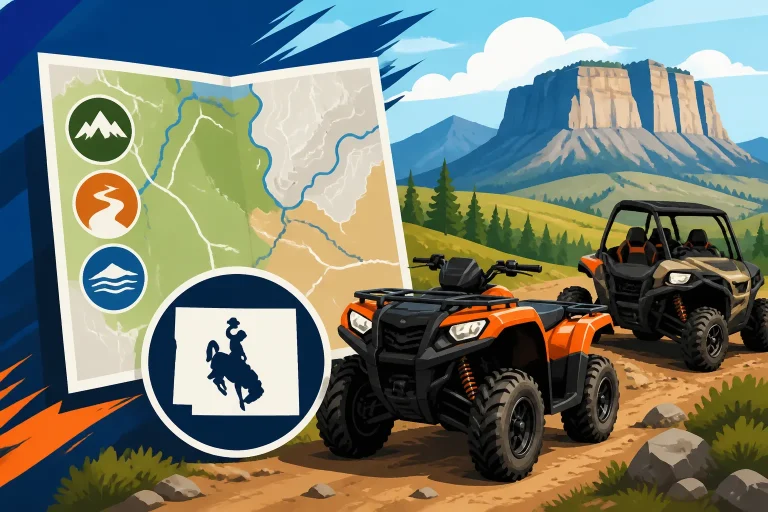
- Check the land manager’s current motorized travel map and route restrictions. For federal land, that may include a Motor Vehicle Use Map or another travel-management map.
- Contact the responsible office if the map or wording does not clearly answer whether a vehicle may leave the route for retrieval.
- Get specific permission from a private landowner before entering or crossing private property.
For more on the hunting side, see Wyoming Rules for Retrieving Game and Wyoming Rules for Hunting From an ATV. For the difference between a route that appears on a map and one that is actually available to riders, When a Map Marks a Route Open and When a Sign on the Ground Says Closed are useful checks.
The practical rule is straightforward: treat off-route travel as prohibited unless the applicable land manager and hunting rules clearly allow it. If you cannot confirm an exception before the hunt, plan to retrieve the animal without driving off the authorized route.
What to check before relying on a machine
A little advance planning can prevent a difficult situation from turning into a citation, a land-access problem or an unsafe recovery. Do these checks before heading out, not after an animal is down.
- Identify who manages the ground. A route may cross federal, state, county or private land, and rules can change at a boundary. Do not assume that one agency’s permission carries over onto neighboring property.
- Find the current route information. Use the official map or travel information for the specific area. Confirm whether the route is open for motorized use, whether your machine fits any width restriction and whether seasonal conditions have closed it.
- Ask about game-retrieval rules directly. If you are considering leaving a route to reach harvested game, ask the responsible land manager whether motorized retrieval is allowed at that location and under what conditions. Do not rely on a general statement that hunters may retrieve game; the method and location matter.
- Confirm private-land permission. Ask the landowner what access is allowed and where. Permission to hunt does not necessarily mean permission to drive off a road, cross a fence line or use a machine to retrieve an animal.
- Plan for an on-route recovery. Decide how the animal can be packed or carried to the machine if off-route driving is not allowed. Consider distance, terrain, daylight, weather, the size of the animal and whether you have enough people and equipment.
- Carry the necessary information. Have the relevant map available offline or on paper, and keep contact details for the land manager accessible. A phone may lose service in remote terrain.
| Question | What to verify | Why it matters |
|---|---|---|
| Is the route open? | Current official map, signs and any seasonal closure notices | A route shown on an older map may no longer be available |
| May this machine use it? | Route width, vehicle type and any machine-specific restrictions | An open route may not be open to every ATV or UTV |
| Can you leave the route for retrieval? | Specific written guidance or confirmation from the land manager | Hunting does not automatically establish a motorized-use exception |
| Does the land cross a boundary? | Ownership and managing agency along the full recovery path | Permission may end at a property or jurisdiction line |
| Can you recover the animal without driving off route? | Carrying plan, people, equipment and daylight | A practical backup helps avoid a rushed decision in the field |
An ORV decal addresses a separate requirement from access. If your machine needs a Wyoming permit, make sure it is current, but do not treat it as permission to use a closed road or travel cross-country. Wyoming ORV Permit for a Hunting Machine explains the permit question; Wyoming Rules for Riding a Designated Route covers the route-use side.
If an animal is down beyond the route
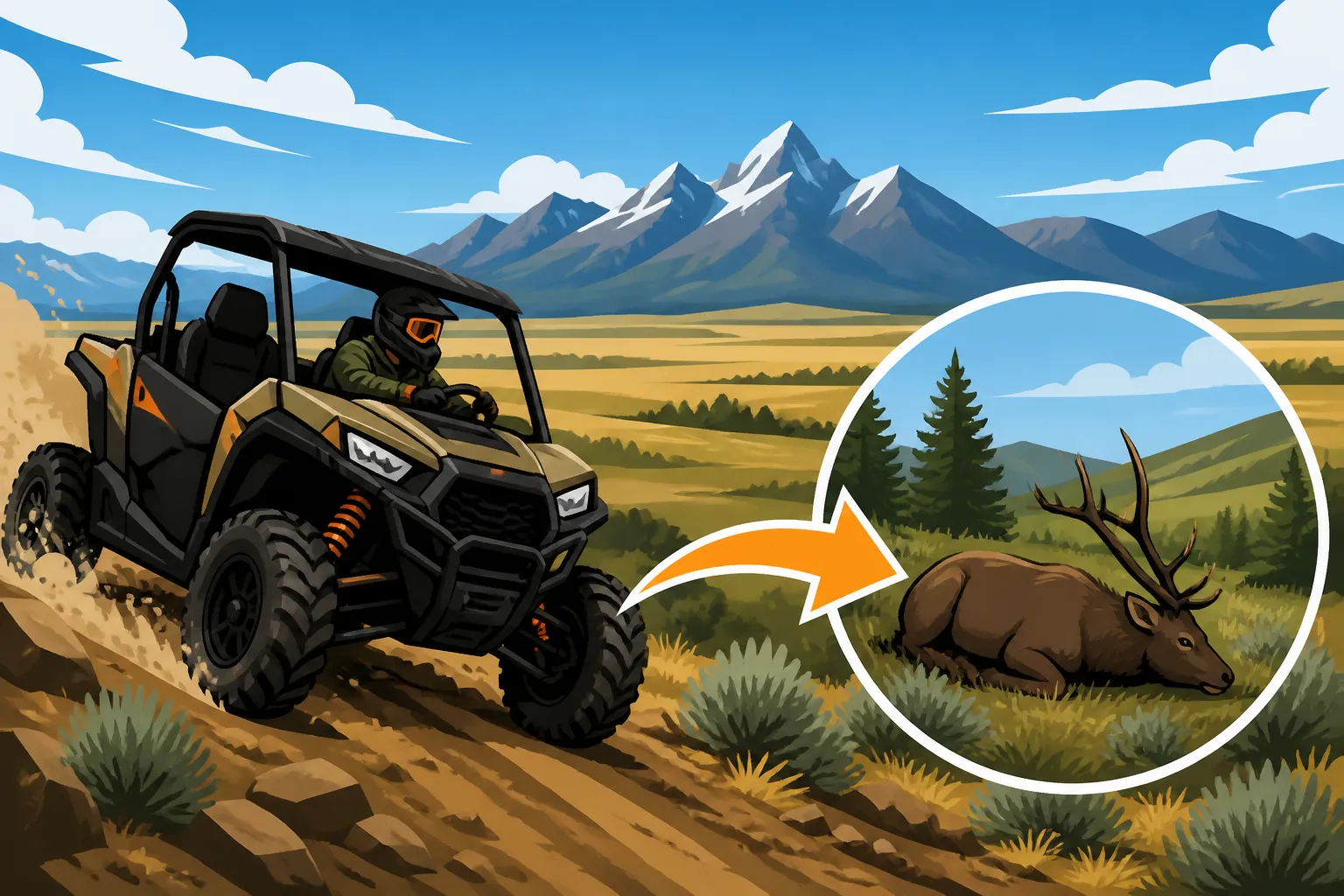
If an animal is down in a place you cannot reach by an authorized motorized route, pause before riding toward it. A difficult recovery is stressful, but it does not change the route designation. First determine whether the animal can be reached and brought out on foot, with help from other hunters, or by another method allowed in that area.
If you think an exception might apply, get confirmation from the land manager or appropriate wildlife official before driving off route. Be precise when you ask: identify the area or route, describe the proposed path and machine, and explain that the purpose is to retrieve harvested game. A broad answer about hunting access may not settle whether motorized travel is allowed at that specific location.
If the person you reach cannot confirm permission, take the conservative option. Stay on the authorized route and use a legal retrieval method, or ask the relevant officials for further direction. Do not assume that a lack of a sign means cross-country travel is permitted. Some restrictions are communicated through official maps and travel orders rather than a sign at every possible exit point.
A vehicle-based retrieval can also raise separate concerns if it crosses private land, grazing areas or a closed segment. Respect gates and property boundaries, and do not use a neighboring road as a shortcut unless it is open to your machine. For more on those issues, see Wyoming Rules for Crossing Private Ground and Wyoming Rules for Riding a Grazing Allotment.
When you contact an official, keep a record of the information you receive: the office, date, route or area discussed, and the guidance provided. If the answer depends on a particular condition, such as staying on an existing road or using a designated access point, follow that condition exactly. General advice from another hunter or a discussion about a different area is not a substitute for confirmation that applies to your location.
Common mistakes and a safer recovery plan
A frequent mistake is treating “I’m only retrieving game” as enough to justify any route. It may explain why you want to travel, but it does not prove that motorized access is allowed. Another is relying on a permit, hunting license or past practice as if one automatically overrides a land manager’s restrictions. Each document or permission has a separate purpose.
It is also risky to make the decision based only on a phone map. Digital maps can be useful, but they may not show the latest closure or accurately represent a boundary. Check official information, pay attention to signs on the ground and ask the agency responsible for the area when the two seem inconsistent. If a sign indicates that travel is closed, do not ride through while trying to resolve the question. Stop and seek clarification.
A safer hunting plan accounts for the possibility that a machine cannot go to the animal. Before leaving the trailhead:
- Know where your authorized route ends and where the next land boundary lies.
- Agree on how the hunting party will handle a recovery that requires walking.
- Carry suitable game bags, navigation tools, water, first-aid supplies and enough lighting for an unexpected delay.
- Set a turnaround plan if weather, terrain or daylight makes a recovery unsafe.
- Keep the machine on routes that are open to it, even when a more direct path appears convenient.
- If you are unsure what an official may check, review What to Expect at a Trailhead Warden Checkpoint.
A recovery can take longer than expected, especially when the animal is far from a route or terrain is steep, muddy or covered in snow. Do not let pressure to finish quickly push the group into an unverified shortcut. If conditions or distance exceed what the party can safely manage, contact the appropriate local officials for guidance rather than attempting a risky ride.
The clearest takeaway is that a valid permit and a lawful harvest do not automatically allow off-route vehicle travel in Wyoming. Confirm the land-specific rule before the hunt, follow the route designation, and use another recovery method unless motorized retrieval is expressly allowed.
Disclaimer
This article is for general informational purposes only and does not constitute professional advice. Laws, prices and regulations vary by location and change over time. Consult a qualified professional for guidance on your specific situation.