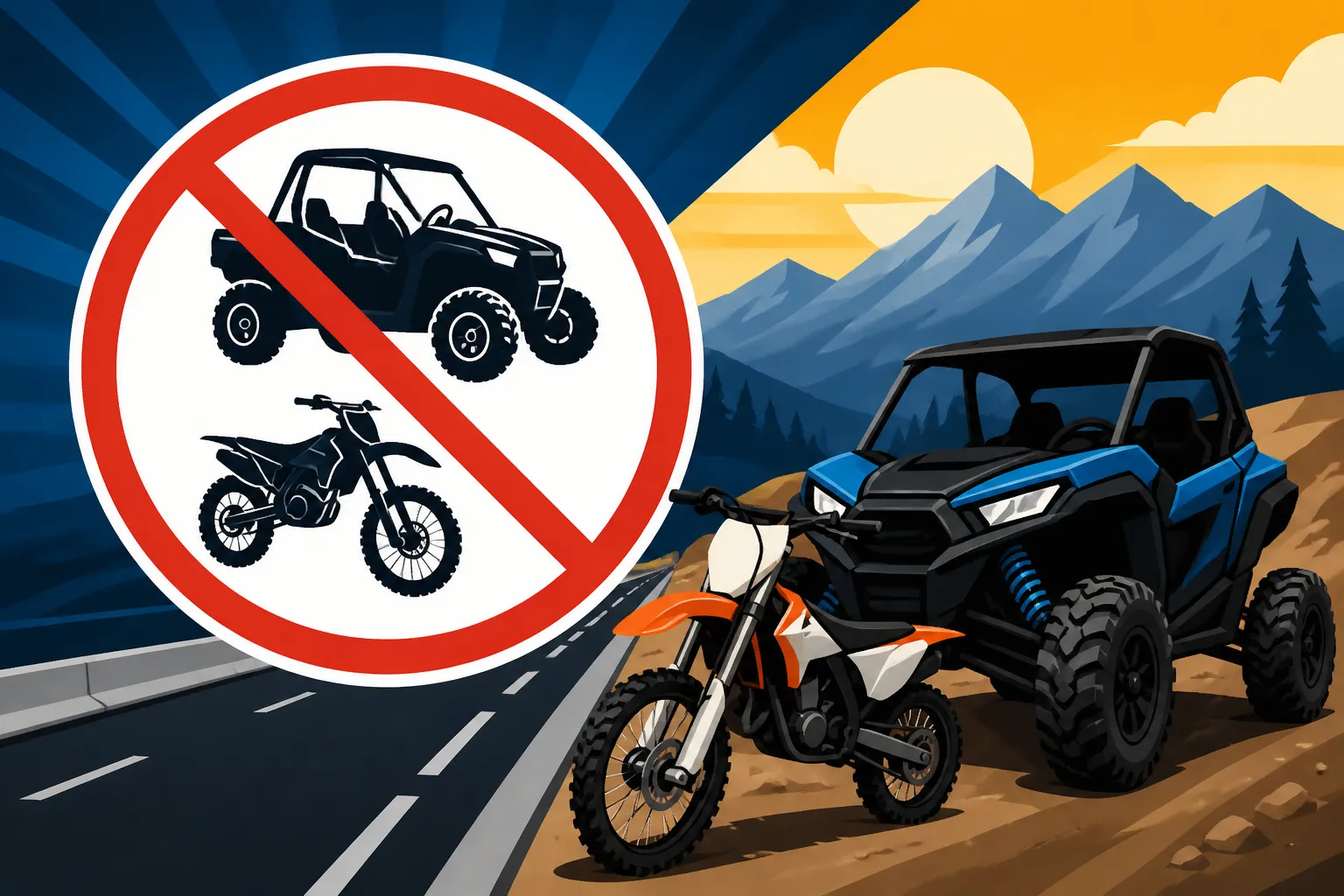
Interstates Closed to MPVs and Dirt Bikes
One of the biggest head-scratchers for off-road enthusiasts in Wyoming is figuring out exactly where you can and cannot take your machine on public roads. It's frustrating to invest in a great side-by-side or dirt bike, only to feel like you're constantly guessing about its street legality, especially when it comes to major thoroughfares. This guide aims to clear up the confusion, specifically tackling why Wyoming's interstates are generally off-limits for Multipurpose Vehicles (MPVs) and dirt bikes, and what the rules truly mean for your riding adventures.
The Hard Truth: Why Interstates Are Mostly Off-Limits for MPVs and Dirt Bikes in Wyoming
It's a common dream for many riders: the open road, the wind in your face, taking your trusty side-by-side or dirt bike from point A to point B without having to trailer it everywhere. While Wyoming offers a surprising amount of freedom for road-legal off-road machines, there's one significant exception that often catches people off guard: the interstate highways. These aren't just high-speed roads; they're designed for a very specific type of traffic and vehicle performance that most MPVs and dirt bikes simply don't meet. The regulations in place reflect a deep concern for safety, both for you and for everyone else on these bustling arteries.
Understanding the "No Go" Zones for Off-Road Machines
When we talk about "interstates," we're not just referring to any multi-lane highway. These are federally designated routes, often marked with an "I-" prefix, like I-80 or I-25, and they come with a distinct set of rules and expectations. For machines like your dirt bike or even a fully street-legal MPV, these roads are largely considered forbidden territory. It's not about whether your machine can physically go 75 mph (though many struggle to do so safely for extended periods); it's about the legal framework and the inherent dangers of mixing slower, lighter, and less protected vehicles with high-speed, heavy traffic. There are rare, specific exceptions for crossing an interstate, often at designated, grade-separated points, but these are for brief transit, not for cruising the open highway. [Wyoming Rules for Crossing an Interstate] delves into these specific scenarios.
Imagine pulling onto an interstate in your side-by-side, even one that's been beefed up with all the necessary road-legal components. You're suddenly surrounded by semi-trucks thundering by at highway speeds, cars whizzing past, and the sheer volume of traffic creates a whirlwind of noise and motion. This environment is radically different from the scenic county roads or quiet forest service routes where these machines truly shine. The law in Wyoming, much like in many other states, recognizes this fundamental difference in vehicle design and operational capabilities. It's less about restricting your fun and more about preventing potentially catastrophic accidents, a point which is often lost in the desire for seamless travel.
Safety Concerns: Speed, Traffic, and Vehicle Design
The primary reason interstates are off-limits boils down to safety. Off-road machines, even those modified for street use, are not engineered for sustained high-speed travel alongside cars and trucks. Their handling characteristics, braking distances, and overall stability at 70+ mph are vastly different. While your machine might feel sturdy on a gravel road, the forces at play on an interstate can quickly overwhelm it. The smaller tires, often designed for grip in loose terrain, perform differently on asphalt at high speeds, and the suspension, built for absorbing bumps, isn't always suited for stable highway cruising.
Think about it from another driver's perspective. A low-profile side-by-side or a narrow dirt bike can be incredibly difficult to see, especially in blind spots or during lane changes at highway speeds. The risk of being overlooked, even by attentive drivers, is significantly higher. Furthermore, if an incident does occur, the lack of robust crumple zones, airbags, or even a full enclosed cab (in many MPVs) means riders are far more exposed to severe injury. It's a sobering reality, but one that underpins these regulations. The purpose of these laws is to safeguard riders and the motoring public from scenarios where these machines are operating outside their intended design parameters, leading to disproportionate risk in high-speed, high-volume traffic.
Differentiating Your Machine: ORV, MPV, and the Path to Road Legality
Wyoming's approach to off-road vehicles on public roads isn't a simple "yes" or "no." It's nuanced, relying on specific definitions that categorize machines based on their design and features. Understanding whether your vehicle is considered an Off-Road Recreational Vehicle (ORV) or a Multipurpose Vehicle (MPV) is the first, crucial step toward knowing where you can legally ride. This distinction isn't just bureaucratic; it dictates everything from required equipment to where you can obtain registration and, ultimately, which roads are open to you.
What Makes a Machine an MPV in Wyoming's Eyes?
Wyoming Statute 31-1-101 is the key here. It lays out a very specific set of criteria that transform a standard off-road machine into a Multipurpose Vehicle (MPV) – a classification that opens the door to limited public road use. This isn't just about throwing some turn signals on your side-by-side; it's about meeting strict requirements that many stock machines don't inherently fulfill. For instance, the statute specifies weight limits: an MPV must weigh more than 300 pounds but not more than 3,000 pounds. This immediately rules out many lighter dirt bikes and some heavier, more robust UTVs from qualifying.
Beyond weight, there's the seat height rule: the machine must have a seat or seats at least 24 inches in height, measured from the ground to the lowest point of the top of the seat cushion. This requirement typically excludes traditional ATVs, which often have lower, straddle-style seating. Side-by-sides, with their bench or bucket seats, are much more likely to meet this criterion. Other requirements include a steering wheel (not handlebars), headlamps, taillamps, turn signals, brake lights, a horn, mirrors, and a spark arrestor. [Wyoming's Multipurpose Vehicle Class] dives deep into these specific definitions, illustrating how a stock machine might need significant upgrades to qualify. Aftermarket accessories from companies like SuperATV can be a great resource for getting your machine up to snuff with these road-legal requirements, ensuring you have the proper mirrors, horns, and lighting.
The Core Difference: ORV vs. MPV in Wyoming Law
The distinction between an ORV and an MPV is fundamental to understanding road access. An ORV (Off-Road Recreational Vehicle) is the broad category for machines like traditional ATVs, dirt bikes, and even some side-by-sides that are primarily designed for off-highway use. These machines require an [Wyoming's Annual ORV Permit] to ride on designated trails and enrolled public lands, but that permit does not grant any privileges for public road use, except for certain designated routes specifically marked as ORV-friendly. Essentially, an ORV permit is for the dirt, not the asphalt.
An MPV (Multipurpose Vehicle), on the other hand, is a subset of off-road machines that, by meeting the specific legal criteria mentioned above, can be registered and plated for limited public road use. This means a title and plates from the county treasurer, in addition to carrying proof of insurance. [Wyoming MPV Title Requirements] and [Wyoming MPV Plate Requirements] detail these processes. An MPV effectively bridges the gap between a pure off-road vehicle and a traditional street-legal vehicle, allowing it to operate on a wider range of public roads than a standard ORV. However, even an MPV has its limits, and as we've discussed, interstates are typically outside those boundaries. The road-legal components, like a functional horn, proper mirrors, and DOT-compliant tires, are essential for this classification, making it clear that a mere ORV sticker won't get you on the street.
Navigating Wyoming's Roads: Where MPVs Can (and Cannot) Go
Okay, so interstates are out for the most part. But that doesn't mean MPVs are confined to trails alone! Wyoming actually offers quite a bit of freedom for properly equipped and registered Multipurpose Vehicles. The trick is knowing which roads are open to you and understanding the subtle but important distinctions between different types of public thoroughfares. It's all about checking your maps, reading the signs, and being aware of local ordinances that might further refine access.
The Freedom of Enrolled County, State, and Federal Roads
For an MPV, the world of county roads, many state highways, and numerous federal roads (especially within National Forests and BLM lands) can be your oyster. [Wyoming's Designated ORV Roads] outlines the types of routes that are generally available. Once your machine is titled, plated, insured, and equipped to meet Wyoming's MPV standards, you can often cruise these roads much like any other vehicle. This is where the true benefit of going through the MPV registration process shines. You can ride from your camp to a trailhead, explore scenic backroads, or even commute short distances between towns, all without having to load your machine onto a trailer.
However, there's a crucial caveat: not all county or state roads are automatically open. Some might have specific restrictions, or local jurisdictions (cities, towns) might have their own ordinances limiting access. Always keep an eye out for signage. A "Motorized Vehicle Use Map" (MVUM) for federal lands (Forest Service, BLM) is an invaluable tool, clearly marking which roads are open to which types of vehicles. For county and state roads, it often comes down to what the state statutes allow and what local authorities have designated. The great thing about Wyoming is the sheer volume of wide-open spaces and rural roads that are perfectly suitable for MPVs, offering endless scenic riding opportunities, especially if you're prepared with a good map and a spirit of adventure.
Designated Crossings: A Limited Opportunity
While sustained travel on interstates is a no-go, there are very specific and limited circumstances where an MPV might legally interact with an interstate: designated crossings. These aren't just any old overpass or underpass. They are carefully selected and marked points where ORVs or MPVs are permitted to cross from one side of an interstate to another. The rules for these crossings are stringent, often limiting the number of machines per year that can use them and requiring a grade-separated path (meaning you're not driving on the interstate itself, but over or under it).
These crossings are typically established to connect existing trail systems that were bisected by interstate construction, or to provide critical access between communities. It's a pragmatic solution to a geographical challenge, recognizing the need for continuous access without compromising the safety standards of the interstate. You won't find these everywhere, and they are always clearly marked. Trying to create your own "crossing" by riding onto an interstate ramp or shoulder is a serious violation and extremely dangerous. Always look for official signage and understand that these are brief transit points, not an invitation to ride parallel to the highway. [Crossing From ORV to MPV] and [Wyoming Rules for Crossing an Interstate] provide more context on these specialized scenarios.
City Streets and Private Property Rules
Navigating towns and cities with your MPV adds another layer of complexity. While state law may permit MPVs on many public roads, cities and towns often have their own municipal ordinances that can restrict or prohibit MPV use on their streets, even if the machine is otherwise street-legal by state standards. This is where it's absolutely vital to do your homework if you plan to ride into a specific community. What might be allowed on a county road outside city limits could be strictly forbidden once you cross the "Welcome to [Town Name]" sign.
On the flip side, riding on private property is generally at the discretion of the landowner. If you have permission from the owner, you can typically ride your ORV or MPV without needing a permit or worrying about road legality, as long as you're not violating any noise ordinances or causing a nuisance. Always respect private property boundaries and get explicit permission before venturing onto someone's land. The freedom of riding in Wyoming is immense, but it comes with the responsibility of knowing and adhering to the specific rules of the road – or the trail – you're on, whether it's a bustling town street or a remote two-track across a ranch.
Equipping Your MPV for the Pavement: Beyond the Trail Requirements
Transforming your off-road machine into a road-legal MPV in Wyoming isn't just about getting the right paperwork; it's also about making sure your vehicle meets a specific set of equipment standards. These requirements go above and beyond what's needed for purely off-road trail riding, and they are critical for both your safety and your compliance with state law. Cutting corners here can lead to citations, vehicle impoundment, or, more importantly, put you at serious risk when sharing the road with other traffic.
Essential Safety Gear and Lighting Upgrades
To become an MPV, your machine needs to be outfitted with a comprehensive set of safety features that align with traditional road vehicles. This includes functional headlights, taillights, and brake lights – all of which must be visible from a certain distance and meet specific brightness standards. But it doesn't stop there. You'll need amber turn signals on both the front and rear of your vehicle, allowing you to clearly communicate your intentions to other drivers. Many off-road machines come with basic lighting, but often lack dedicated turn signals or brake lights that are robust enough for road visibility. Companies like SuperATV offer excellent kits to upgrade your lighting to be street-legal, often bundling everything you need into one package.
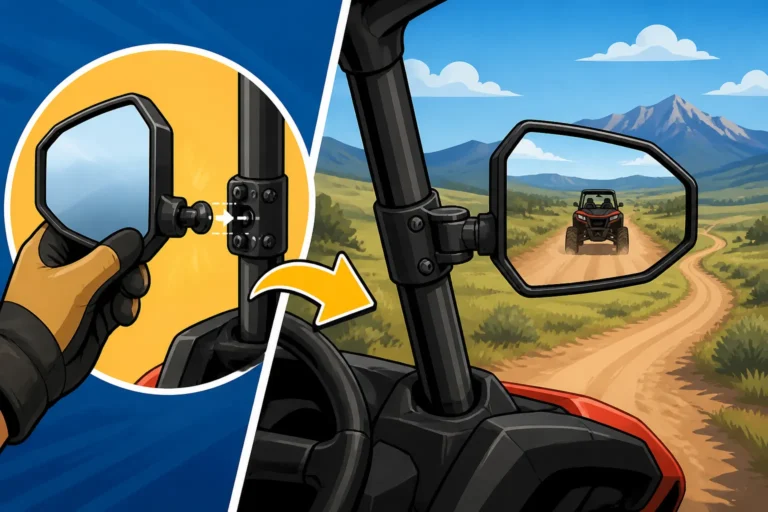
Furthermore, a working horn is mandatory for an MPV, as is at least one rear-view mirror mounted to provide a clear view of the road behind you. While many side-by-sides have mirrors, they might not be positioned optimally for road use, or you might need a second mirror on the passenger side for better visibility. A red rear reflector is also a must, ensuring your machine is visible even if your taillights fail. You can imagine how crucial these components are when you're navigating a busy county road, trying to signal a turn or get the attention of an inattentive driver. [Wyoming Lighting Requirements for ORVs], [Wyoming Mirror Requirements for Road Use], and [Wyoming Horn Requirement on a Road Machine] provide detailed guidance on these specific equipment mandates.
Driver Licensing and Insurance Requirements for Road Use
Just like driving any other vehicle on public roads, operating an MPV in Wyoming comes with specific licensing and insurance obligations. For starters, you'll need a valid driver's license. If your MPV requires a motorcycle endorsement (often the case for two-wheeled dirt bikes that might qualify as MPVs, or certain smaller, less car-like side-by-sides), you'll need that as well. It's not enough to simply have an ORV permit; that only covers off-road use. [Wyoming Driver's License Rules for ORVs] clarify these requirements, ensuring that anyone behind the wheel of an MPV on a public road has demonstrated the necessary driving skills and knowledge.
Beyond licensing, proof of liability insurance is absolutely non-negotiable for an MPV operating on public roads. Just as you wouldn't drive your car without insurance, your street-legal MPV needs to be covered. This insurance protects you financially in case you're involved in an accident, covering damages or injuries you might cause to others. Carrying your insurance card, along with your driver's license and MPV registration, is paramount. A law enforcement officer stopping you will expect to see all these documents, and failure to provide them can result in significant fines or even impoundment of your vehicle. These rules aren't just about bureaucracy; they're about ensuring responsible operation and protecting all road users, reflecting the serious nature of sharing public thoroughfares.
Consequences of Ignoring the Rules: Fines, Safety, and Machine Recovery
The open spaces and free-spirited nature of Wyoming might tempt some riders to bend or outright ignore the rules regarding MPVs on roads, especially interstates. However, doing so carries significant consequences that extend far beyond a simple slap on the wrist. These penalties are designed to deter unsafe behavior and protect everyone on the road, including you. Understanding the potential repercussions is crucial for making informed decisions about where and how you ride.
What Happens When You Ride a Restricted Road
If you're caught operating your ORV or MPV on a restricted road, especially an interstate, you're looking at a range of serious penalties. The most immediate consequence is typically a citation, which can come with substantial fines. [Wyoming Fines for Riding a Closed Road] delves into the financial penalties you might face. These aren't just minor traffic tickets; they can easily run into hundreds of dollars, potentially escalating with repeat offenses or if additional violations (like no insurance or improper licensing) are discovered. Imagine being pulled over far from home, facing a hefty fine, and then needing to figure out how to transport your machine because it's no longer legally allowed to proceed under its own power.
In many cases, law enforcement might also order your vehicle to be impounded. This means your machine will be towed away, and you'll be responsible for towing fees, storage fees, and any administrative costs incurred to get it back. This can be a significant financial burden and a major logistical nightmare, especially if you're a nonresident or far from your primary residence. Furthermore, if you're involved in an accident while illegally operating your machine on a restricted road, your insurance coverage could be jeopardized, leaving you personally liable for damages and injuries. The idea of saving a few minutes by taking an interstate can quickly turn into a very expensive and stressful ordeal.
The Real-World Risks of Interstate Riding
Beyond the legal and financial penalties, the most profound consequences of riding an ORV or MPV on an interstate are the real-world safety risks. We've touched on this before, but it bears repeating: these machines are simply not designed for the sustained speeds and intense traffic conditions of an interstate. The risk of a high-speed collision is exponentially higher, and the outcome for a rider on an exposed dirt bike or in an open-cab side-by-side can be catastrophic. Even a minor mechanical failure or a sudden gust of wind can lead to a loss of control, with devastating results when sharing the road with vehicles traveling at 70+ mph.
Think about the implications for your fellow motorists. A slower-moving, less visible machine on an interstate can create hazards for other drivers, leading to sudden braking, swerving, and an increased risk of multi-vehicle pileups. Law enforcement officers are vigilant about enforcing these rules precisely because they understand the immense dangers involved. It's not just about protecting you as the rider, but about ensuring the safety of every person on that roadway. Ultimately, the rules prohibiting ORVs and MPVs on interstates are a stark reminder that some boundaries are put in place for very good, life-preserving reasons, and respecting them is a fundamental part of responsible riding in Wyoming.
Disclaimer
This article is for general informational purposes only and does not constitute professional advice. Laws, prices and regulations vary by location and change over time. Consult a qualified professional for guidance on your specific situation.