Wyoming Lighting Requirements for ORVs
Oh, the open road! There's nothing quite like the dream of taking your trusty ATV or side-by-side from the dusty two-track right onto a paved county road, heading to the next trailhead or even just cruising into town for a burger. But if you've ever tried to figure out what it actually takes to make your off-road machine street-legal in Wyoming, you've probably found yourself staring at a screen, head spinning, wondering where to even begin with all the rules. It feels like you need a law degree just to understand what kind of lights you need! This guide is here to untangle the confusion specifically around Wyoming's lighting requirements for off-road vehicles when you want to make them road-worthy, helping you understand exactly what to equip to stay safe and compliant.
The Basics: Why Lighting Matters for Road Use
It's easy to think of lights on your ATV or UTV as just for seeing the trail ahead in the dark, or maybe for looking cool. And while those things are true out in the backcountry, when you start talking about driving on public roads, the purpose of your lighting system takes on a whole new, much more serious meaning.
More Than Just "Seeing and Being Seen"
On the trail, your single headlight or light bar might be enough to illuminate those dark sagebrush flats or dense forest paths. You're likely moving at slower speeds, and the only "traffic" you might encounter is another rider or perhaps some wildlife. But on a public road, everything changes. You're sharing the pavement with cars, trucks, and even semi-trucks, all moving at significantly higher speeds. Suddenly, your lights aren't just about your visibility, but about their ability to see you.
Wyoming's rules for road-legal vehicles prioritize not just seeing where you're going, but clearly communicating your presence and intentions to other motorists. This means having lights that meet specific brightness, color, and functionality standards that are often far beyond what's stock on many off-road machines. It's a fundamental shift from recreational riding to integrated road travel, and the safety stakes are much, much higher for everyone involved.
Wyoming's MPV Classification and Its Impact
The core reason your off-road machine suddenly needs specific lighting (and other equipment) in Wyoming is the "Multi-Purpose Vehicle," or MPV, classification. Your ATV or UTV might be a pure ORV (Off-Road Vehicle) most of the time, meant for trails and dirt. But the moment you decide to take it onto an enrolled public road in Wyoming, you're looking at transforming it into an MPV. This isn't just a label change; it triggers a whole new set of legal requirements.
An MPV, under Wyoming law, is generally an off-road vehicle that meets specific criteria regarding weight (between 300 and 3,000 pounds) and seat height (at least 24 inches from the ground to the lowest part of the seat). When your machine fits this definition, and you intend to register it for road use, it needs to be equipped like a small car, not just a trail toy. This is where the lighting, mirrors, and horn requirements kick in, making sure your machine can safely share the road with traditional vehicles. Understanding [Wyoming's MPV Definition in W.S. 31-1-101] is the first crucial step to figuring out your lighting needs.
Essential Lighting Components for Street Legality
When you're upgrading your ORV to be a full-fledged MPV ready for Wyoming's enrolled roads, the lighting system is where you'll see some of the most significant changes. These aren't just "extra" lights; they're mandatory safety features that ensure you're as visible and predictable as any other vehicle on the road.
Headlights: More Than Just Brightness
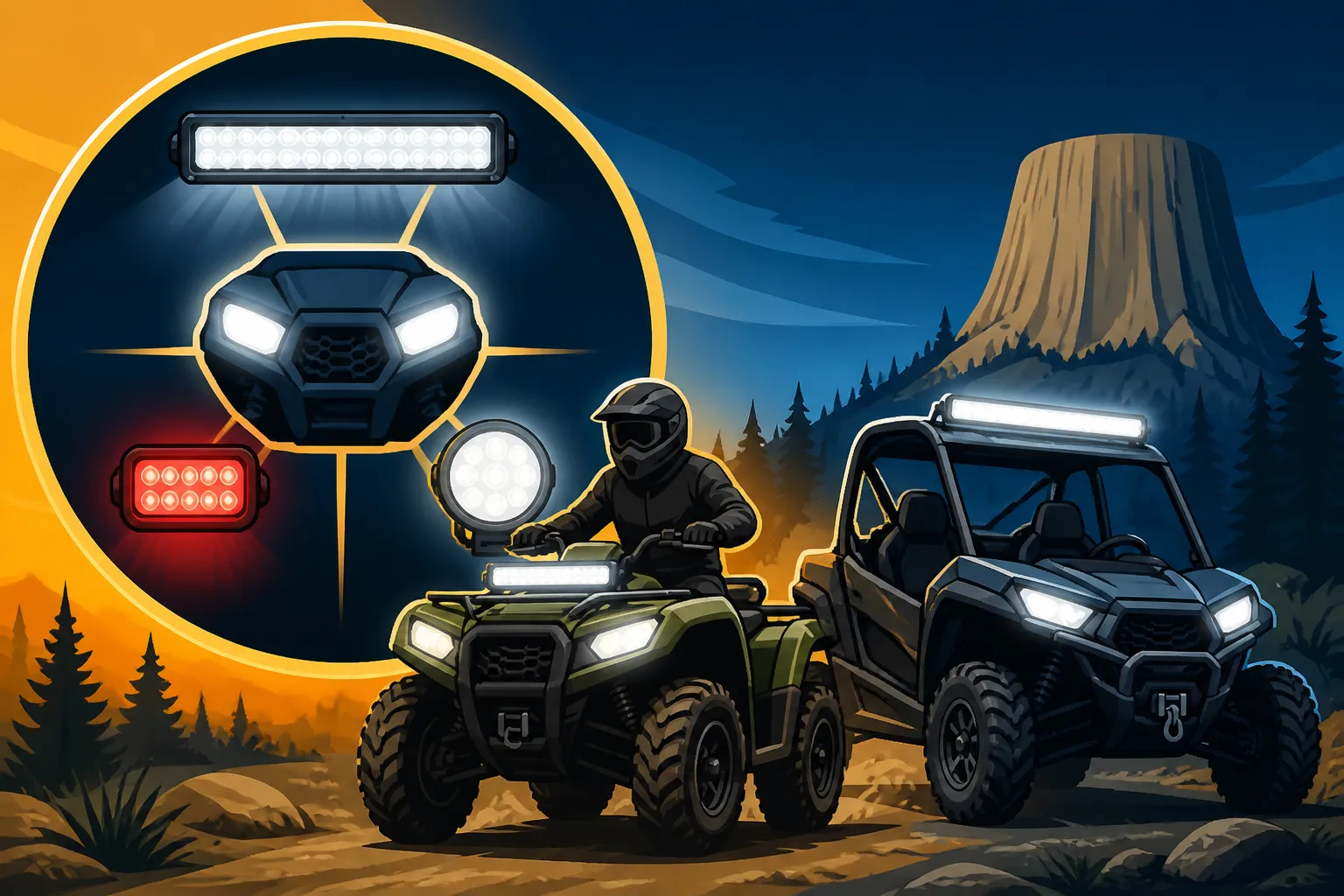
Your stock ATV or UTV headlights might be bright enough for blazing a trail through the dark, but for road use, it's about more than raw lumens. Wyoming requires that an MPV be equipped with headlamps that emit a white light, visible from at least 500 feet to the front. Crucially, these aren't just "on or off" lights; they must have both a high beam and a low beam function, just like a car. This allows you to adequately illuminate the road without blinding oncoming traffic.
Proper alignment of these headlights is also paramount. A headlight aimed too high can be a serious hazard, even if it's technically on "low beam." You'll want to ensure your chosen headlight setup can be adjusted correctly. Many aftermarket kits, including those you can find from companies like SuperATV, offer street-legal headlight assemblies that are designed with these requirements in mind, often offering a much more robust and compliant solution than trying to modify existing trail lights. Always remember, it's not just about having lights, but having the right kind of lights that meet the [Wyoming Lighting Requirements for ORVs].
Taillights and Stop Lamps: Signaling Your Intent
Just as important as seeing where you're going is letting everyone behind you know you're there and what you're doing. This is where taillights and stop lamps come into play. Your MPV must have a red taillight visible from at least 500 feet to the rear. This light must be illuminated whenever your headlights are on, ensuring your machine is always visible from behind in low light conditions.
Even more critical are your stop lamps, or brake lights. These are the red lights that illuminate brightly when you apply the brakes. They need to be clearly visible from at least 500 feet during daylight and even further at night. Many ORVs come with a basic taillight, but often the "stop lamp" function isn't as robust or bright as required for road use, or the brake light switch might only activate from the foot pedal, not the hand lever (or vice-versa). You'll need to ensure both brake controls activate the stop lamps reliably. Upgrading to a comprehensive wiring harness or an integrated signal kit is often the easiest way to ensure all these functions work correctly and reliably.
Turn Signals: Communicating Your Direction
Here's one that most off-road machines don't come with from the factory: turn signals. When you're on a public road, hand signals aren't always sufficient or safe, especially at speed or in traffic. Wyoming law requires an MPV to be equipped with electric turn signal lamps that display a flashing amber light to the front and either an amber or red light to the rear, clearly visible from both directions.
These turn signals must be activated manually by the driver to indicate a turn or lane change, just like in a regular car. This means installing a turn signal switch, flasher relay, and the lamps themselves. Many aftermarket companies specialize in universal or model-specific turn signal kits that integrate seamlessly into your machine's electrical system. For instance, SuperATV offers several turn signal kits that are designed to help get your machine street legal, providing all the necessary components for reliable signaling on the road. This is a non-negotiable item for road-legal MPV status.
Additional Reflectors and Illuminations
Beyond the active lighting systems like headlights and turn signals, there are some passive lighting components and additional illumination requirements that are essential for making your ORV legal for the road in Wyoming. These might seem like small details, but they play a big role in overall visibility and compliance.
Rear Reflectors: Passive Safety Measures
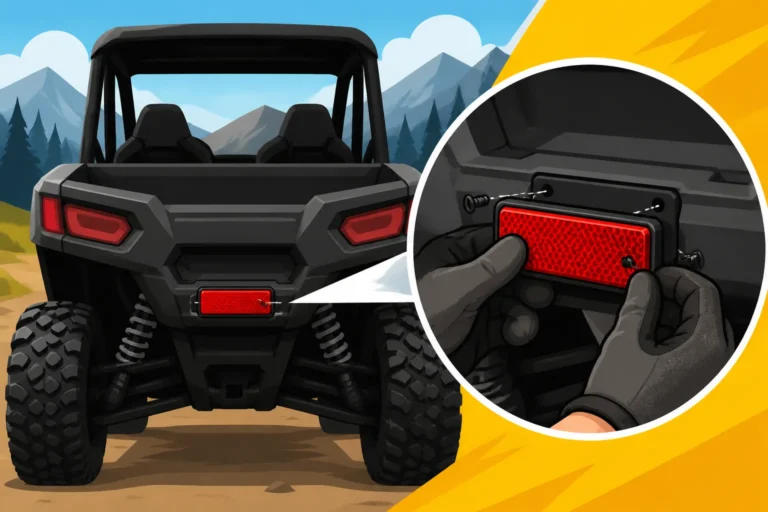
Even if your taillights are working perfectly, Wyoming law still requires an MPV to have at least one red reflector mounted on the rear of the vehicle. This reflector serves as a passive safety measure, meaning it reflects light from other vehicles' headlights even if your own lights somehow fail. It's an extra layer of visibility that helps prevent rear-end collisions, particularly in low-light conditions or emergencies.
The reflector must be visible from a specified distance and be properly mounted, typically on the rear fender or bodywork. It shouldn't be obscured by cargo, a hitch, or any other part of the machine. It's a small, inexpensive addition, but it's a critical component in meeting the road-legal criteria. You can learn more about this specific requirement in [A Red Rear Reflector on a Wyoming Machine]. Don't overlook this simple, yet important, detail when prepping your machine.
License Plate Illumination
If you've gone through the process of titling and plating your side-by-side or ATV as an MPV with your county clerk and county treasurer, you'll have a license plate. And that license plate needs to be visible at all times, day or night. This is why Wyoming law mandates that your rear license plate must be illuminated by a white light whenever your headlights are on.
This small, dedicated light ensures that your license plate number is legible to law enforcement and other drivers, even after dark. Often, aftermarket tail light assemblies or integrated kits will include a small LED light to handle this, or it can be a separate small light mounted above or below the plate. It's a detail that's easy to forget but essential for full compliance.
Other Important Road Equipment (Beyond Just Lights)
While lighting is a huge part of making your ORV street-legal in Wyoming, it's not the only thing you'll need to add or confirm. To truly transform your machine into a Multi-Purpose Vehicle ready for public roads, you'll need a few other critical components that aid in driver awareness and communication with other motorists.
Mirrors: Seeing What's Behind You
You wouldn't drive a car without a rearview mirror, right? The same logic applies to an MPV on the road. Wyoming law requires that an MPV must be equipped with at least one mirror that allows the driver to see a distance of 200 feet to the rear of the vehicle. This mirror must be mounted on the left side of the vehicle. Many riders, for enhanced safety and visibility, choose to install a right-side mirror as well, and often a center rearview mirror, but only the left-side mirror is legally mandated.
These mirrors help you monitor traffic approaching from behind, crucial for changing lanes, turning, or simply being aware of your surroundings on a busy road. Aftermarket companies like SuperATV offer a wide range of robust mirrors designed specifically for ATVs and UTVs, many of which clamp easily to roll cages or handlebars. Checking out [The Left-Side Mirror Wyoming Wants] will give you more details on this requirement.
Horns: Making Your Presence Known
Another essential piece of equipment for road safety is an audible warning device – in plain terms, a horn. Your MPV must be equipped with a horn that is capable of emitting a sound audible from at least 200 feet. This isn't just for sounding off in frustration; it's a vital safety tool for alerting other drivers, pedestrians, or even wildlife to your presence, especially in situations where visual signals might be missed.
Many ORVs come with a small, often weak, horn from the factory, if they have one at all. You'll want to ensure yours is loud enough to meet the legal standard and functions reliably. Installing an aftermarket electric horn with a dedicated button is a common and straightforward upgrade to meet this requirement. For specific guidance on installation, you might find resources like [Fitting a Horn to a Road-Legal Side-by-Side] helpful.
Muffler and Spark Arrester Rules
While not strictly "lighting," your exhaust system is another area where road rules often require compliance beyond what's typical for pure off-road use. For any ORV operating on public lands in Wyoming – and that includes enrolled roads – a properly functioning muffler system is required to keep sound levels within legal limits. Excessive noise isn't just a nuisance; it can lead to citations.
Equally important, especially in Wyoming's often dry climate, is a U.S. Forest Service-approved spark arrester. This device prevents hot carbon particles from escaping your exhaust and potentially igniting wildfires. Even if you're riding on an enrolled road, if that road traverses or borders public land managed by agencies like the Forest Service or BLM, this requirement will apply. It's a good practice to ensure your machine is equipped with both a compliant muffler and a spark arrester at all times when riding on public routes, whether trail or road. You can dive deeper into these requirements with [Wyoming Muffler and Spark Arrester Rules].
Why These Rules Exist: Safety and Integration
It can sometimes feel like a hassle to add all these components to your beloved off-road machine, especially when you bought it primarily for ripping through dirt and mud. But understanding why these rules are in place makes the effort worthwhile. It's not about making things difficult for riders; it's about ensuring safety for everyone who shares Wyoming's beautiful roads.
Blending With Traffic
The primary reason for all these lighting and equipment requirements is to allow your MPV to safely and predictably blend in with conventional road traffic. A car driver needs to know if you're stopping, turning, or simply present on the road. Without proper headlights, taillights, brake lights, and turn signals, you become an unpredictable element, which drastically increases the risk of an accident.
Imagine trying to navigate a busy intersection at dusk without turn signals or adequate brake lights – it's a recipe for disaster. By requiring these standard features, Wyoming ensures that MPVs operate under the same communication expectations as motorcycles and cars, making our roads safer for everyone, whether you're in a pickup or on a side-by-side. These rules, along with those found in [Wyoming MPV Street Legal Requirements], are designed to facilitate this integration.
Avoiding Costly Tickets and Headaches
Beyond the critical safety aspect, equipping your MPV correctly will save you a lot of grief in the long run. Wyoming law enforcement takes road safety seriously, and an improperly equipped MPV is an easy target for a traffic stop. Getting pulled over, facing fines, and potentially even having your riding privileges revoked is a real possibility if your machine doesn't meet the legal standards.
Consider the cost of a ticket for non-compliant lighting versus the cost of an aftermarket kit – the kit is almost always the more economical choice. Plus, the peace of mind knowing that you're legal and won't be hassled by a warden or state trooper is invaluable. A quick roadside check by [What a Wyoming Trooper Checks Roadside] can turn into a bad day if your lights aren't up to snuff. Investing in the right equipment from the start, and carrying proof of your [Wyoming MPV Plate Requirements] and registration, means you can focus on enjoying the ride, not worrying about law enforcement.
Here’s a quick overview of the essential lighting and related equipment for an MPV in Wyoming:
| Component | Requirement | Purpose |
|---|---|---|
| Headlights | White, high/low beam, visible 500 ft, properly aimed | Illuminate road, signal presence, avoid blinding others |
| Taillight | Red, visible 500 ft to rear (when headlights on) | Signal presence from behind |
| Stop Lamp (Brake Light) | Red, visible 500 ft, activates with brake application | Signal braking action to following traffic |
| Turn Signals | Front amber, rear amber/red, visible, manually activated | Communicate turns and lane changes |
| Rear Reflector | Red, passive, mounted on rear | Passive safety, visible if active lights fail |
| License Plate Light | White, illuminates rear license plate (when headlights on) | Ensure license plate visibility for identification |
| Left-Side Mirror | Allows view 200 ft to rear | Monitor traffic approaching from behind |
| Horn | Audible 200 ft | Alert others to presence or potential hazards |
| Muffler | Legal sound limits | Reduce noise pollution |
| Spark Arrester | USFS-approved | Prevent wildfires from exhaust sparks |
This article is for general informational purposes only and does not constitute professional advice. Laws, prices and regulations vary by location and change over time. Consult a qualified professional for guidance on your specific situation.