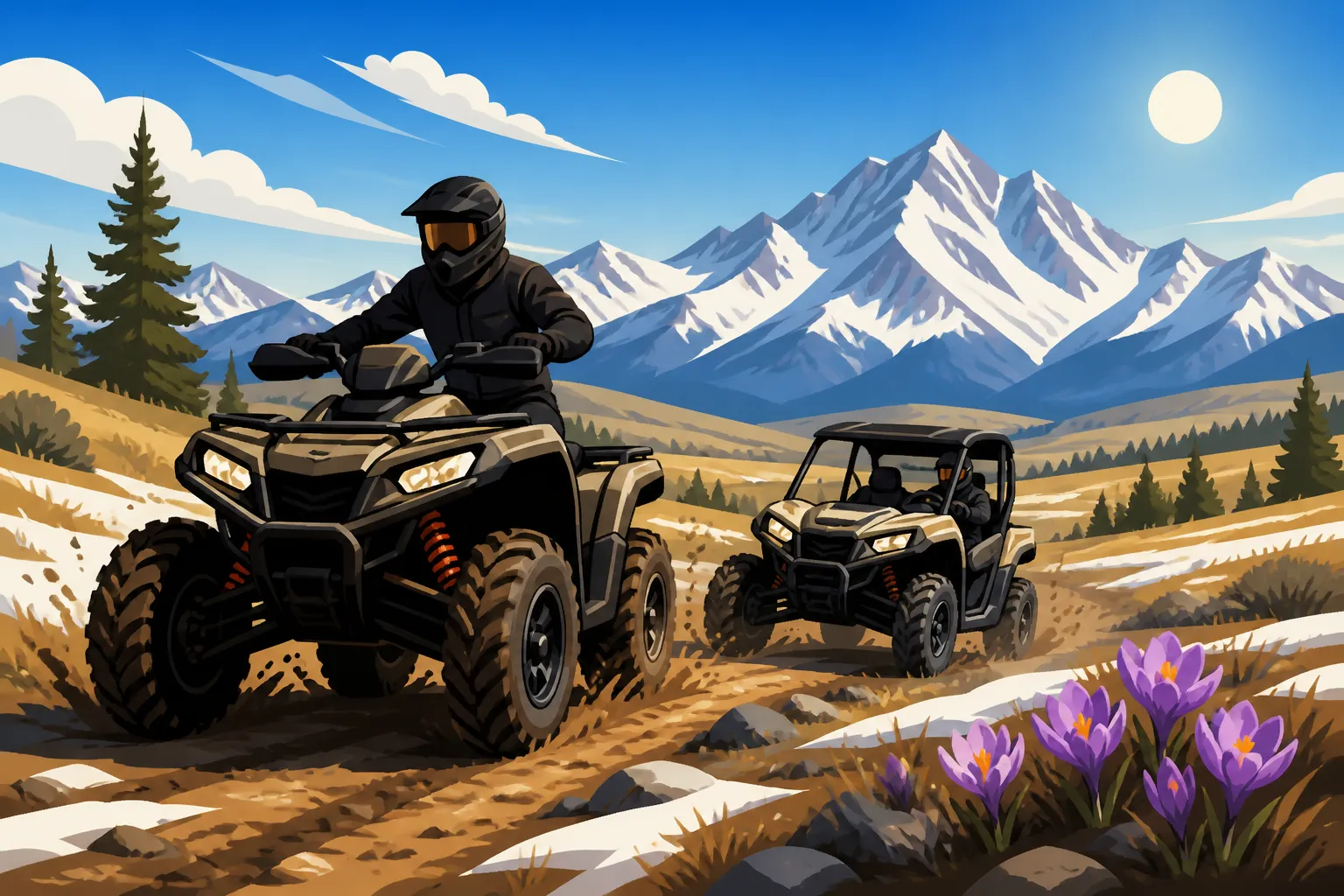
Wyoming Riding in Early Spring
Early spring can look rideable from town and still be a mess on the trail: snow may linger in shaded timber, thawing ground can rut under tires, and a route that was open last fall may be closed for seasonal protection. This guide helps you choose a sensible Wyoming ATV or UTV outing, check access, read conditions, and avoid turning a spring ride into a recovery job.
Why early spring riding in Wyoming takes extra planning
Weather and trail conditions can change quickly
In Wyoming, “spring” does not mean the same thing everywhere. A sunny afternoon in Rock Springs can feel far removed from a cold, windy morning in the Bighorn Mountains. Elevation, aspect, recent snowfall, and overnight temperatures all affect whether a route is dry, icy, muddy, or still buried. Even on a lower-elevation road, shaded cuts and north-facing slopes may hold snow after exposed ground has thawed.
That patchwork can make a route look deceptively manageable. The first few miles may be dry and firm, while a shaded section farther along turns into deep mud or snow. A UTV can also make it tempting to push through soft ground, but spinning tires can carve deep ruts, damage vegetation, and make the route harder for everyone who follows. If the surface is yielding under your tires or your machine is leaving deep tracks, turning around is often the responsible call.
Check the forecast for the riding area, not just the nearest town. Pay attention to overnight lows, wind, precipitation, and the chance of a rapid temperature swing. A warm day can soften snow and saturated soil, while a freeze overnight can leave shaded stretches slick the next morning. For a broader look at seasonal patterns, see [Wyoming Riding in Early Spring] and [Wyoming Riding in Midsummer].
Seasonal closures are part of the access picture
A road or trail shown on a map is not automatically open for riding on the day you arrive. Land managers may close routes during muddy periods, wildlife-sensitive seasons, or snowmelt, and closures can vary by area and route. Forest roads in the Medicine Bow and Bighorn regions, for example, can have very different conditions from lower-elevation routes near Casper or Rock Springs. Do not assume that a route open in one part of the state is open elsewhere.
Before you leave, check the relevant land manager’s travel information and look for posted signs at the trailhead or route entrance. Maps are useful for planning, but current notices and on-the-ground signs matter. If a sign says a route is closed, do not ride around it or follow tracks that appear to continue beyond it. Other riders’ tire marks do not establish legal access.
Plan a backup route and be willing to change the day’s objective. A late snowstorm, a muddy access road, or a closure can make the original plan impractical. The guide to [Wyoming Trail Closures to Check First] can help you think through what to verify, while [Who Decides When a Wyoming Trail Reopens] explains why reopening decisions can depend on local conditions and land-management authority.
Choosing a spring riding area
Match the destination to elevation and exposure
For early-season planning, think about elevation and sun exposure rather than relying on a general “open” label for a region. Lower, more exposed areas may dry sooner than high forest routes, but that does not guarantee every route is rideable or legally open. Conditions can change from one drainage to the next. South-facing slopes often receive more sun, while shaded timber, narrow canyons, and high passes can retain snow and ice.
The Killpecker Sand Dunes near Rock Springs are a different kind of spring ride from a forest road in the Snowy Range. Sand can avoid the same snowmelt problems found in timber, but wind, soft sections, and changing surface conditions still call for care. Check access rules, current restrictions, and route information before heading out. For area-specific preparation, read [Riding the Dunes at Killpecker] and [Wind and Shifting Sand on the Dunes].
Poison Spider OHV Park outside Casper may also come up when you are looking for a lower-elevation outing, but do not treat its location as proof that it is ready for every machine or every spring day. Rain and thaw can make bentonite surfaces especially troublesome. A ride that begins on apparently firm ground can turn into a slick, difficult return. Review [Poison Spider After Rain] before deciding whether conditions are suitable.
Use trail maps to understand the route, not promise conditions
A good map helps you identify route networks, access points, and possible alternatives, but it cannot tell you exactly how a trail feels under your tires this morning. Land-management maps, including Motor Vehicle Use Maps, show designated routes and restrictions for specific areas. They are essential for avoiding unauthorized travel, especially where roads, trails, and nonmotorized areas meet.
Digital tools can be handy for comparing route options and keeping track of where you are. Some riders use onX Offroad to review mapped routes before a trip, but a digital map should support—not replace—official land-manager information, posted closure signs, and good judgment. Download what you need before you leave cell coverage, and check that your device can still be used if service drops.
| Planning question | What to check before leaving | Why it matters in early spring |
|---|---|---|
| Is the route designated for my machine? | Official travel map and route restrictions | Some trails have width or vehicle-use limits |
| Is it open today? | Current land-manager notices and signs | Seasonal and temporary closures may apply |
| Can I reach the trailhead? | Road conditions, snow, and local access notices | The approach may be worse than the riding route |
| Is the surface suitable? | Recent precipitation, thaw, and local reports | Mud and soft ground can cause damage or stuck machines |
| Can I navigate without cell service? | Offline maps, charged device, backup navigation | Remote areas may have limited or no coverage |
Carry a map that clearly shows the area and route network, and know how to read it before you start riding. If the map and a posted sign appear to conflict, stop and resolve the question rather than continuing on the assumption that the map is newer. For more on using route information, see [Wyoming Trail Maps and MVUMs] and [When a Map and a Sign Disagree].
Preparing your ATV or UTV for cold, mud, and remote travel
Inspect the machine before loading it
Spring conditions are hard on equipment. Mud can hide a loose fastener, snow can conceal rocks and ruts, and cold starts can reveal a weak battery. Before you head out, check tires, brakes, steering, lights, fuel, and fluid levels. Look for damage around the undercarriage and make sure the machine’s tires are appropriate for the terrain you expect to ride. A small problem found in the driveway is far easier to handle than one found miles from the trailer.
For a UTV, check the safety equipment and secure loose items inside the cab or cargo bed. For an ATV, confirm that your gear is attached firmly and cannot catch on brush or interfere with control. Bring the tools and basic repair supplies that match your machine, not just a generic kit you have never opened. A spare belt may make sense for some UTVs; a plug kit and tire inflator can be useful for many machines. Know how to use what you carry.
Cold mornings can affect batteries and rider comfort, while thawing trails can coat components with mud. Pack layers that work when you are stopped as well as when you are moving. Gloves that feel fine during a warm climb may become uncomfortable after an hour in wind. Carry dry layers in a protected bag and keep essential items accessible rather than buried beneath luggage.
Prepare for a ride that takes longer than expected
A spring plan should include time for changing conditions, wrong turns, and a slow return. Tell someone where you plan to ride and when you expect to be back. Take water, food, a first-aid kit, a charged phone, and a backup way to navigate. In remote areas, a satellite messenger can provide a way to reach help when there is no cell signal. Do not count on another rider happening by at the right moment.
Fuel planning deserves special attention. Distances between services can be substantial, and a cold machine working through soft ground may use fuel differently than it does on a firm summer route. Start with a full tank where possible, estimate the round trip conservatively, and leave a margin for detours or a slower pace. Avoid setting out on a route that depends on finding fuel at an uncertain location.
Also think through recovery before you need it. A winch, tow strap, shovel, traction boards, or other recovery gear may be useful depending on the machine and terrain, but recovery equipment does not make a closed or unsafe route acceptable. If your group has no safe way to recover a machine from mud or snow, choose a shorter route. For additional trip-planning ideas, see [Breaking Down Far From Help] and [Fuel Range Between Wyoming Towns].
Riding responsibly on wet or thawing ground
Turn around before tires begin digging in
One of the hardest calls on an early spring ride is deciding that the trail is too soft. Riders may have already driven a long way, unloaded their machines, and seen a stretch of dry ground at the entrance. It can feel frustrating to turn back after all that effort. But pushing farther can make the situation worse: wheelspin digs holes, mud builds up around tires, and a recovery attempt can widen the damage.
Use the surface as information. If your tires are sinking, leaving deep ruts, or sliding sideways on a gentle section, stop and reassess. Do not keep adding throttle in the hope that momentum will solve the problem. On a UTV, extra weight can increase the impact on soft ground; on an ATV, a rider may have less room to recover control if the machine starts sliding. Back out slowly only if the route behind you is safe and doing so will not cause more damage.
Avoid riding around a muddy patch through grass or brush. That shortcut can create a new track where no route exists, disturb vegetation, and potentially put you on land where vehicle travel is not allowed. If a route is too soft, the best response is usually to turn around and return when conditions improve.
Protect other trail users and the land
Early spring can bring wildlife activity, ranch work, and changing access conditions. Keep your machine on designated routes, close gates as you found them, and slow down around livestock, hikers, and other trail users. Muddy routes can also hide drainage channels and soft shoulders, so stay alert rather than riding on autopilot.
Yield courteously and give horses plenty of space. Stop your machine where it is safe to do so, follow the rider’s directions, and avoid sudden acceleration or loud revving. If you encounter a landowner, ranch worker, or agency employee, be respectful and follow instructions. A calm interaction can prevent a misunderstanding from becoming a larger access problem.
Do not assume an old two-track is public just because it appears on the ground. Route authorization depends on land ownership and management rules, and a visible path may cross private property or an area closed to motorized travel. Learn more with [Wyoming Trail Etiquette With Ranchers], [Wyoming Landowner Permission Rules], and [Why a Land Manager Must Mark a Route Open].
A practical early spring ride plan
Use a go-or-no-go checklist
A simple checklist helps keep the decision grounded in conditions rather than excitement. The night before, review the forecast for the riding area and check for current closures. Confirm the trailhead approach is accessible, verify the route is designated for your machine, and make sure every rider knows the planned destination and turnaround time. If the route has a seasonal restriction or unclear status, choose another area instead of guessing.
On the morning of the ride, assess what you can see at the trailhead. Look for snow, standing water, deep ruts, damaged signs, or fresh closure notices. If the first section is already soft, do not assume the trail improves farther in. A quick conversation with a local land-management office or an official visitor contact can help clarify access, but do not treat an informal comment as permission to ignore posted rules.
Agree as a group on conditions that mean “turn around.” For example, everyone might agree to stop if a machine begins making deep ruts, if snow becomes too deep to travel safely, or if the route is blocked by a closure sign. This prevents one person’s enthusiasm from pressuring the group to continue after the ride has stopped making sense.
Keep expectations flexible
A successful early spring outing may be shorter than the route you originally planned. It might mean a cautious ride on a firm, designated road, a visit to a lower-elevation area, or a decision to postpone. That can feel disappointing if you have been waiting all winter, but a conservative choice protects your machine, the route, and your ability to ride later in the season.
Build options into the day. Pick a primary area and a reasonable alternative, and identify a point at which you will head back rather than keep searching for a passable trail. If the destination is too muddy, use the day to scout access, check maps, or inspect a different area without riding onto a closed or fragile route. Avoid letting the time already spent driving dictate a risky decision.
Wyoming’s big distances and changing terrain reward preparation, but they also reward humility. Conditions can be excellent in one place and poor a short distance away. Choose routes that match the day’s weather and surface, follow current restrictions, and treat turning around as part of good riding rather than a failed trip. When the ground is firm and access is confirmed, you will have a much better experience—and leave the route in better shape for the riders who come after you.
Disclaimer
This article is for general informational purposes only and does not constitute professional advice. Laws, prices and regulations vary by location and change over time. Consult a qualified professional for guidance on your specific situation.