Machines Under 300 Pounds Cannot Become an MPV
It can be incredibly frustrating to discover that the small, agile off-road vehicle you love, perhaps a youth ATV or a lightweight dirt bike, simply doesn't qualify for street-legal registration in Wyoming. Many riders assume that if a machine has wheels, it can eventually be plated, but Wyoming has very specific rules for what constitutes a "Multipurpose Vehicle" (MPV) – the key to legal road access – and a significant hurdle for smaller machines is their weight. This guide will walk you through why off-road vehicles weighing less than 300 pounds cannot become a Wyoming MPV and what that means for your riding adventures.
Understanding Wyoming's Multipurpose Vehicle Definition
Wyoming, bless its wide-open spaces, has done a great job carving out a path for many off-road vehicles to become street-legal through its Multipurpose Vehicle (MPV) classification. This is a game-changer for folks who want to connect trails, run into town for supplies, or simply reduce the need for constant trailering. However, this special classification comes with a very clear set of criteria, and if your machine doesn't tick every box, it just won't make the cut. The core idea behind the MPV is to bridge the gap between a pure off-road machine and a traditional licensed vehicle, allowing certain UTVs and larger ATVs to share the pavement when designated.
The state's definition is laid out pretty clearly in the statutes, and it's not arbitrary; it's designed with safety and road compatibility in mind. An MPV is more than just a regular ATV or side-by-side; it's a vehicle that can meet minimum safety standards for road use, yet retain its off-road capabilities. This distinction is crucial because it helps differentiate between machines designed for trail-only use and those that can safely navigate both environments. It’s why you'll see a lot of side-by-sides, like those from SuperATV that are often outfitted for road use, able to qualify, while smaller, lighter machines typically can't.
If you're dreaming of cruising down a county road to reach your favorite trailhead, understanding these specifics is your first step. It's not just about adding a horn or turn signals; it's about the fundamental characteristics of the machine itself. The weight, the seat configuration, and even engine size all play a role in whether your beloved machine can escape the "trail-only" designation and embrace the freedom of the open road. This careful classification aims to ensure that vehicles sharing public roads are capable of doing so safely, both for their operators and for other motorists.
The Weight Requirement: 300 to 3,000 Pounds
One of the most defining characteristics of a Wyoming Multipurpose Vehicle is its weight. The law specifies that an MPV must have a dry weight of at least 300 pounds but not more than 3,000 pounds. This is a non-negotiable threshold, and it immediately disqualifies a whole host of smaller, lighter off-road machines. It's not a suggestion; it's a hard rule that the county clerk and treasurer will look for when you try to get your machine titled and plated.
Think about it from a practical standpoint: a vehicle that's too light might not handle road speeds and other traffic conditions as stably as a heavier machine. The engineers and lawmakers who crafted this rule likely had concerns about stability, braking performance, and general roadworthiness. A very lightweight machine, while nimble on the trail, could be easily buffeted by wind or the slipstream of passing semi-trucks on a paved highway. It’s about ensuring a minimum level of structural integrity and mass for safe interaction with other vehicles on the road.
This 300-pound minimum is often the biggest sticking point for owners of youth ATVs, smaller dirt bikes, or highly specialized, ultra-light off-road buggies. Even if your machine has all the other required road-legal equipment, if it doesn't meet that weight minimum, it simply cannot be titled and registered as an MPV. It’s a clear line in the sand that separates machines deemed suitable for limited road use from those that are strictly for off-pavement adventures. So, before you invest in mirrors and turn signals, grab a scale and check your machine's dry weight.
The Seat Height Rule: At Least 24 Inches Up
Beyond the weight, another crucial physical characteristic that dictates whether your machine can be an MPV in Wyoming is the height of its seat. To qualify as a Multipurpose Vehicle, a machine must have a seat height of at least 24 inches from the ground. This rule is often overlooked but is just as important as the weight requirement. It directly impacts whether traditional ATVs can become MPVs, as many older or smaller ATVs might not meet this standard.
The rationale behind this rule likely stems from rider ergonomics and visibility. A higher seat generally means a more upright riding position, which can improve the operator's line of sight over traffic and allow them to be more visible to other drivers. It also influences how the machine handles and feels on a paved surface compared to the dynamic, body-English riding style common on trails. A very low-slung machine, while potentially stable, might put the rider too close to the ground, reducing their visibility and making them harder for other vehicles to spot.
This seat height rule is particularly relevant when considering conventional ATVs. While many modern side-by-sides easily clear this 24-inch benchmark, a traditional ATV, where the rider straddles the engine and sits lower, might struggle to measure up. Even if your quad meets the weight requirement, if its seat is too low, it's out of the running for MPV status. It's another layer of protection, ensuring that MPVs on Wyoming's roads offer a certain level of driver presence and visibility that aligns with typical road-going vehicles. Always measure from the lowest point of the seat to the ground, with the tires properly inflated, to get an accurate reading.
What This Means for Smaller, Lighter Machines
If your off-road machine doesn't meet the 300-pound minimum or the 24-inch seat height for an MPV, it's a tough pill to swallow, especially if you had visions of riding it between trailheads. It essentially means that your machine is designated as a pure Off-Road Vehicle (ORV) in the eyes of Wyoming law. While this doesn't diminish its fun factor on the trails, it significantly limits where you can legally operate it. You can't just slap a license plate on it and hit the pavement like you might with a larger side-by-side that qualifies as an MPV.
The regulations are designed to be quite clear on this distinction to avoid confusion and ensure safety on public roads. It's not about singling out specific brands or types of machines, but rather about defining categories based on inherent physical characteristics. This delineation helps law enforcement and riders alike understand the boundaries of legal operation. While a larger UTV from a brand like SuperATV might offer a range of accessories to make it road-ready, these modifications won't overcome a fundamental issue like being underweight or having a seat that's too low.
This can be a point of frustration for riders who own smaller machines and want the convenience of road access. You might have added turn signals, mirrors, and a horn, only to find out that the core characteristics of your vehicle prevent it from ever being street legal in Wyoming. It's vital to check these specifications before making any modifications or assuming your machine can qualify. Knowing these limits upfront saves both time and money.
Why Youth Quads Don't Qualify as MPVs
Youth ATVs are a fantastic way to introduce younger riders to the joys of off-road adventuring, providing scaled-down power and size appropriate for developing skills. However, these machines are almost universally disqualified from MPV status in Wyoming, primarily because of their weight. Most youth quads are designed to be lightweight and manageable for younger, smaller operators, often tipping the scales well below the 300-pound minimum for an MPV.
Consider a typical youth ATV, which might weigh anywhere from 150 to 250 pounds. This is perfect for its intended purpose – easy to maneuver, less intimidating, and safer for kids learning to ride. But for the MPV classification, this light weight is a non-starter. The state's weight requirement isn't just a random number; it's a reflection of the expected stability and mass needed for a vehicle to safely share roads with cars and trucks. A lightweight youth machine, even if somehow outfitted with all the required lights and mirrors, wouldn't offer the same level of road performance or occupant protection.
Furthermore, many youth ATVs also feature lower seat heights, designed to allow young riders to comfortably reach the ground. This also typically falls short of the 24-inch minimum for an MPV. So, between the weight and the seat height, youth quads are firmly entrenched in the ORV category. This means they are strictly for designated off-road trails and private property with permission. Trying to register a youth ATV as an MPV would be a futile exercise at the county clerk's office, as it simply doesn't meet the fundamental structural criteria. [Wyoming Rules for a Youth Machine on a Trail] provides more details on where these machines can be ridden.
The Limitations for Smaller Dirt Bikes and Other ORVs
The 300-pound weight minimum isn't just an issue for youth quads; it also impacts many smaller adult dirt bikes and highly specialized, lightweight off-road vehicles. While dirt bikes are phenomenal machines for tackling challenging trails, many are designed to be as light as possible for agility and performance, often falling under that critical 300-pound mark. This puts them in the same boat as the youth quads when it comes to MPV eligibility in Wyoming.
For example, a high-performance 250cc motocross bike might weigh around 220-240 pounds dry. Even an enduro-focused 450cc might hover just around or slightly above 250 pounds. While you might be able to find a dual-sport or street-legal dirt bike that already meets road requirements in other states, if it's under 300 pounds, Wyoming won't classify it as an MPV. This means that while some dirt bikes can be street-legal in Wyoming if they meet motorcycle requirements, the MPV route is often closed off due to weight.
Other niche off-road vehicles, like certain dune buggies or custom-built light buggies, might also run into this weight restriction. While they might be incredibly capable off-road, their lightweight construction, often a design advantage for specific terrains, becomes a disadvantage when attempting to gain MPV status. It's a reminder that Wyoming's MPV rules are quite specific and don't make exceptions based on how "off-road" a vehicle is, but rather on its adherence to a defined set of characteristics for on-road eligibility. Ultimately, if your machine is under the 300-pound limit, its place is strictly off the pavement, requiring a Wyoming ORV permit for public lands. [Wyoming Permits for a Dirt Bike] offers more context on the permit required.
Alternatives and Considerations for Lightweight ORVs
So, if your machine is under 300 pounds and can't be an MPV, what are your options in Wyoming? It's easy to feel defeated when you hit these roadblocks, but it certainly doesn't mean your riding adventures are over. It simply means you need to adjust your expectations for where and how you'll operate your vehicle. The good news is that Wyoming has an incredible amount of public land and a vast network of trails perfect for ORVs, even those that don't qualify for street legality.
The key is to understand the distinction between an ORV and an MPV and to embrace your machine for what it is: a dedicated off-road vehicle. This means focusing on its strengths for trail riding, exploring scenic routes, and enjoying the wild landscapes of Wyoming. You'll still need the proper permits and always follow all trail regulations, but you won't be navigating the complexities of road-legal conversions. For many riders, the raw, untamed experience of off-road riding is exactly what they seek, and their lightweight machine is perfectly suited for it.
It also means that you'll need to rely on trailering or hauling your machine to designated riding areas. This might be less convenient than simply riding from your garage, but it's a common practice for serious off-road enthusiasts. Planning your trips around established trailheads and staging areas becomes part of the adventure. And remember, even if your machine can't be an MPV, it can still provide countless hours of fun and exploration.
Sticking to Off-Road Trails with an ORV Permit
For machines under 300 pounds, the clear path forward in Wyoming is to embrace their identity as Off-Road Vehicles (ORVs) and stick to the vast network of designated trails and open riding areas. This is where these machines truly shine, offering agility, lightweight handling, and the ability to navigate technical terrain that might challenge heavier, road-legal MPVs. Wyoming boasts an incredible array of public lands managed by the Forest Service and the Bureau of Land Management (BLM), most of which offer miles upon miles of ORV-friendly routes.
To legally ride your sub-300-pound machine on these public lands, you'll need a [Wyoming's Annual ORV Permit]. This permit is mandatory for all off-road vehicles operating on enrolled trails and public access areas in the state, regardless of whether you're a resident or a visitor. It's a small fee that goes directly back into maintaining and improving the trail system, funding things like signage, trail reconstruction, and even vault toilets at trailheads. Think of it as your passport to Wyoming's incredible backcountry.
Acquiring an ORV permit is a straightforward process, and you can often get one at numerous locations across the state, including powersports dealerships, county treasurer offices, and even some forest ranger stations. [Where Wyoming Sells ORV Permits] is a helpful resource for finding a convenient location. Once you have your permit, make sure to affix the decal properly to your machine where it's clearly visible, as rangers and wardens do check for compliance. With your permit in hand, your lightweight ORV is ready to explore some of the most scenic and challenging trails in the West.
Understanding Where You Can Still Ride
Just because your machine doesn't qualify as an MPV doesn't mean you're stuck in your backyard. Wyoming has a comprehensive system of designated ORV routes on federal and state lands, and it's these areas where your under-300-pound machine will find its purpose. The key is to understand the rules of the road (or, rather, the trail) and know exactly where you're permitted to ride. Land management agencies like the U.S. Forest Service and the Bureau of Land Management publish detailed Motor Vehicle Use Maps (MVUMs) that clearly delineate open routes for different types of vehicles.
These maps are your best friend when planning an outing. They show which trails are open to ORVs, any seasonal closures, and sometimes even indicate width restrictions. For example, some single-track trails might be perfect for a small dirt bike but off-limits to a wider side-by-side. The general rule in Wyoming is "travel on designated routes only," meaning you can't just drive cross-country or create new trails. Sticking to these marked routes is crucial for environmental protection, preventing resource damage, and avoiding hefty fines.
For machines under 300 pounds, you'll be looking for trails that are specifically open to ORVs, which includes the vast majority of the state's trail network. While you won't be riding on state highways, county roads (unless they are specifically enrolled as ORV routes), or city streets, the sheer volume of off-road opportunities is immense. From the high mountain passes of the Bighorns to the vast open spaces of BLM land in the Red Desert, your lightweight ORV has a playground waiting for it. Always check current maps, look for signage, and be aware of any fire restrictions or seasonal closures before heading out. The adventure is still very much alive, just in a different arena. [Where to Ride an ATV in Wyoming] can help you discover fantastic locations.
Comparing ORV and MPV Requirements in Wyoming
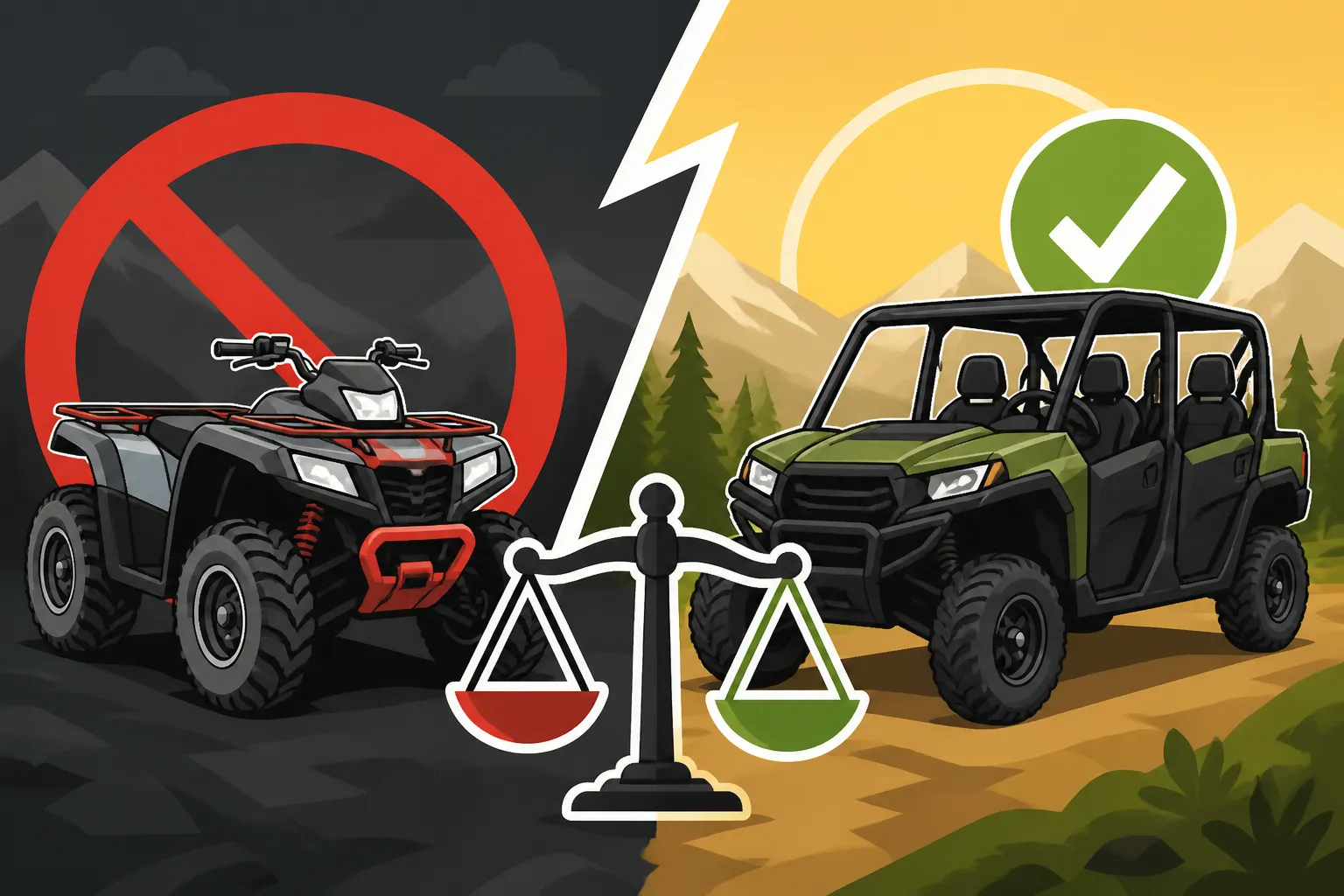
To help clarify the distinctions we've discussed, especially regarding the weight and seat height, here's a table summarizing the key differences between an Off-Road Vehicle (ORV) and a Multipurpose Vehicle (MPV) in Wyoming. This comparison highlights why machines under 300 pounds are restricted to ORV status.
| Feature / Requirement | Off-Road Vehicle (ORV) | Multipurpose Vehicle (MPV) |
|---|---|---|
| Primary Use | Dedicated off-road trails, private land | Designated off-road trails and enrolled public roads |
| Wyoming Permit/Plate | [Wyoming's Annual ORV Permit] (decal required) | County-issued [Plates From a Wyoming County Treasurer] (after titling as MPV) |
| Weight Requirement | No minimum or maximum weight for ORV permit | Minimum 300 lbs dry weight, Maximum 3,000 lbs dry weight |
| Seat Height Requirement | No specific height for ORV permit | Minimum 24 inches from ground to seat |
| Titling | [Why No Title for an Off-Road Machine in Wyoming] (mostly no title) | Mandatory [Titling a Multipurpose Vehicle in Wyoming] at County Clerk |
| Driver's License | Not required on trails (age/supervision rules apply) | Required for public road use; M or MR endorsement often needed for certain machines ([Wyoming Motorcycle Endorsement for an MPV]) |
| Insurance | Not required for trail use (recommended) | Mandatory liability insurance for public road use ([Wyoming ATV Insurance Requirement]) |
| Road Equipment | Spark arrester, muffler | Headlights, taillights, stop lamps, horn, mirrors, turn signals, DOT tires, brake lights, seatbelts (for UTVs) – all specific items needed for road-legal status |
| Allowed on Paved Roads | Generally not allowed (except for short crossings to access trails) | Allowed on enrolled county, state, and BLM roads; strict rules for crossing interstates ([Wyoming Rules for Crossing an Interstate]) |
This table clearly illustrates that the weight and seat height criteria are fundamental gates for MPV status. If your machine is under 300 pounds, it simply cannot enter the MPV category, regardless of any other modifications you might make. This means your riding future with that machine in Wyoming will be primarily focused on the extensive and beautiful off-road trail system, which, let's be honest, is an incredible experience in itself!
Disclaimer
This article is for general informational purposes only and does not constitute professional advice. Laws, prices and regulations vary by location and change over time. Consult a qualified professional for guidance on your specific situation.