Wyoming Rules for a Rider Under 16 on a Trail
If your child is under 16, the key question is not only whether they can operate an ATV or UTV. The route, land manager, machine, and permit all matter. Wyoming does not offer one simple answer for every trail. Here’s how to check the rules before you ride and how to make a youth trip safer.
Start with the Route, Not the Rider’s Age
A trail ride and a road ride can fall under different rules, even when they connect or appear on the same map. A route may be managed by a federal agency, a state agency, or another landowner, and each can have its own access restrictions. A road designated for certain off-road vehicles is not automatically open to every rider or machine.
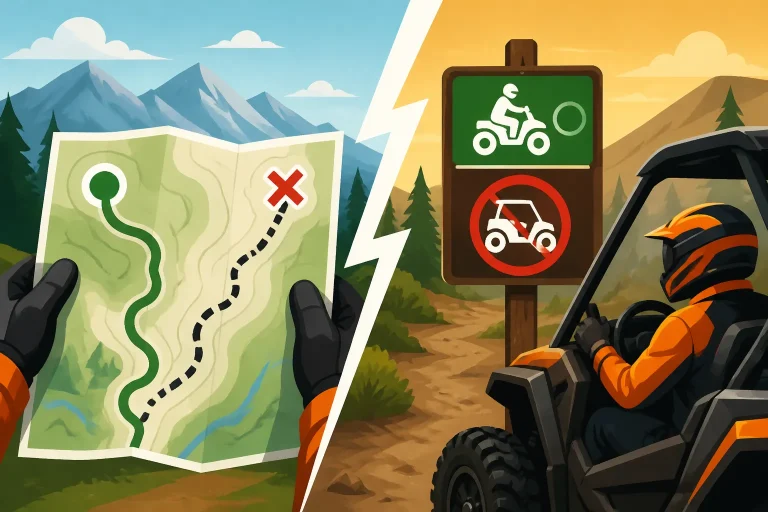
For a rider under 16, identify the exact route and the authority responsible for it before setting out. Check the current travel-management map, signs at the trailhead, and any posted seasonal or age restrictions. If those sources are unclear, contact the land manager. A general trail map or a route shared online may not show every closure or condition.
| Riding situation | What to check |
|---|---|
| Designated off-road trail | Whether the route is open to the machine’s type and width, and whether youth or supervision rules apply |
| Forest or BLM route | The current land-manager map, signs, seasonal closures, and any local restrictions |
| Road open to off-road vehicles | Whether the road is officially designated for that use and what operator requirements apply |
| Public road that is not designated | Do not assume an off-road permit makes it legal to ride there |
| Private land | Get the owner’s permission and follow any conditions they set |
Wyoming’s off-road permit is tied to the machine, not the age of the person riding it. If the machine needs a Wyoming decal for the area where you plan to ride, a youth rider does not replace that requirement. A permit also does not grant access to a closed route or turn an ordinary road into an off-road route. See Wyoming ORV Permit for a Youth Quad and [Wyoming Rules for Riding a Designated Route] for related permit and route questions.
The same caution applies to visiting families. A registration or sticker from another state should not be treated as automatic permission to ride in Wyoming. Confirm what the specific Wyoming route requires before the trip; Wyoming ORV Permit for a Visiting Rider explains the permit issue for nonresidents.
Separate trails from roads
A child who can ride on a designated trail is not necessarily eligible to operate the same machine on a road. Road use can involve driver licensing, equipment, insurance, helmet, and age requirements that do not apply in the same way to off-road riding. An ORV decal is not a road license.
Before taking a route that touches pavement, find out whether that road segment is officially open to the machine and whether the rider is allowed to operate there. Do not rely on the fact that other machines have used the road or that a navigation app shows it as a route. Start with Wyoming’s Designated ORV Roads and Wyoming’s MPV Path to the Road if the ride includes a public road segment.
Check Age and Supervision Rules for the Specific Area
There is no safe shortcut such as assuming every Wyoming trail has the same age minimum or supervision rule. Requirements can depend on the land manager, the route, and whether the machine is being operated off-road or on a road. Some places may set restrictions beyond the state’s general requirements. Rules can also differ for a youth-sized ATV and a larger side-by-side.
Before riding, ask the agency or landowner clear, specific questions:
- Is this exact route open to the machine?
- May a rider under 16 operate it there?
- Must a parent, guardian, or other adult accompany the rider?
- Does “accompany” mean riding alongside, staying within sight, or something else?
- Are there additional age, passenger, or training restrictions?
- Does the answer change if the route includes a road?
Do not assume that an adult being somewhere nearby will meet a supervision rule. If supervision is required, ask what the rule means in practice and follow the stricter direction from the responsible authority. For a broader look at age and supervision questions, see Wyoming Minimum Age to Ride Public Land and Wyoming Supervision Rules for Young Riders.
Even when no rule clearly requires an adult to ride alongside, close supervision is sensible for a young or inexperienced rider. Choose terrain that matches the rider’s ability, keep the adult close enough to intervene, and make sure the child knows how to stop and what to do if the machine stalls or tips. A child who can operate a machine in a field may not be ready for a narrow, rocky trail with blind corners, steep grades, or other users.
The machine matters, too
A machine’s size and design affect where it can go. A route may have a width limit or may be open to some types of vehicles but not others. A youth quad may fit a narrow trail where a side-by-side cannot; a larger machine may be restricted even if its operator is an adult.
Check both the route rules and the machine’s dimensions. Do not let a young rider follow a route simply because the machine can physically fit through it. Legal access depends on the route designation and restrictions, not just whether the vehicle can get through. For routes on national forest land, [Wyoming Rules for Riding a National Forest] is a useful starting point, but current maps and local signs should guide the actual trip.
Permits, Equipment, and Road Segments
A youth rider does not need a separate permit simply because they are under 16, but the machine may need its own Wyoming off-road permit. Confirm the requirement for the area and vehicle before leaving home, and make sure the decal is attached as required. Keep the purchase record available, but do not assume a receipt—on a phone or on paper—takes the place of a required decal.
If you are unsure whether the machine is covered, verify its classification and the route’s requirements with the appropriate program or land manager. A permit does not prove that the rider meets any age or supervision requirement. It also does not authorize riding off the designated route. More on the distinction is covered in Why an ORV Permit Is Not a Road License.
Protective equipment deserves the same attention as paperwork. Use a properly fitted helmet designed for the kind of riding, along with eye protection, gloves, sturdy footwear, and clothing that covers arms and legs. Check current rules for helmets and other required equipment, especially if any part of the ride uses a road. Wyoming Helmets for Riders Under 18 addresses the separate helmet considerations for young riders.
A helmet bought online or in a store still needs to fit the rider correctly and be suitable for the activity. If shopping through Amazon, check the product’s size guidance and safety labeling rather than choosing by appearance alone. Recheck fit as a child grows; a helmet that was secure last season may no longer fit properly.
For the machine, check that controls are easy for the child to reach and use. The rider should be able to operate the brakes, throttle, and engine shutoff without stretching or losing control. Follow the manufacturer’s rider and passenger limits. A child should not carry a passenger unless the machine is designed for one and the rider can safely manage that added responsibility.
Before a trip, confirm that the machine is in working order. Check the brakes, tires, throttle return, lights if needed, and fuel. Carry water, basic first-aid supplies, and a way to contact help where coverage is limited. An adult should know the route, expected return time, and a backup plan if the group gets separated or conditions change.
A Safer Plan for a Young Rider
A good first ride is short, predictable, and easy to stop. Avoid starting with a long backcountry route, a difficult trail, or a ride that depends on keeping up with faster adults. Practice basic control in a permitted, appropriate area before moving onto unfamiliar terrain.
Use this pre-ride sequence:
- Confirm the route. Check the current map and signs, then verify any age, supervision, or machine restrictions with the land manager.
- Confirm the permit. Make sure the machine has the required Wyoming decal for the planned riding area.
- Inspect the machine. Check the controls, brakes, tires, and safety equipment; use the manufacturer’s guidance on rider size and operation.
- Set clear limits. Agree on where the child may ride, how far ahead they can go, and what to do at a junction, gate, or stop.
- Match the pace to the child. Keep the ride short enough that fatigue does not become a safety problem.
- Reassess as conditions change. Turn around if weather, visibility, trail surface, traffic, or the rider’s confidence makes the route unsuitable.
Explain trail etiquette before starting. A young rider should know to slow down near other people, yield as required, stay on the route, and stop when asked. They should never ride through a closed gate, around a closure sign, or cross private land without permission. Teach them to wait at junctions and never assume the adult behind them knows which direction they chose.
Avoid letting a child ride beyond the adult’s view or hearing, particularly on unfamiliar ground. If the group includes several machines, put the young rider where an adult can monitor them and make sure another adult knows who is responsible for that rider. A phone may help where there is service, but it is not a substitute for staying together in remote areas.
Finally, keep the plan flexible. Wyoming routes can have seasonal closures, changing surface conditions, and weather that makes an easy ride difficult. If a route is closed, too demanding, or unclear, choose another one. The decal, the map, and an adult’s confidence do not override a closure or make an unsuitable route safe for a young rider.
Disclaimer
This article is for general informational purposes only and does not constitute professional advice. Laws, prices and regulations vary by location and change over time. Consult a qualified professional for guidance on your specific situation.