Wyoming Rules for Crossing a Highway
Navigating Wyoming's vast and breathtaking landscapes on your ATV or side-by-side offers unparalleled freedom, but hitting a paved road, especially a state highway, can suddenly inject a dose of anxiety into your adventure. Many riders get confused about where they can and can't ride, and how to legally get their machine from one trail system to another when a highway stands in the way. This guide will thoroughly break down Wyoming's specific rules for crossing highways, helping you understand the legalities, necessary equipment, and safe practices so you can ride with confidence and stay on the right side of the law.
Understanding Wyoming's Road Laws for Off-Road Vehicles
Wyoming's approach to off-road vehicles on public roads is unique and often misunderstood, leading to potential fines and frustration for riders who just want to enjoy the scenery. It's not as simple as having an ORV permit; there's a distinct difference between being trail-legal and road-legal. This fundamental distinction is the key to safely and lawfully crossing highways in the Cowboy State.
The Core Distinction: ORV vs. MPV
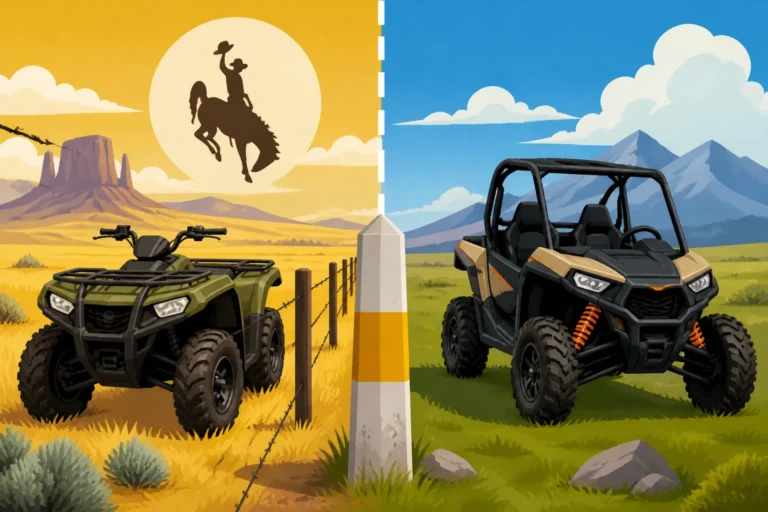
First things first: Wyoming makes a crucial legal distinction between an Off-Road Recreational Vehicle (ORV) and a Multipurpose Vehicle (MPV). Most of us think of our ATVs, dirt bikes, and side-by-sides as ORVs, and for trail use, that's exactly what they are. An ORV permit allows you to ride on designated trails and unpaved roads within state and federal lands. However, this permit explicitly does not authorize you to ride on paved public highways or city streets. Think of it like a hunting license – it lets you hunt, but it doesn't give you permission to drive your truck through someone's private field to do it.
An MPV, on the other hand, is a specific class of vehicle that, under certain conditions, can be legally operated on public roads in Wyoming. This is the path to gaining the ability to cross highways. For your ATV or side-by-side to qualify as an MPV, it must meet several criteria, including specific weight limits (between 300 and 3,000 pounds), a minimum seat height of 24 inches, and factory-installed safety features. It's not a blanket approval for all off-road machines; rather, it's a pathway for many side-by-sides and some larger ATVs to gain road access. [Wyoming's MPV Path to the Road] is a great resource if you're looking into this option.
If your machine doesn't meet the MPV definition, or if you haven't gone through the titling and plating process, it remains an ORV. As an ORV, your options for interacting with paved public roads are severely limited, primarily to making direct crossings where specifically allowed, or operating on certain "enrolled" unpaved roads. Without the MPV designation, driving your ORV down a paved highway, even for a short distance, is generally illegal and can lead to a citation.
The "Enrolled Road" Concept
Another critical concept to grasp in Wyoming is the "enrolled road." This doesn't apply directly to state highways, which are almost universally paved, but it's vital context for understanding how ORVs interact with other public roads. An enrolled road is typically a county road, forest service road, or BLM road that has been officially designated and marked by the Wyoming Department of State Parks and Cultural Resources (which manages the state's Off-Road Vehicle Program) as open for ORV use. [Wyoming's Enrolled Roads and Trails] covers this in detail.
These roads are often gravel, dirt, or unimproved, connecting various trail systems or providing access to remote areas. The "enrolled" status means that the managing agency (county, Forest Service, BLM) has agreed to allow ORV traffic on that specific segment. You'll typically see clear signage indicating where an enrolled segment begins and ends. However, even on an enrolled road, riders are usually expected to operate safely, follow all traffic laws, and be aware that the road is shared with other vehicles, including cars and trucks. The presence of these enrolled roads can sometimes create confusion, as riders might assume if one road is open, all roads are. But state highways are in a different category altogether.
Why an ORV Permit Isn't a Road License
This is perhaps the biggest misconception for visiting and even some resident riders. Your annual Wyoming ORV permit, while absolutely essential for legal trail riding, is not a license to operate on public roads, paved or otherwise. It's specific to off-road trails and designated unpaved routes. Think of it this way: your ORV permit contributes to the maintenance of trails and the overall ORV program, ensuring the places you love to ride remain open and accessible.
However, operating a vehicle on a public highway requires a different set of legal conditions. It involves meeting federal motor vehicle safety standards (or state equivalents for MPVs), carrying specific insurance, and having a valid driver's license. [What Wyoming Law Says About ORVs on Roads] explicitly outlines these differences. The ORV permit simply doesn't cover these requirements. Trying to use your ORV permit as justification for riding down a paved state highway will not hold up if you're stopped by a Wyoming Highway Patrol trooper. They'll be looking for a license plate, proper lighting, mirrors, and proof of insurance, none of which are typically associated with a standard ORV permit.
Specific Rules for Crossing State Highways
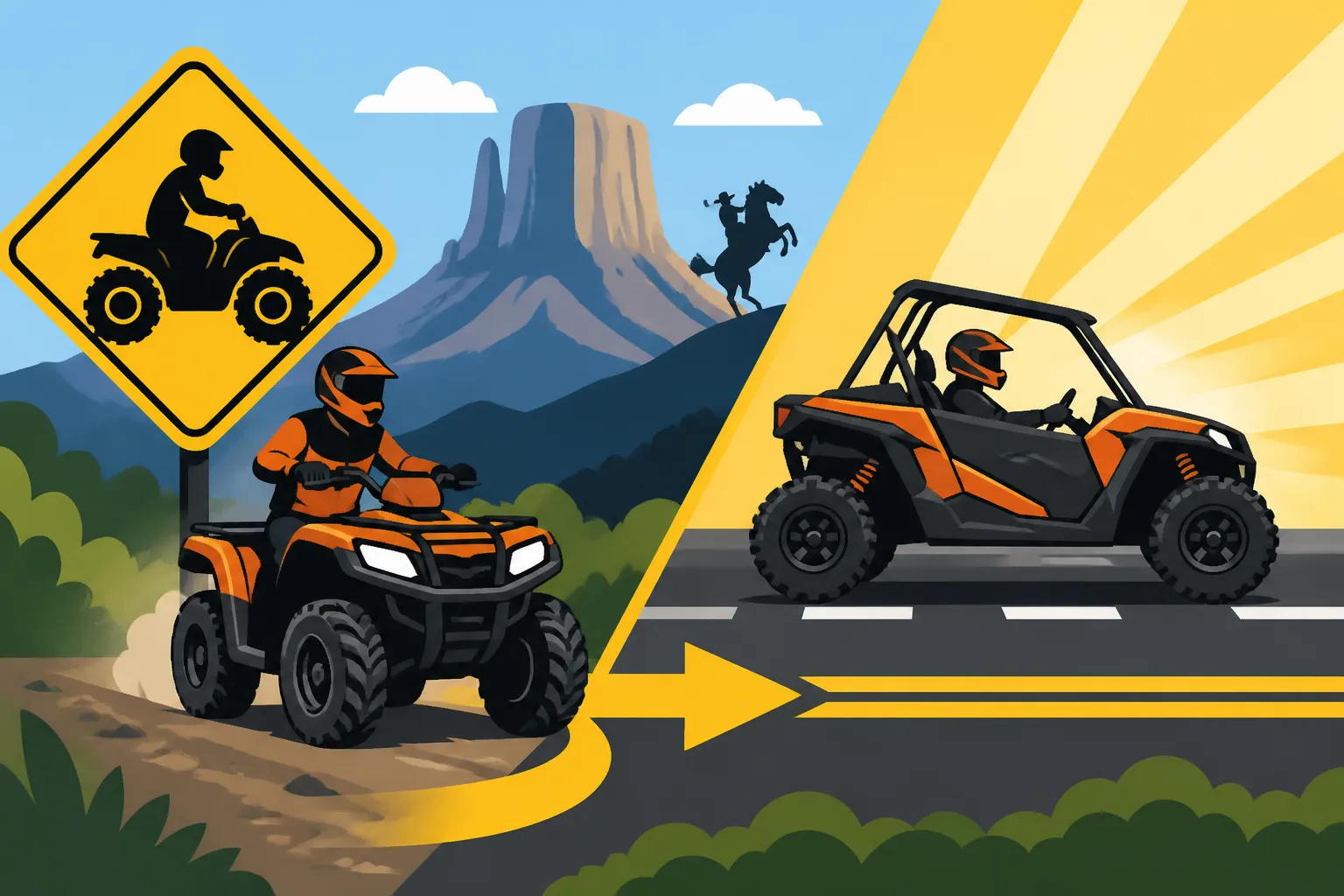
So, if you can't ride on a state highway as an ORV, how do you get across one to reach another trail? Wyoming law does provide specific, limited allowances for ORVs to cross paved public roads, including state highways, but these crossings must be done correctly and safely. This isn't a free-for-all; it's a highly regulated maneuver designed to minimize risk to both ORV riders and highway traffic.
The Stop and Yield Requirement
The most fundamental rule for crossing any paved public road in Wyoming is that you must come to a complete stop and yield to all oncoming traffic. This isn't just a courtesy; it's a legal mandate. Imagine you're riding a two-track out in the Bighorns, and it comes to an abrupt T-intersection with State Highway 14. You cannot simply roll through or accelerate across. You must stop, just as a car would at a stop sign.
Once stopped, you must yield to any vehicles approaching on the highway from either direction. This means waiting until the road is completely clear, or until you can cross safely without interfering with the flow of highway traffic. Highway speeds are much higher than trail speeds, and vehicles can cover ground quickly. Misjudging the speed or distance of an oncoming car can have severe consequences. This is one of those times when patience is absolutely vital, and a few extra seconds of waiting could literally save lives.
Sight Distance and Safety
Another critical factor in safely crossing a state highway is ensuring adequate sight distance. You need to be able to see clearly in both directions for a sufficient distance to confirm that it's safe to cross. This means more than just a quick glance. If there are obstructions like hills, dense trees, or buildings near the intersection, they can severely limit your visibility, making a safe crossing difficult or even impossible.
If your line of sight is restricted, you might need to dismount and carefully walk to a point where you can see clearly before attempting to cross. In some situations, especially on winding mountain roads, the sight distance might be so poor that a crossing is simply too dangerous and should not be attempted. Always err on the side of caution. Remember that highway traffic isn't expecting an ATV or UTV to dart out from a side road, so the responsibility for a safe crossing falls squarely on the ORV rider. You are the one interrupting the flow of traffic, so you must do so without creating a hazard.
Direct Crossings vs. Riding Along the Shoulder
Wyoming law is very clear on this: an ORV (one that is not designated as an MPV and properly licensed) is generally only permitted to make a direct crossing of a paved public highway. What does "direct crossing" mean? It means going straight across, perpendicular to the highway, from one legal off-road area to another. You are not allowed to ride down the shoulder, even for a short distance, to find a better crossing point, or to connect to another trail that runs parallel to the highway.
Riding along the shoulder is typically prohibited because it places the ORV in the flow of highway traffic, albeit on the edge, for an extended period. This increases the risk of collision, especially given the speed differential between highway vehicles and off-road machines. The intent of the law is to allow for practical movement between trail systems, not to enable ORVs to use highways as travel corridors. If you need to travel parallel to a highway, you must find an alternative off-road route or, if your machine is a properly plated MPV, use the designated highway travel rules for that class of vehicle.
Here’s a quick overview of common scenarios for highway interactions:
| Scenario | ORV (Non-MPV) Rule | MPV (Street Legal) Rule |
|---|---|---|
| Crossing a State Highway | Allowed, but must stop, yield, and cross directly (perpendicular). No riding on shoulder. | Allowed, must stop, yield, and cross directly or can ride on shoulder to find best crossing point if safe and legal. |
| Riding along Highway Shoulder | Generally prohibited. | Allowed on specific state highways if necessary to reach an enrolled route, or connect segments, at slower speeds. |
| Riding on Main Highway Lane | Prohibited. | Allowed on specific state highways, generally in right-hand lane, observing speed limits and all traffic laws. |
| Crossing an Interstate | Prohibited, except at designated grade-separated crossings (underpasses/overpasses). | Prohibited, except at designated grade-separated crossings, where special rules apply. |
Note: MPV rules for riding along or on the main highway lane are subject to specific highway designations, local ordinances, and always require full street-legal equipment and licensing.
Navigating Interstate Highways in Wyoming
Interstate highways present an entirely different challenge for ATV and UTV riders in Wyoming. These are high-speed, limited-access roads designed for heavy vehicular traffic. The rules for crossing them are much stricter, and in most cases, outright prohibition is the standard. However, Wyoming has recognized the need for riders to traverse these significant barriers, leading to specific, carefully managed exceptions.
General Prohibition on Interstates
Let's be crystal clear: you generally cannot ride your ATV or UTV, whether it's a standard ORV or a street-legal MPV, on the main lanes or shoulders of an Interstate highway in Wyoming. This prohibition is due to the inherent dangers of mixing slow-moving off-road vehicles with high-speed interstate traffic. The risks of severe accidents are simply too great. This rule is non-negotiable and strictly enforced. Do not attempt to ride on an Interstate to get from one point to another. [Interstates Closed to MPVs and Dirt Bikes] further emphasizes this.
This general prohibition extends to the on-ramps and off-ramps of interstates as well. These are considered part of the interstate system, designed for vehicles accelerating to or decelerating from interstate speeds. Using them with an off-road machine is illegal and extremely hazardous. If your trail ends at an Interstate, you must find a legal alternative, which almost always means a grade-separated crossing.
The Exception: Grade-Separated Crossings
Recognizing that Interstates can effectively cut off access to popular riding areas, Wyoming has implemented a specific exception to the general prohibition: grade-separated crossings. These are underpasses or overpasses where an ORV trail or an enrolled road goes under or over the Interstate highway, without the ORV ever entering the actual traffic lanes.
These crossings are typically found in areas where a strong local demand exists for connecting trail systems that have been bisected by an Interstate. For example, the community of Evanston saw their trail access split by I-80, which led to the development of legal crossing points. These aren't just random tunnels or bridges; they are purpose-built or specially designated routes that ensure riders do not have any direct interaction with interstate traffic. They are clearly marked and maintained as part of the ORV trail system. [How to Cross I-80 Legally on an ATV] offers more context.
Designated Crossings and Their Limitations
Even with grade-separated crossings, there are strict limitations. Each designated crossing is usually part of an approved plan that manages the number of ORV trips per year across that specific point. For example, some crossings might have an annual cap of 1,000 machines. This cap is put in place to manage the impact on the crossing infrastructure and to ensure safety remains paramount.
These crossings are not always intuitive to find. You'll need to consult detailed ORV maps, often provided by the Wyoming Department of State Parks and Cultural Resources, the Forest Service, or the BLM, to identify the exact locations of these legal interstate crossings. Relying on guesswork could lead you to an illegal and dangerous situation. Furthermore, even at a designated crossing, all other ORV rules apply. Riders must yield to other traffic using the underpass or overpass (if it's a shared road), observe speed limits, and maintain environmental responsibility. These are not areas for reckless riding; they are critical junctures in the trail system that demand careful and compliant operation.
Equipment and Licensing for Road Use and Crossings
Successfully navigating Wyoming's roads, particularly when crossing highways, isn't just about knowing where you can ride; it's also about ensuring your machine is properly equipped and you, the rider, are legally qualified. This is where the distinction between an ORV and a street-legal MPV becomes incredibly important.
Essential MPV Equipment
If you intend to operate your side-by-side (or qualifying ATV) as an MPV on any public road, including making direct crossings or riding on designated state highways, it must meet specific equipment requirements. These are designed to bring the machine up to a safety standard comparable to other road vehicles. You can't just slap a license plate on it and go.
Key equipment includes:
- Headlights and Taillights: Functioning headlights and taillights are a must, providing visibility during daylight and especially after dark. This isn't just for you to see; it's for other drivers to see you.
- Brake Lights/Stop Lamps: When you apply the brakes, a red light must illuminate at the rear of your machine. This is a critical safety feature to warn following traffic.
- Horn: A working horn is essential for signaling other drivers or pedestrians. It might seem minor, but it's a basic requirement for road-legal vehicles.
- Mirrors: At least one mirror, typically on the left side, providing a clear view to the rear is required. Many riders add a second mirror for improved visibility. [Wyoming Mirror Requirements for Road Use] outlines this. If you're looking for durable, adjustable mirrors, companies like SuperATV offer a wide range of aftermarket options that are perfect for street-legal conversions, ensuring you meet these requirements without compromising on quality or off-road functionality.
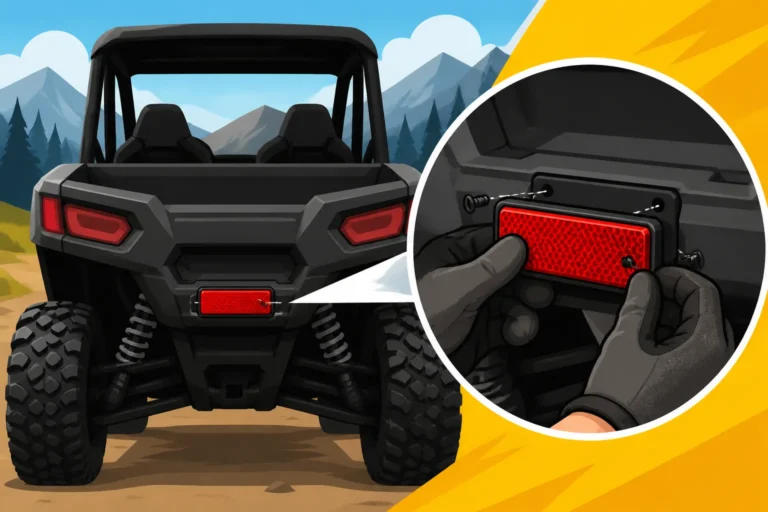
- Red Rear Reflector: A non-illuminated red reflector at the rear of the machine provides passive visibility, especially in low light conditions.
- Windshield (often implied for side-by-sides, though not always explicitly called out as mandatory for all MPVs, check specific regs for your vehicle type).
- License Plate Light: The rear license plate must be illuminated after dark.
These are not suggestions; they are legal requirements. Operating an MPV on a public road without these features can result in fines and citations. [Wyoming Lighting Requirements for ORVs] goes into further depth on what's needed.
Driver's License and Endorsement Requirements
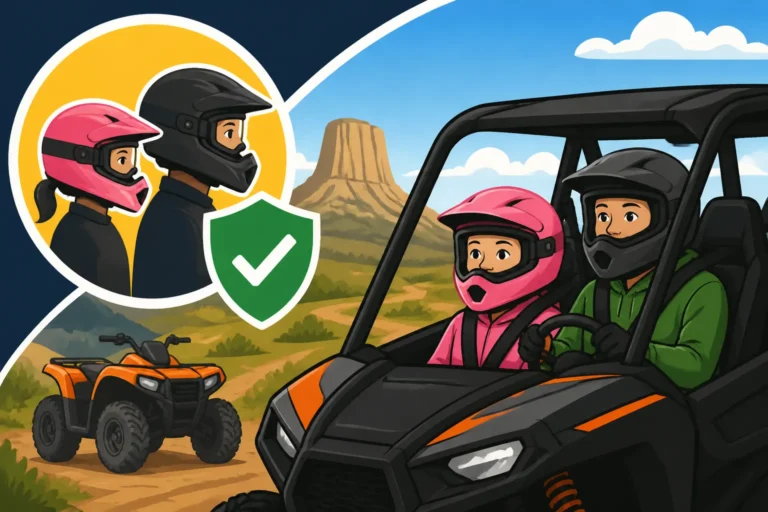
Just as your machine needs to be properly equipped, you need to be properly licensed. To operate an MPV on public roads in Wyoming, you must possess a valid driver's license. This isn't a special "ORV license"; it's a standard Class C driver's license (the kind you use to drive your car or truck).
Furthermore, Wyoming requires a specific endorsement on your driver's license for operating an MPV. This is usually an "M" (motorcycle) endorsement or sometimes an "MR" endorsement, which is specific to multipurpose vehicles. This means you can't just have your car license; you need to pass the appropriate tests (written and sometimes riding) to get this endorsement. This requirement ensures that riders operating MPVs on public roads have demonstrated knowledge of traffic laws and the unique handling characteristics of these machines. Failing to have the correct endorsement can result in a citation for driving without a proper license.
Insurance Requirements
Finally, if your machine is registered as an MPV and you intend to operate it on public roads, you must carry proof of financial responsibility, typically in the form of liability insurance. This is the same requirement that applies to cars, trucks, and motorcycles operating on Wyoming roads. This insurance protects you and others in the event of an accident.
It's crucial that your insurance policy specifically covers your machine for on-road use as an MPV. Many standard ORV policies only cover trail riding and may not extend to public highway operation. Check with your insurance provider to ensure you have adequate coverage before you venture onto any paved roads. Carrying proof of insurance, like your insurance card, is mandatory when operating on a public road, and a Wyoming Highway Patrol trooper will certainly ask for it if you're stopped. Without it, you could face fines and other penalties, similar to if you were driving a car without insurance.
Enforcement and Penalties for Non-Compliance
It's tempting to think that in wide-open Wyoming, enforcement might be lax, but when it comes to road safety and legal compliance, authorities take it seriously. Ignoring the rules for crossing highways or operating illegally on them can lead to significant headaches, from fines to more serious legal consequences.
What a Wyoming Trooper Checks Roadside
If you're stopped by a Wyoming Highway Patrol trooper, or even a county sheriff's deputy or a Forest Service or BLM ranger, they'll be looking for several key things, especially if you're on a paved public road. First and foremost, they'll want to see your driver's license with the appropriate MPV or motorcycle endorsement. Then, they'll check for proof of insurance that covers the machine for road use.
Next, they'll visually inspect your machine for the required MPV equipment. This includes checking for functioning headlights, taillights, brake lights, a horn, and at least one rearview mirror. They'll also look for a valid license plate mounted in the proper location and ensure it's illuminated if it's dark. If you're operating an ORV (not a plated MPV) and you're caught riding on a highway (not just making a legal direct crossing), they'll also check for your [Wyoming ORV Permit]. Even if you have the permit, it won't excuse illegal road behavior. [What a Wyoming Trooper Checks Roadside] will give you an idea of what to expect.
Troopers are well-versed in the distinctions between ORVs and MPVs and the specific rules for each. They're not out to ruin your fun, but to ensure everyone's safety on the public roadways.
Consequences of Illegal Crossings
The penalties for operating an ATV or UTV illegally on Wyoming highways can vary depending on the specific violation, but they are rarely minor.
- Fines: Expect monetary fines for offenses such as operating without proper equipment, no driver's license/endorsement, or no insurance. These fines can quickly add up.
- Citations: You'll receive a citation, which means a formal legal notice of the offense. Accumulating multiple citations can lead to more severe penalties.
- Impoundment: In some cases, especially for repeat offenses or very serious violations (like driving under the influence), your machine could be impounded, leading to towing and storage fees on top of the fines.
- Accident Liability: If you're involved in an accident while operating illegally, your insurance might not cover you, leaving you personally liable for damages and injuries.
- Misdemeanor Charges: More serious offenses, such as reckless driving or egregious disregard for road rules, could escalate to misdemeanor charges, potentially impacting your driving record and even leading to court appearances.
[Wyoming Fines for Riding a Closed Road] or an illegally accessed road can be substantial, and the inconvenience of dealing with a legal situation far outweighs the minor effort of understanding and following the rules.
The Importance of Knowing Your Route
Ultimately, the best defense against unintentional violations and potential penalties is thorough preparation. Before you head out on your ride, especially if your route involves any interaction with paved public roads or crossing a highway, know your route inside and out.
This means consulting official maps – not just a general trail map, but specific ORV maps from the Forest Service, BLM, or the Wyoming State Parks and Cultural Resources Department. These maps will clearly designate enrolled roads, legal crossing points for interstates, and areas where ORV use is restricted or prohibited. Don't rely on assumptions or vague directions from others. The information changes, and what was legal last year or in another state might not be legal here and now.
Use GPS devices with pre-loaded ORV maps if possible, and always have a paper map as a backup. Plan your fuel stops, water breaks, and especially any points where you'll need to cross or interact with paved roads. If a section of your planned route on a public highway or crossing looks questionable, find an alternative. Companies like SuperATV offer excellent GPS units and accessories designed for off-road use, which can be invaluable for pre-planning and staying on track. Being prepared means you can focus on the incredible scenery and the joy of riding, rather than worrying about legal trouble.
Disclaimer
This article is for general informational purposes only and does not constitute professional advice. Laws, prices and regulations vary by location and change over time. Consult a qualified professional for guidance on your specific situation.