Wyoming MPV Street Legal Requirements
Trying to figure out if your beloved ATV or UTV can legally cruise down the paved roads in Wyoming can feel like trying to solve a Rubik's Cube blindfolded. It's a common headache for riders who want to expand their adventures beyond the dirt, leading to confusion about permits, plates, and what exactly qualifies as "street legal." This comprehensive guide will untangle Wyoming's specific requirements for Multipurpose Vehicles (MPVs), walking you through everything you need to know to get your machine from the trail to the tarmac safely and legally.
Understanding Wyoming's MPV Classification
Wyoming has a unique way of classifying off-road machines that can be a bit of a head-scratcher, especially when you start dreaming of connecting trails via a short stretch of pavement. It’s not as simple as slapping a license plate on your quad; there's a distinct classification called a Multipurpose Vehicle (MPV) that dictates whether your machine is welcome on public roads. This isn't just bureaucratic jargon; it's the foundation for safely integrating these powerful machines into the existing road infrastructure, recognizing that they have different characteristics than a car or even a traditional motorcycle. Many states don't have this nuanced approach, which is why Wyoming riders often feel like they're navigating a maze.
What Exactly is a Multipurpose Vehicle MPV in Wyoming?
The journey to street legality in Wyoming begins with understanding the definition of a Multipurpose Vehicle, or MPV. According to Wyoming Statute 31-1-101, an MPV isn't just any ATV or UTV. It's a specific class of vehicle that's designed for both on- and off-road use, but critically, it has to meet certain structural criteria to even be considered. This legal definition is crucial because it’s the gateway to getting a title and then a license plate for road use. Without meeting these baseline requirements, your machine will forever be confined to off-road status, no matter how many mirrors or turn signals you bolt onto it. It's a common frustration for riders who bought a machine thinking it could be street legal, only to find out it doesn't meet the state's specific dimensional criteria.
At its core, an MPV in Wyoming is typically a side-by-side or a UTV that fits specific characteristics. The law defines it as a vehicle that's not a motorcycle, not a snowmobile, and not an ORV (Off-Road Recreational Vehicle), but is designed to travel on four or more wheels. It must be able to operate on both paved and unpaved roads and primarily used for recreational, utility, or agricultural purposes. This distinction means that your typical sport quad, while a blast off-road, likely won't ever make the cut as an MPV because it simply doesn't fit the design parameters set forth by the state. This can be a tough pill to swallow for some riders, but it's vital to know before you invest time and money into modifications.
Key Physical Requirements for an MPV
Beyond the general definition, Wyoming lays out very specific physical requirements for a machine to qualify as an MPV. These aren't arbitrary rules; they're designed with safety in mind, particularly when these vehicles share the road with traditional automobiles. The state wants to ensure that any MPV operating on public roads has a certain level of stability and visibility, distinguishing it from smaller, less stable ATVs. It’s these precise measurements that often trip up riders, as a slight deviation can mean the difference between getting a title and being told your machine can only ever be an ORV.
One of the most critical requirements is the vehicle's weight. To be classified as an MPV, your machine must weigh between 300 and 3,000 pounds. This range typically includes many modern side-by-sides, but it immediately excludes smaller, lighter youth models or older, heavier custom builds that might fall outside these parameters. Another key aspect is the seating arrangement: the machine must have a seat that is at least 24 inches high, measured from the ground. This rule is designed to ensure the operator has a commanding view of the road, similar to a small car or truck, rather than being low to the ground like a traditional ATV. For example, a typical sport quad where you straddle the seat simply won't meet this height requirement, making it ineligible. You can find more detail on [Wyoming's MPV Definition in W.S. 31-1-101].
The Difference Between an ORV and an MPV
This is where a lot of riders get tangled up: understanding that an ORV permit and an MPV designation are two entirely different animals in Wyoming. Many assume that if they have their annual ORV permit decal, they're good to go anywhere. However, an ORV permit is solely for off-road use on designated trails, public lands, and approved routes. It does not grant you permission to ride on public roads. Period. The state maintains this clear separation because the safety requirements, operational rules, and even the type of registration are fundamentally different for machines intended to share paved roads with cars and trucks.
An ORV (Off-Road Recreational Vehicle) includes your standard ATVs, dirt bikes, and even some side-by-sides that don't meet the MPV criteria. These machines are registered annually with the Wyoming Department of State Parks and Cultural Resources and get a decal that lets them ride on the state's extensive network of [Wyoming's Enrolled Roads and Trails]. An MPV, on the other hand, is titled and licensed through the county, much like a car or truck, and receives a traditional license plate. This distinction is crucial because without the MPV classification, title, and plate, you are simply operating an ORV on a road, which is illegal and can result in significant fines. It’s a classic "you can't just put a street legal kit on an ORV and call it good" scenario that catches many visitors and new residents off guard.
Getting Your MPV Ready for Wyoming Roads
So, you've confirmed your side-by-side or UTV meets the physical criteria to be a Wyoming MPV. That's a huge first step! Now comes the practical part: equipping it properly and navigating the bureaucracy to make it genuinely street legal. This isn't just about avoiding a ticket; it's about making sure your machine is safe for you and others when you're sharing the pavement. Think of it like getting a vehicle inspection for a car – there are specific items that must be in working order and meet state standards before you can legally operate it on public roads. Skipping these steps, or cutting corners, can lead to dangerous situations and unwanted attention from law enforcement.
Essential Road-Legal Equipment Checklist
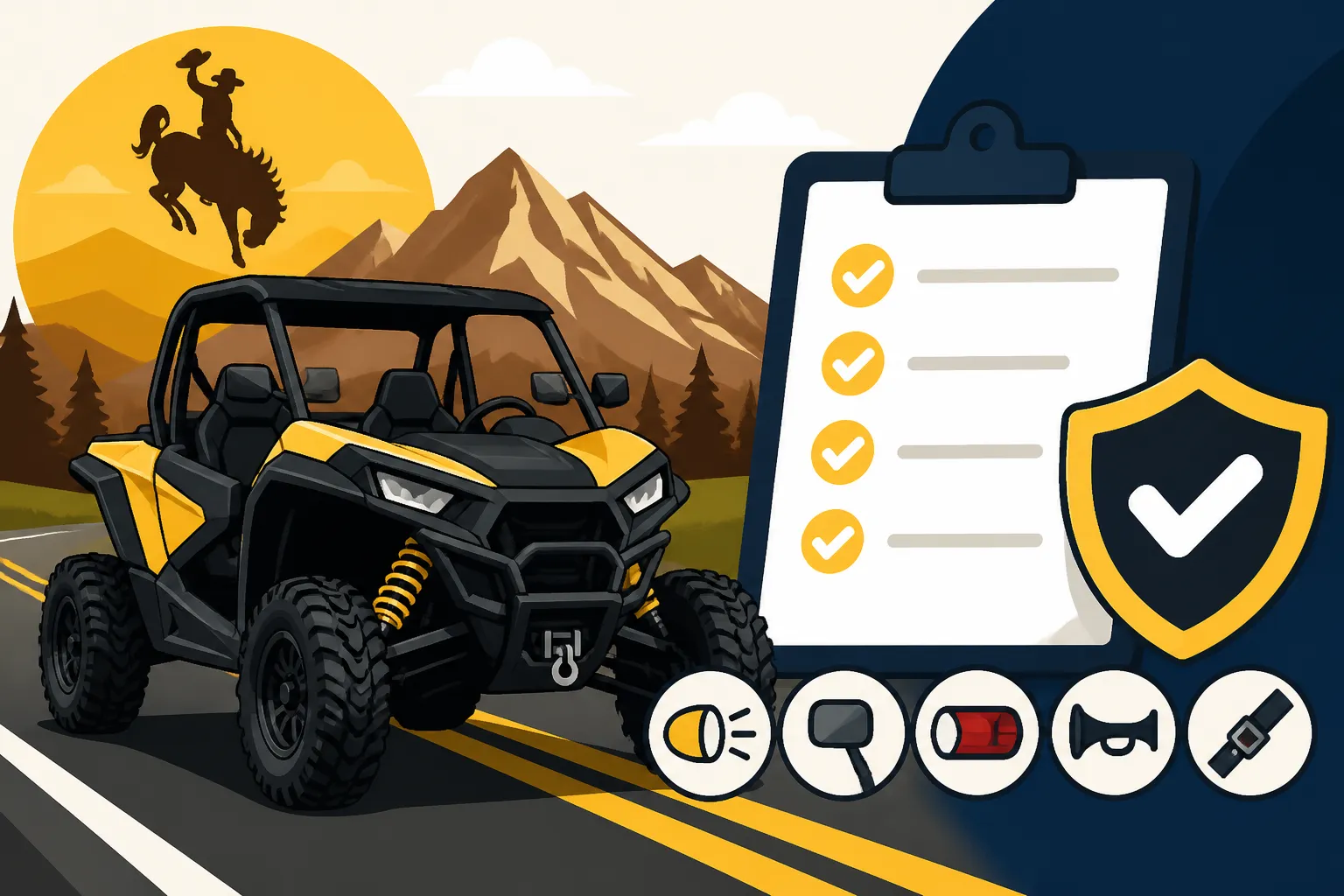
Once your machine qualifies as an MPV by its dimensions and weight, the next hurdle is outfitting it with all the necessary equipment to comply with Wyoming's road laws. This goes far beyond just a simple headlight. These requirements are in place to ensure your machine is visible, capable of signaling its intentions, and able to stop effectively when operating alongside regular traffic. Many riders find that while their stock UTV might have some of these features, a full street-legal conversion often requires adding or upgrading several components. Companies like SuperATV offer conversion kits that can help streamline this process, bundling many of the required parts into one package.
Here's a breakdown of the key equipment your MPV will need:
| Equipment Feature | Specific Wyoming Requirement |
|---|---|
| Headlights | At least one, but preferably two, that emit a white light visible from a distance of 500 feet during darkness and poor visibility. They must be mounted at a height between 24 and 54 inches. |
| Taillights | At least one, but preferably two, red taillights visible from 500 feet to the rear. They must be mounted between 15 and 72 inches from the ground. |
| Brake Lights | A red or amber stop lamp, visible from 300 feet to the rear, that illuminates when the brake is applied. This is often integrated with the taillight. |
| Turn Signals | Front and rear turn signal lamps capable of emitting a flashing amber light, visible from 300 feet, to indicate a turn. |
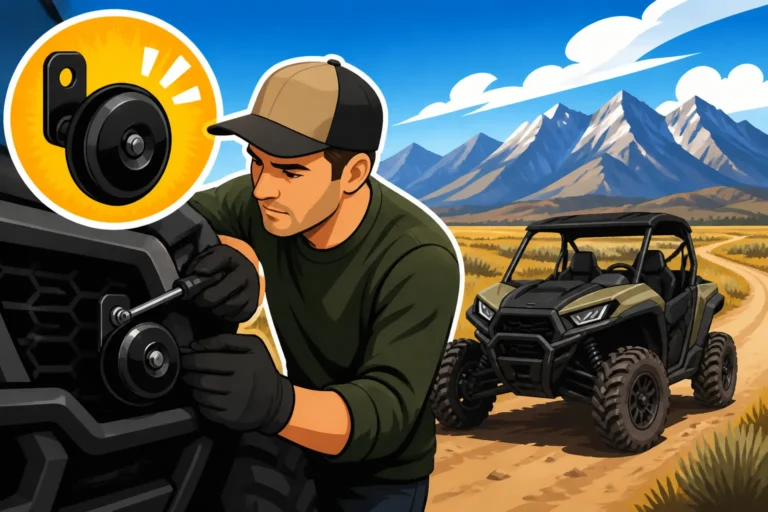
| Horn | A horn capable of emitting sound audible under normal conditions from a distance of at least 200 feet, but not an unreasonably loud or harsh sound. |
| Rearview Mirrors | At least one rearview mirror, providing the driver a view of the highway for a distance of at least 200 feet to the rear. Most riders opt for two, one on each side, for better visibility. SuperATV, for instance, has a range of side mirrors designed for UTVs that fit this bill. |
| Windshield | While not explicitly required for all MPVs by statute, it is highly recommended for safety and comfort. Many MPVs come with one, or it can be an aftermarket addition. |
| Tires | Tires must be in good condition with sufficient tread depth, and suitable for highway use (not just aggressive mud tires if you're doing extensive road riding). |
| Brakes | Adequate brakes on all wheels, capable of stopping the vehicle within a reasonable distance. |
| Muffler/Exhaust | Must have an adequate muffler to prevent excessive or unusual noise. Spark arresters are still required for off-road use and good practice generally. |
| License Plate Light | A white light that illuminates the rear license plate, making it clearly legible from 50 feet at night. |
| Red Rear Reflector | At least one red reflector on the rear, mounted between 15 and 60 inches from the ground. |
It's not just about having the equipment; it's about having it working and properly installed. A dead turn signal bulb or a horn that doesn't work will get you a ticket just as quickly as not having the equipment at all. Before you head to the County Clerk's office for your title, double-check every item on this list. Many a rider has been turned away because of a missing reflector or a non-functioning brake light, delaying their plans to hit the pavement.
The Wyoming MPV Titling and Plating Process
Okay, your MPV is physically ready for the road. Now for the administrative hurdles, which in Wyoming involve a bit of a two-step dance between different county offices. This can be a source of confusion because you're dealing with two separate entities to get one machine street legal. It’s important to understand the sequence and which office handles what, to avoid making multiple trips or getting frustrated when one office can't help you with the other's domain. Patience and preparedness are key here.
First, you'll need to head to your local [Wyoming County Clerk Title Process]. The County Clerk is responsible for issuing the title for your MPV. This is where you'll prove ownership, likely with a manufacturer's statement of origin (MSO) if it's new, or a bill of sale and previous title if it's used. This is also where the crucial "What the MPV and ORV-MC Checklist Form Asks" comes into play, as you’ll need to certify that your machine meets the weight and seat height requirements discussed earlier. Without a proper title identifying your machine as an MPV, you cannot get a license plate. It’s the foundational document that establishes your machine's identity as a road-worthy vehicle.
Once you have your MPV title in hand from the County Clerk, your next stop is the [Wyoming County Treasurer Plate Process]. This is the office that handles vehicle registration and issues your actual license plate. You'll present your MPV title, proof of insurance, and pay the registration fees. The Treasurer’s office will then issue you a standard Wyoming license plate, just like you’d get for a car or truck. This plate must be displayed prominently on the rear of your MPV, just as it would be on any other road vehicle. It’s a process that requires a little legwork, but successfully getting that plate means you're officially ready to roll on enrolled roads. Remember, you need both the title and the plate – one without the other isn't enough for street legality.
Driver's License and Insurance Requirements for Street Use
Having an MPV that's properly equipped, titled, and plated is a big step, but it's not the final one. Just like driving any other vehicle on public roads, you, the operator, also need to meet certain qualifications. This includes having the appropriate driver's license endorsement and carrying the necessary insurance. These requirements are non-negotiable for safety and liability reasons, ensuring that anyone operating an MPV on Wyoming's roads is prepared and covered. Don't assume your regular driver's license is enough; Wyoming has specific stipulations for MPVs.
For starters, to operate an MPV on Wyoming's public roads, you generally need a valid driver's license with either a motorcycle endorsement ("M" endorsement) or a "Multipurpose Vehicle" endorsement ("MR" endorsement). This is a crucial detail often overlooked. While some states might allow a standard Class C driver's license, Wyoming recognizes the unique handling characteristics of MPVs and requires specific training or testing to ensure competency. [Wyoming Motorcycle Endorsement for an MPV] goes into more detail, but generally, the MR endorsement is designed specifically for MPVs and is a common path for UTV owners. Check with the Wyoming Department of Transportation (WYDOT) for current testing requirements.
Beyond the license, carrying valid liability insurance is absolutely mandatory when operating an MPV on any public road in Wyoming. This is the same requirement as for cars, trucks, and motorcycles. Proof of insurance must be carried with you at all times when driving on the road and presented upon request by law enforcement. Failure to have insurance can lead to significant fines and penalties. Just imagine the headache of an accident without coverage – it's simply not worth the risk. Always ensure your policy covers your MPV for on-road use, as some off-road specific policies might not extend to public highways. [Wyoming ATV Insurance Requirement] further clarifies the necessity of this coverage.
Where You Can and Can't Ride Your Street-Legal MPV
You've done the work, your MPV is street legal, and you're ready to explore. But where exactly can you go? This is another area where Wyoming has specific rules that can be different from what riders might expect or what they've experienced in other states. The term "street legal" doesn't mean "any street." Wyoming meticulously designates which roads are open to MPVs, often balancing recreational access with safety concerns and local jurisdiction. Understanding these designations is paramount to a lawful and enjoyable ride, avoiding fines or venturing onto restricted land.
Designated Roads vs. Closed Roads
In Wyoming, the default rule for unpaved county roads and many Forest Service or BLM roads is often "open unless posted closed" for appropriately registered and equipped MPVs. However, it's critical to understand that this isn't a blanket permission slip for all roads. State highways and specific county roads might have different rules, and often, only roads that have been officially "enrolled" for ORV/MPV use are legally accessible. This can be confusing, as a road might look perfectly rideable but still be off-limits. Always look for signage and consult official maps.
Wyoming's State Parks, Historic Sites and Trails system, along with various federal land management agencies, work together to identify and "enroll" specific roads and trails for ORV and MPV use. These are often marked with specific signage indicating that MPVs are permitted. The emphasis here is on designated routes. You cannot simply venture off-road onto undesignated areas, even if your machine is street legal. This also applies to riding within city limits; local ordinances can supersede state rules, so always check with the specific municipality if you plan to ride within city boundaries. [Wyoming's Designated ORV Roads] elaborates on the importance of these designated routes. It's not uncommon for riders to receive a citation for riding on a seemingly innocuous county road that hasn't been officially opened for MPVs, highlighting the need for vigilance and current information.
Specific Rules for Interstates and Crossing Highways
One of the most tightly regulated areas for MPVs in Wyoming is their interaction with interstates and major state highways. Unlike some states where UTVs might have broader highway access, Wyoming has very strict limitations regarding these high-speed thoroughfares. The safety concerns are obvious – the speed differential between an MPV and interstate traffic is significant, and MPVs simply aren't designed for sustained high-speed travel. This can be a major point of frustration for riders trying to connect riding areas that are bisected by an interstate.
Generally speaking, MPVs are not permitted to travel on interstate highways in Wyoming. There are, however, very specific and limited exceptions for crossing interstates. Wyoming law allows for designated, grade-separated interstate crossings or, in extremely limited circumstances and with explicit permission, at-grade crossings. These crossings are often the result of complex agreements between WYDOT and local entities, designed to allow riders to access trails on the other side of the interstate without traveling long distances. For example, [How to Cross I-80 Legally on an ATV] highlights the specifics of such arrangements, which are often capped at a certain number of machines per year. It's never a given, and always requires adherence to strict rules and signage. For state highways, while some segments might be enrolled, MPVs are generally required to stay on the right-hand shoulder or as far to the right as practicable, and adhere to all traffic laws and posted speed limits.
Navigating City Streets, County Roads, and BLM/Forest Roads
Once you've wrapped your head around the interstate rules, navigating other types of roads becomes a bit clearer, though still requires careful attention to local rules. Your street-legal MPV opens up a lot of possibilities for connecting trails, running errands in small towns, or simply enjoying a scenic drive on lesser-traveled routes. But "street legal" doesn't mean "rule-free." Every type of road comes with its own set of considerations.
When it comes to [Wyoming Rules for Riding a County Road] or [Wyoming Rules for Riding a Forest Road] or [Wyoming Rules for Riding a BLM Road], the principle of "open unless posted closed" generally applies for duly licensed MPVs. This is the benefit of having gone through the titling and plating process. On these roads, you must obey all standard traffic laws: speed limits, stop signs, yielding, and signaling turns. Remember, you're sharing the road with cars, trucks, and possibly even livestock. Always be courteous and conscious of your dust and noise levels, especially when passing homes or other recreational users. Some counties or specific areas within forests or BLM land may have their own additional restrictions, so always check local signage and current travel management plans (like MVUMs for Forest Service land).
Riding on [Wyoming Rules for Riding a City Street] is another layer entirely. While your MPV might be legal on county and federal roads, cities and towns in Wyoming have the authority to enact their own ordinances regarding MPV use within their corporate limits. Some smaller towns, especially those that cater to outdoor recreation, might have specific routes or even entire sections of town open to MPVs. Other, larger cities might restrict them entirely from most streets. It's crucial to check with the local city or town clerk's office for their specific rules before planning to ride your MPV through town. A quick phone call can save you a significant fine and a ruined day. Always assume city streets are not open to MPVs unless you have verified otherwise, and stick to the designated routes you've confirmed.
Disclaimer
This article is for general informational purposes only and does not constitute professional advice. Laws, prices and regulations vary by location and change over time. Consult a qualified professional for guidance on your specific situation.