A Federal Permit for a Wyoming Event
Planning an ATV or UTV group ride on federal land in Wyoming? A regular riding permit or decal may not be enough when you organize an event. Whether you need separate authorization depends on the land manager, route, activity and scale. Start by identifying who manages the land, then ask what approvals apply before you advertise, collect fees or finalize plans.
When an Organized Ride May Need Federal Authorization
A federal permit is not simply another version of an individual rider’s ORV permit. It is an authorization from the federal land manager for a particular activity or use of public land. An organizer may need one even when every participant has the required vehicle decal and is riding on an open, designated route.
The key question is whether the proposed activity counts as an organized event or a use that needs special authorization. A large rally, race, guided outing, fundraiser or commercial ride is more likely to require advance review than a few friends meeting for an ordinary recreational ride. But the number of riders alone does not settle the question. The route, timing, activity, commercial purpose and likely effects on other visitors or land resources can matter too.
Federal land in Wyoming is not managed as one continuous riding area. The Bureau of Land Management and the U.S. Forest Service manage different places, and local offices handle proposals for the lands under their authority. A route may cross more than one management unit or landowner. In that case, approval from one office should not be assumed to cover the whole route.
Public access also does not mean that every organized use is automatically authorized. A road or trail may be open for individual recreation while an event using that route still requires review. Conversely, the fact that a group is organized does not automatically mean it needs a federal permit. The land manager has to assess the actual proposal.
Ask the agency directly before treating any of these situations as approved:
- A timed event, race or competitive ride
- A ride promoted to the public or open to registration
- A guided ride offered for a fee
- An event that uses a staging area, parking area or campground intensively
- A planned ride that could affect other visitors, wildlife, vegetation or road use
- Commercial filming, a fundraiser or an event involving vendors or equipment
The agency may distinguish between a casual group ride and an event that needs formal authorization. For more on planning a group outing, see Wyoming Rules for a Group Ride. If the ride is a rally or similar organized activity, What a Wyoming Rally Organizer Needs is also relevant. Commercial tours have a separate set of considerations; see Wyoming Rules for a Commercial Guide.
Federal Event Authorization Is Separate From Vehicle Permits
An event permit and an ATV or UTV riding permit answer different questions. The event authorization concerns the organizer’s proposed use of a specific area. A vehicle decal or ORV permit concerns whether a machine meets the applicable riding requirements. One does not replace the other.
In Wyoming, riders should not assume that a state decal, registration or permit from another state authorizes an organized activity on federal land. Nor should an event organizer assume that federal approval makes every vehicle legal to ride. Participants may still need the required Wyoming permit, and they must follow route restrictions, equipment rules and any applicable land-management conditions. Read Wyoming ORV Permits Explained for the individual machine permit issue.
| Requirement or approval | What it generally addresses | Who should check it |
|---|---|---|
| Federal event authorization | The organized use of a specific federal area | Event organizer and relevant federal land manager |
| Wyoming ORV permit or decal | The machine’s state riding permit requirements | Each rider or fleet operator |
| Route access | Whether the specific road or trail is open to the machine and activity | Organizer and riders |
| Commercial or filming authorization | Activities such as paid guiding or production work, when applicable | Business or production organizer |
| Private or state land permission | Access to land not controlled by the federal office | Organizer and landowner or managing agency |
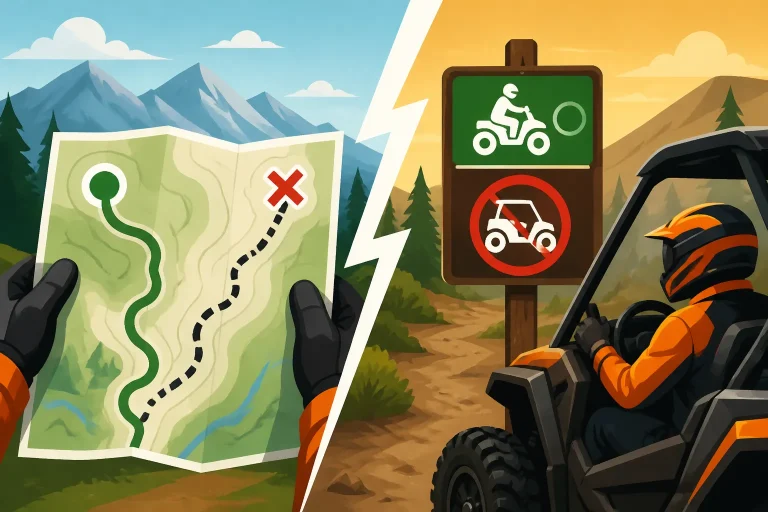
The route matters as much as the event name. A ride that begins on federal land may pass onto private land, state land or another federal unit. A permit from one land manager does not grant access across land managed by someone else. Even if a map shows a connected route, the organizer needs to confirm that each segment is open and that the planned event is allowed there.
Check current route information as well as event requirements. A route that is open to ordinary recreation may have seasonal restrictions, vehicle-width limits, temporary closures or other conditions. Use the appropriate travel management map and verify details with the responsible office. For background on riding areas managed by different federal agencies, see Wyoming Rules for Riding a National Forest and Wyoming Rules for Riding BLM Land.
How to Find the Right Office and Start an Application
The most practical first step is to identify the land manager for every part of the proposed route and event footprint. Include not only the riding route, but also the planned gathering point, parking, check-in, staging, camping and any support locations. If you are unsure which office has jurisdiction, describe the location and ask where to direct the proposal.
Do not rely on a general map alone to determine which office can approve an event. A route may cross boundaries, and management responsibilities can be divided among local units. If the event involves multiple areas, ask each responsible office what it needs and whether one office can coordinate the review.
A useful starting sequence is:
- Write a clear event description. State what kind of ride you plan, whether it is competitive, guided or recreational, and whether participants will pay or register.
- Map the proposed route and activity areas. Mark the start and finish, roads or trails, staging and parking, support locations, and any overnight use.
- Estimate the event’s scale. Give the expected number of machines, participants, staff and support vehicles. If attendance is uncertain, provide a realistic range.
- Contact the relevant land manager early. Ask whether the proposal needs a special use permit, event authorization or another form of approval, and which office handles it.
- Request the current application instructions. The agency can explain what information it needs, how it reviews proposals, and whether there are deadlines or other requirements.
- Wait for written direction before committing to the route. Do not treat a phone conversation, a route map or an individual riding permit as final event approval.
A complete proposal may need a route map, event schedule, participant estimate, traffic and parking plan, safety arrangements, sanitation plan, waste plan or other details. What is required depends on the location and event. The agency may also ask about emergency access, signs, communications, equipment, environmental protection or how the organizer will keep riders on the approved route.
Ask about fees, insurance, deposits, bonding or other financial requirements rather than assuming they apply or do not apply. Requirements can depend on the activity, land unit and authorization type. Confirm the current terms directly with the responsible office before setting registration prices or promising participants that the event is cleared.
If filming is part of the event, mention it at the start. Commercial filming can trigger additional review or a separate authorization. See Wyoming Rules for Filming on Federal Land for that issue. Likewise, a paid guided ride should be described accurately rather than presented as a private group outing; the land manager needs to assess the real activity.
Planning for Review, Conditions and Changes
Federal review is not just a paperwork step. The land manager may need to assess whether the event fits the area, conflicts with other uses, or creates effects that need to be avoided or managed. A proposal that changes the way an area is used may require more review than a small gathering on an established route.
Season and conditions can affect feasibility. Wildlife concerns, fire restrictions, weather, snow, muddy roads, maintenance work and other temporary conditions may affect access. An approved plan may include limits on dates, locations, group size, route, noise, signs, staging or other event details. These are not details to treat as optional: conditions attached to an authorization are part of what makes the use permitted.
Build flexibility into the plan. Ask whether the event can be moved, reduced or rescheduled if the proposed route becomes unavailable. Avoid advertising a route or date as confirmed until the office has given the required approval. If the route or event details change after review, tell the agency; a substantial change may need additional approval.
Organizers should also have a practical compliance plan for the day of the event. Assign someone to communicate with participants, keep the group on the approved route, manage staging and parking, handle waste, and respond if an unexpected closure or safety issue arises. Brief riders before departure about route boundaries, local rules and what to do if the group becomes separated.
Keep copies of the authorization and its conditions accessible to event staff. Share the relevant instructions with participants in advance, not just at check-in. If the land manager requires a specific route, schedule or operating limit, make sure the person leading the ride knows it and can enforce it.
The same care applies to routes that include land outside the federal unit. Get permission from the landowner or relevant agency for those segments, and confirm that access is valid for the event rather than only for ordinary travel. A federal event authorization cannot grant rights on private or state land.
For participants, make clear that event approval does not excuse individual violations. Riders remain responsible for having the required permit and using only routes open to their machine. The organizer’s permit may also impose event-specific obligations that do not apply to a person riding alone. Treat the approvals as complementary: the organizer clears the activity, while riders follow their own vehicle and route requirements.
If an office says the proposal does not need a federal event permit, ask what rules still apply and whether that answer covers the entire route and all planned activities. Keep a record of the response and check again if the event grows, changes from recreational to commercial, adds competition, or moves to a different area. A changed plan can change the authorization question.
The safest approach is straightforward: identify the land manager, describe the event honestly, and get requirements in writing before you invite riders or make nonrefundable commitments. That gives the office a chance to identify conflicts early and gives the organizer time to adjust the route, schedule or format.
Disclaimer
This article is for general informational purposes only and does not constitute professional advice. Laws, prices and regulations vary by location and change over time. Consult a qualified professional for guidance on your specific situation.