A Seat at Least 24 Inches Up
It's easy to get lost in the sea of rules and regulations when you're just trying to figure out where and how you can legally ride your ATV or side-by-side in Wyoming. Many folks assume all off-road machines are treated the same, but that's simply not true, especially if you're dreaming of hitting some paved roads. This guide will clarify one of the most crucial, yet often overlooked, distinctions: the 24-inch seat height rule, and why it's a game-changer for your machine's legal classification in the Cowboy State.
Navigating Wyoming's Off-Road Vehicle Categories
Wyoming has a unique way of classifying off-road vehicles, and understanding these categories is the first step to staying on the right side of the law. It’s not just about getting a permit; it's about knowing what kind of machine you actually own in the eyes of the state. This distinction becomes incredibly important when you start thinking about riding anywhere beyond designated trails.
The Familiar Off-Road Vehicle ORV
For most of us, when we picture an ATV or a dirt bike, we're thinking of what Wyoming designates as an Off-Road Vehicle, or ORV. These are the machines designed purely for tearing up trails, exploring rough terrain, and enjoying the great outdoors away from paved roads.
These vehicles are primarily regulated by the Wyoming Department of State Parks, Historic Sites and Trails. When you get your annual [Wyoming's Annual ORV Permit], you're getting a decal that allows your ORV to be ridden on enrolled trails and designated public lands. This is the simplest category to understand because its purpose is straightforward: off-road use only. Traditional quads, dirt bikes, and even many smaller side-by-sides often fall squarely into this ORV category. They are trail machines, pure and simple, and while incredibly fun, they generally aren't built or equipped for mingling with highway traffic.
Introducing the Multipurpose Vehicle MPV
Now, here's where things get interesting and a bit more complex. Wyoming also has a class of vehicles called Multipurpose Vehicles, or MPVs. This category was specifically created to address the growing popularity of larger, more utility-focused side-by-sides that often bridge the gap between an off-road machine and a small car.
MPVs are a distinct classification because, unlike ORVs, they have the potential to become street legal in certain situations. This isn't a given, though; a machine must meet a very specific set of criteria to be classified as an MPV. This classification opens up doors for riders who want the versatility of driving their side-by-side on designated county roads or even, in limited circumstances, crossing certain highways. [Wyoming's Multipurpose Vehicle Class] fundamentally changes how your machine is titled, registered, and ultimately, where you can legally operate it. It's a critical difference that often surprises riders who are new to Wyoming's rules or are simply used to different classifications in other states.
The 24-Inch Seat Height Rule: What It Really Means
One of the most defining characteristics that separate an MPV from an ORV in Wyoming is the height of its seat. It might seem like a small detail, but in the eyes of the law, it's monumental. This specific measurement, "a seat at least 24 inches up," is a critical hurdle for any side-by-side aspiring to be an MPV.
How to Accurately Measure Your Machine's Seat Height
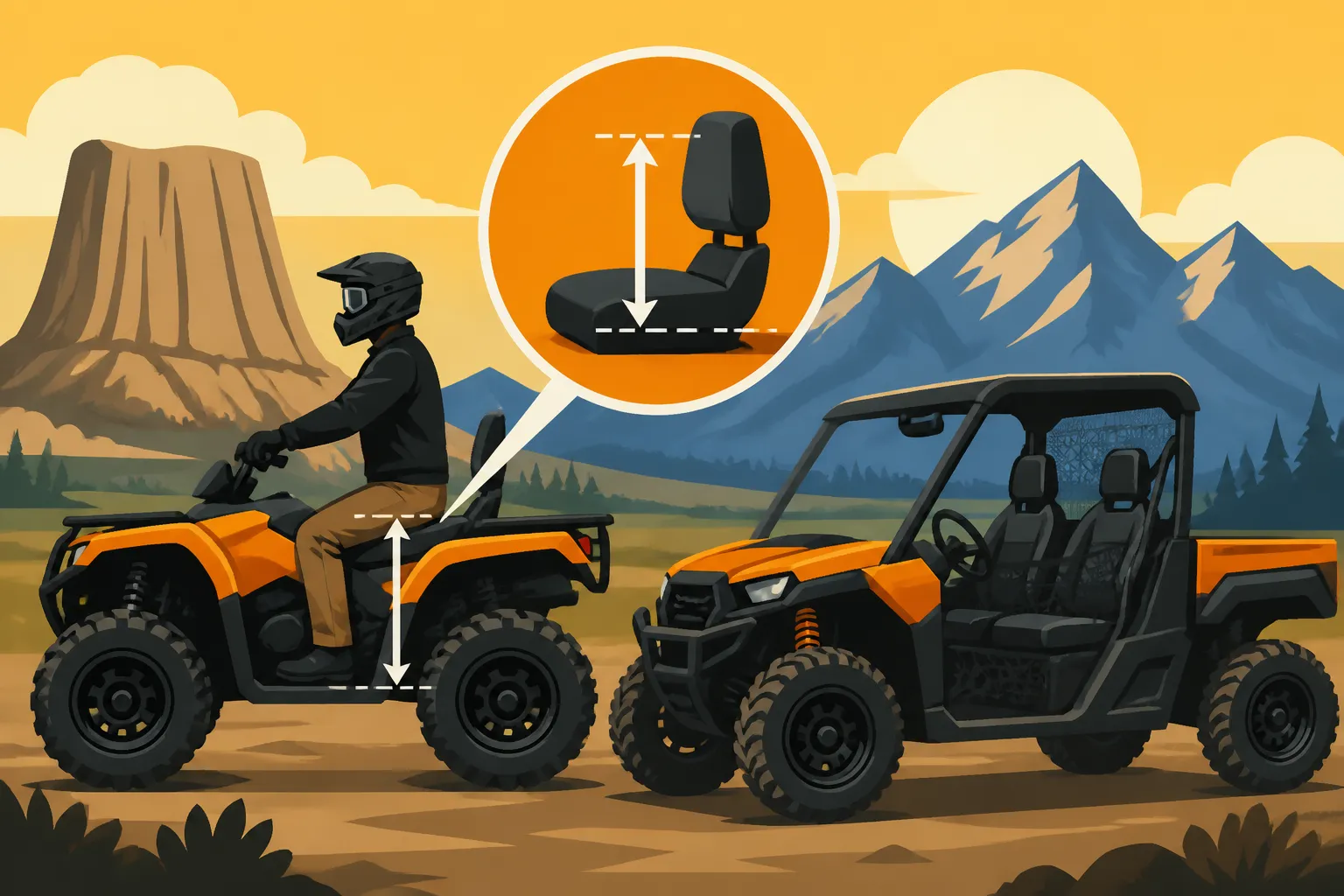
Getting this measurement right is crucial. It’s not just an estimate; it needs to be precise. The state defines "seat height" as the distance from the ground to the lowest point of the top of the driver's seat.
To measure accurately, park your machine on a level, hard surface. Ensure the tires are properly inflated to the manufacturer's recommended pressure. Using a tape measure, extend it straight up from the ground to the lowest point on the seating surface of the driver's seat. If your machine has multiple seating positions or bucket seats, focus on the lowest point of the primary driver's seat. Make sure the vehicle is unloaded, as any weight could compress the suspension and give you an inaccurate, lower reading. Don't eyeball it; get down on the ground and use a rigid tape measure or a carpenter's square for the most accurate result.
The Purpose Behind the Specific Measurement
So, why 24 inches? This specific height isn't arbitrary; it's a legislative decision aimed at distinguishing between traditional, saddle-style ATVs and the more automobile-like utility vehicles or side-by-sides.
Traditional ATVs typically have a saddle seat that the rider straddles, with a much lower center of gravity and a riding position that's more "on" the machine than "in" it. Their seat heights are often considerably less than 24 inches. In contrast, many side-by-sides feature bucket seats or bench seats, with the driver sitting in a more upright, car-like position, often well above that 24-inch threshold. This distinction is rooted in safety and operational characteristics; a higher seat often implies a different vehicle design, potentially with different stability characteristics and intended uses on public roads. The rule, which began with [The MPV Rule That Started in 2008], was designed to ensure that only vehicles meeting certain design parameters, suggesting a higher level of stability and control on roads, could qualify for the MPV classification.
Seat Height, Weight, and Wyoming's MPV Classification
The 24-inch seat height rule doesn't stand alone. It's part of a trio of key physical characteristics that determine if a machine qualifies as a Multipurpose Vehicle (MPV) in Wyoming. The other two critical factors are its weight and its wheel configuration. All these elements work together to paint a clear picture of whether your off-road machine can truly be considered an MPV.
The Importance of the 300 to 3,000 Pound Weight Window
Beyond seat height, your machine's weight is another non-negotiable factor. To qualify as an MPV, a vehicle must have an unladen (empty) weight of at least 300 pounds but no more than 3,000 pounds. This [Weight Between 300 and 3,000 Pounds] rule further hones in on the specific types of vehicles Wyoming intends to classify as MPVs.
This range effectively excludes very light recreational dirt bikes or youth quads on one end, and extremely heavy utility or agricultural vehicles on the other. It's meant to capture the vast majority of consumer-grade side-by-sides, which typically fall comfortably within this weight range. For instance, a small, basic two-seater side-by-side might weigh around 1,000 to 1,500 pounds, while a larger, four-seat model with more features could push towards 2,000 to 2,500 pounds. If you're buying or selling a machine and need to document its weight accurately, particularly for a transfer of ownership, a formal bill of sale or other agreement could include this detail. Services like LawDepot provide templates that can help you create professional legal documents for such transactions.
Why Most ATVs Cannot Qualify as MPVs
This is a common point of frustration for many ATV owners in Wyoming. While some might wish their traditional quad could become street legal, the reality is that most ATVs simply do not meet the criteria to be classified as an MPV, primarily due to the seat height rule.
Traditional ATVs, by their very design, feature a saddle-style seat that the rider straddles. This seating position inherently places the rider much closer to the ground than the 24-inch minimum required for an MPV. Even larger, sport-utility ATVs typically have seat heights well below this threshold. Furthermore, [Why a Quad Cannot Qualify as an MPV] often comes down to the number of wheels: MPVs are defined as having at least four tires, but the overall design must align with the "multipurpose" intent, meaning they look and operate more like a small vehicle than a traditional quad. So, while an ATV is an incredible machine for off-road adventure, its fundamental design means it will almost certainly remain an ORV in Wyoming, limited to enrolled trails and designated off-road areas.
The MPV Checklist: Your Roadmap to Registration and Titling
If your machine clears the initial hurdles of having four wheels, weighing between 300 and 3,000 pounds, and, crucially, having a driver's seat at least 24 inches off the ground, you're on your way to navigating the MPV registration and titling process. This journey requires a specific form and a two-stop process at your county offices.
Filling Out the MPV and ORV-MC Checklist Form
The lynchpin of the MPV registration process is the "MPV and ORV-MC Checklist Form." This document is where you formally declare that your machine meets Wyoming's specific criteria for an MPV. It's not just a formality; it's a sworn statement.
The form asks for detailed information about your vehicle, including its make, model, VIN, and most importantly, requires you to attest to its physical characteristics. This includes checking boxes for "at least four tires," "unladen weight between 300 and 3,000 pounds," and "a seat at least 24 inches up." You'll also need to verify that the vehicle is designed to transport people and has a steering wheel, among other things. Completing this form accurately is paramount, as any misrepresentation could lead to issues down the line. It serves as the official declaration that your side-by-side qualifies under [Wyoming's MPV Definition in W.S. 31-1-101]. Remember, it's about checking all the boxes, not just one or two.
The Two-Stop Titling and Platting Process for an MPV
Unlike standard ORVs, which generally don't have titles in Wyoming, an MPV that is going to be used on public roads requires both a title and a license plate. This means a two-step process at your local county offices.
First, you'll visit the County Clerk's office. This is where you'll submit your completed MPV checklist form, proof of ownership (like a bill of sale or manufacturer's certificate of origin), and apply for a title for your machine. This title legally establishes you as the owner of the MPV. Once you have your title from the County Clerk, you'll then proceed to the County Treasurer's office. Here, you'll register your MPV, pay the necessary fees, and receive your Wyoming license plate. This plate signifies that your MPV is properly registered and legally allowed to operate on designated public roads. Remember that this two-step process is crucial for legal road operation, making [Titling a Multipurpose Vehicle in Wyoming] a distinct and essential step compared to simply getting an ORV decal.
Riding an MPV: Road Use and Equipment Requirements
Once your side-by-side is officially classified, titled, and plated as an MPV, a whole new world of riding opportunities can open up. However, being an MPV doesn't mean you can just hit any road you please. There are specific rules of the road and equipment requirements you need to be aware of.
Where an MPV Can Legally Operate on Wyoming Roads
Even with an MPV classification and a license plate, your side-by-side isn't a free pass to drive on all public roads like a car. Wyoming has specific rules about where MPVs can and cannot be operated.
MPVs are generally permitted on designated county roads, certain forest service roads, and Bureau of Land Management (BLM) roads that have been officially "enrolled" for MPV use. This means the specific road or segment of road must have been approved by the relevant agency (county, Forest Service, BLM) for MPV travel. You'll need to consult local maps and signage to confirm which roads are open. [Wyoming's MPV Path to the Road] is not a blanket permission; it's route-specific. For example, while many rural county roads are often open, interstates and most state highways remain off-limits, with very few exceptions for specific grade-separated crossings. Always check current maps and posted signs before venturing onto any paved or public road with your MPV.
Essential Equipment for Street-Legal MPV Operation
To be considered street-legal in Wyoming, your MPV needs more than just a title and a plate. It must also be equipped with certain safety features mandated for road use. This is where many off-the-shelf side-by-sides might need some modifications.
These requirements typically include headlights, taillights, brake lights, turn signals, at least one rear-view mirror (which must be mounted on the left side of the vehicle), a horn, and a windshield. Your tires must also be suitable for highway use, and the vehicle must have a muffler and spark arrester that meet federal standards. Additionally, you'll need to carry proof of liability insurance, just like any other road vehicle. If your machine isn't factory-equipped with these items, you'll need to add them before it can legally hit the road. It's vital to ensure your machine meets [Wyoming's MPV Street Legal Requirements] fully, as law enforcement takes these equipment rules seriously for public safety.
Practical Advice for MPV Owners and Prospective Buyers
Understanding Wyoming's MPV rules is one thing, but applying that knowledge in real-world scenarios, especially when buying or modifying a machine, is another. Here are some practical tips to help you navigate the nuances.
Due Diligence When Buying a Used Side-by-Side
If you're in the market for a used side-by-side in Wyoming with the intention of registering it as an MPV, a little bit of upfront investigation can save you a lot of headaches later on. Don't assume anything.
Always confirm that the machine meets the 24-inch seat height rule and the 300-3,000 pound weight criteria before you commit to a purchase. Bring your tape measure and ask the seller about the machine's unladen weight. If the seller claims it's an MPV, ask to see its current title and registration. If it's never been titled as an MPV, you'll be responsible for going through that process yourself, and you'll need all the original ownership paperwork, such as a manufacturer's certificate of origin or a properly executed bill of sale from the previous owner. For a smooth transaction, using a professional bill of sale template, which can be found through resources like LawDepot, ensures all necessary details, including the machine's VIN and current classification, are clearly documented, protecting both buyer and seller. Always perform a VIN check to ensure the machine isn't stolen or salvaged, which can often be done through state DMV resources.
The Impact of Aftermarket Modifications on MPV Status
Modifying your side-by-side is a popular pastime for many riders, but if you're aiming for or maintaining MPV status, you need to be mindful of how those changes might affect its classification.
For instance, installing an aftermarket seat that's lower than the original, or adding a heavy accessory like a winch or heavy-duty bumper, could potentially change your machine's critical measurements. A lower seat might drop you below the 24-inch threshold, effectively revoking its MPV qualification. Adding too much weight could push it over the 3,000-pound limit. Conversely, a lift kit could raise the seat height, but remember that MPV classification also requires a steering wheel, not handlebars, and specific dimensions. Always re-measure and re-evaluate your machine's characteristics after significant modifications if its MPV status is important to you. It's not just about what looks good; it's about what still complies with Wyoming law for road use.
Here's a quick comparison of ORV vs. MPV characteristics in Wyoming:
| Feature | Off-Road Vehicle (ORV) | Multipurpose Vehicle (MPV) |
|---|---|---|
| Typical Machines | ATVs, dirt bikes, some smaller side-by-sides | Most side-by-sides (UTVs) |
| Primary Use | Off-road trails, public lands, private property | Off-road and designated public roads |
| Seat Height | Varies, often below 24 inches (saddle-style) | At least 24 inches from ground to lowest point of seat |
| Weight | No specific range for classification | 300 to 3,000 pounds unladen |
| Wheel Configuration | Often 2, 3, or 4 wheels | At least 4 wheels |
| Steering | Handlebars (ATVs, dirt bikes) or steering wheel (SxS) | Steering wheel required |
| Titling | Generally no title issued by the state | Requires a Wyoming title from County Clerk |
| Registration/Permit | Annual ORV decal from State Parks | Annual license plate from County Treasurer |
| Road Legal Potential | No, not street-legal (except specific crossings) | Yes, on designated, enrolled roads |
| Required Road Equipment | None (for ORV status) | Headlights, taillights, brake lights, turn signals, horn, mirrors, windshield, insurance |
Disclaimer
This article is for general informational purposes only and does not constitute professional advice. Laws, prices and regulations vary by location and change over time. Consult a qualified professional for guidance on your specific situation.