Wyoming Riding Areas With RV Parking
Finding an ATV or UTV riding area in Wyoming is only half the planning; the other half is figuring out where a truck, trailer, and RV can actually fit. Parking and camping options vary by site, season, and vehicle size. This guide covers promising areas, what to check before driving in, and how to plan a trip that works with a larger rig.
Wyoming riding areas to consider with an RV
Wyoming offers everything from open sand to forest roads, but a riding area that suits your machine may not have a campground or parking space designed for a long motorhome and trailer. Treat riding access and RV access as two separate questions: first, confirm that the route is open to your vehicle; then check where you can stage or camp.
| Riding area | Riding character | RV planning notes |
|---|---|---|
| Killpecker Sand Dunes | Open sand and dune riding near Rock Springs | Check the access road, current camping conditions, and space for your full rig before arrival |
| Poison Spider OHV Park | A compact OHV area outside Casper | Useful for a shorter riding stop, but confirm where an RV and trailer may park |
| Medicine Bow National Forest | Forest roads and designated routes near communities such as Laramie and Saratoga | Campground access, seasonal openings, and vehicle-size limits vary |
| Bighorn National Forest | Mountain roads and forest riding near Buffalo and Sheridan | Expect changing road conditions and check campground access before taking a large rig uphill |
Killpecker Sand Dunes near Rock Springs
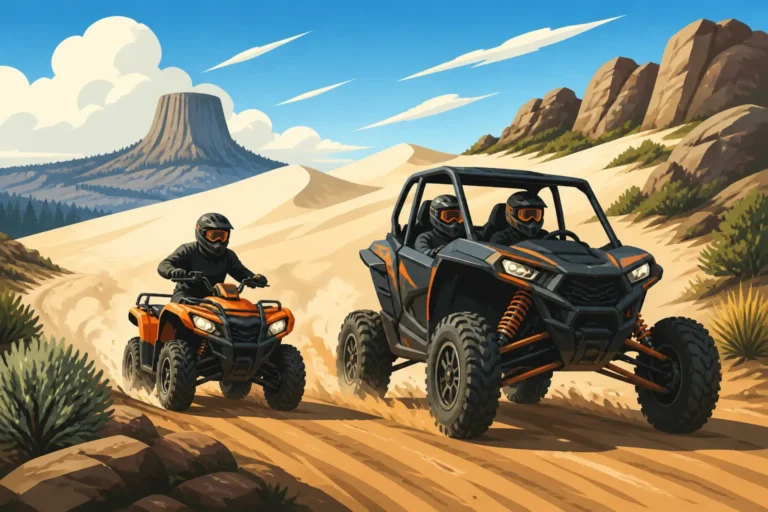
Killpecker is a distinctive option for riders who want a wide-open landscape rather than a forest trail network. The area is reached from the Rock Springs region, and the dunes make sand conditions an important part of the day’s plan. Wind can reshape the surface, and a route that felt straightforward on a previous visit may feel different after weather changes.
For RV owners, the main question is not just whether you can reach the general area, but whether the access road and available staging space suit your entire setup. A motorhome towing a trailer needs more room to turn around than a pickup carrying one ATV. Before committing, check current land-manager information, road conditions, and where overnight stays are allowed. [Riding the Dunes at Killpecker] offers useful trip-planning context, while [Free Camping Below the Dunes] can help you think through the difference between dispersed camping and a developed campground.
Do not assume that a place to camp means a full-service RV site. Remote areas may have limited facilities, no hookups, and little or no cell coverage. Arrive with enough water, fuel, food, and waste-storage capacity for the stay you have planned, and avoid driving a large rig onto soft sand or an unverified route. [Wyoming Dune Riding Areas] is another useful starting point when comparing sand riding with other terrain around the state.
Poison Spider OHV Park outside Casper
Poison Spider OHV Park is a practical choice for riders looking to explore near Casper without planning a long mountain drive. Its location can make it easier to build a shorter trip around town, particularly if you want food, fuel, or lodging nearby. The riding experience is different from a large forest network, so check the area’s route details and vehicle suitability before loading up.
The RV question still deserves a separate check. A riding area may have a parking area without having space for a long RV and trailer, and parking capacity can be affected by busy days or local conditions. Confirm where you are allowed to stage, whether overnight parking is permitted, and whether the route from the main road is suitable for your rig. [Poison Spider's 284 Acres] gives background on the park, and [Poison Spider for an Afternoon] can help you picture a shorter outing.
If your RV is too large for the immediate staging area, consider staying at an established RV park or campground in the Casper area and driving a tow vehicle to the riding location. That approach takes more coordination, but it can be less stressful than attempting a tight turn or parking maneuver at the trailhead.
Medicine Bow and Bighorn forest riding
The Medicine Bow National Forest and Bighorn National Forest offer a very different trip from the dunes or a compact OHV park. Forest riding may involve designated roads and trails, changing elevation, and seasonal closures. A route shown on a map is not automatically open to every machine, so check current travel-management information and signs on the ground. [Riding the Medicine Bow National Forest] and [Riding the Bighorns From Buffalo] provide helpful context for these regions.
RV access can be particularly variable in forest country. A campground may have a limit on site length, a narrow access road, or a turning area that is difficult for a motorhome towing a trailer. Mountain weather and seasonal road conditions can also affect access. If a campsite’s vehicle dimensions or road approach are unclear, call the campground or land manager before setting out rather than trying to work it out at the entrance.
A flexible plan helps here. You might reserve or identify an RV-friendly base near Laramie, Saratoga, Buffalo, or Sheridan, then tow the ATV or UTV to an appropriate staging point. This can mean driving farther each morning, but it gives you a reliable place to park and reduces the chance of taking a large rig onto a narrow forest road.
How to check RV parking and camping before you go
“RV parking” can mean several different things: a day-use lot that fits a camper van, a trailhead with room for a pickup and small trailer, a campground with larger sites, or a dispersed area where overnight camping is allowed. Those are not interchangeable. Confirming the exact arrangement before departure can save you from arriving tired, loaded, and unable to turn around.
Separate trailhead parking from overnight camping
Start by identifying where you plan to ride and where you plan to sleep. A trailhead may be suitable for unloading machines but prohibit overnight camping. A nearby campground may welcome RVs but sit several miles from the riding access point. If you need both, make sure the driving route between them works with your trailer and tow vehicle.
When researching a site, look for details beyond the word “RV.” Check maximum vehicle or site length, road width, turning space, surface type, and whether the information refers to parking, camping, or both. A listing that says RV access does not necessarily mean a long motorhome with a trailer can fit comfortably. If the details are missing, call ahead and describe the full rig, including the tow vehicle and trailer.
Also check the rules for the specific land and site. Public-land camping rules can differ from campground rules, and a map app does not replace posted restrictions. [Camping Near Wyoming Trailheads] can help you compare staging strategies, while [Wyoming Riding Areas With RV Parking] is a useful topic to keep in mind as you narrow down possible bases.
Verify access, season, and route status
A campground or parking area can be open while the route you intend to ride is closed, snowbound, or restricted to certain vehicle types. Forest roads and trails may have seasonal openings, and local conditions can change after snow, rain, fire activity, or maintenance work. Before leaving, check the relevant forest or land-manager map and look for current closure notices.
Maps are best used as planning tools, not guarantees. An app such as onX Offroad can help you review route options and orient yourself, but compare the information with official travel-management maps and signs at the site. Download map areas before entering places with weak reception, and make sure everyone in your group knows which route is the intended one. [Wyoming Trail Maps and MVUMs] explains why map types and designated routes matter.
For a forest trip, confirm both the vehicle-width rules and the route designation. Some trails have limits that may rule out a wider side-by-side, while nearby roads may be open to it. If you are not sure whether your machine fits a route, do not assume that a route suitable for an ATV will also suit a UTV. [Wyoming's 50-Inch Trail Limit] is relevant when choosing trails for a wider machine.
Ask practical questions before arrival
A quick call can answer the questions that are hardest to resolve from a general description. Explain that you are bringing an RV and specify whether you are towing a trailer, how long the whole setup is, and whether you need overnight parking. Ask whether the access road is paved, gravel, narrow, steep, or prone to washboarding, and whether there is a place to turn around if the campground is full.
It is also worth asking what facilities are available and what you need to bring. Some remote riding areas have few services. A site may have a vault toilet but no water, or a place to camp without hookups. Never plan around an assumed dump station, potable water source, or fuel stop; verify those separately. [Wyoming Riding Areas With Toilets] and [Wyoming Riding Areas With No Water] can help you think through comfort and supply needs.
Choosing an RV setup that fits the riding trip
The best base is not always the closest one to the trail. A slightly longer drive from a roomy campground can be a better choice than squeezing into a small, remote staging area. Think about your group, the size of your RV, and how much effort you want to spend moving machines each day.
Use a developed RV park as a reliable base
For large motorhomes, long fifth wheels, or a tow vehicle and trailer combination, an established RV park near a Wyoming town may be the simplest option. Town-based lodging can make fuel, groceries, repairs, and meals easier to manage. You can then drive the smaller tow vehicle and trailer to the riding area rather than bringing the entire rig to the trailhead.
This arrangement is especially useful when you are visiting several riding areas or traveling with people who want a day away from the machines. It also gives you more options if weather closes a route or changes your plans. The tradeoff is additional daily driving and the need to secure machines and gear overnight.
Before booking, ask whether the site can accommodate the full length of your RV and trailer together, or whether you need to disconnect. Check the route into the park, too. A site may have adequate spaces but be difficult to reach with a large rig if the approach includes tight turns or low branches.
Consider dispersed camping only when your rig and the rules allow it
Dispersed camping can offer a quieter, closer-to-nature base, but it requires more self-sufficiency. Sites may be uneven, exposed, or far from services, and not every pullout or open patch of ground is an authorized campsite. Confirm the applicable rules, stay on established access routes, and avoid blocking gates, roads, or other users.
A large RV can be a poor fit for remote dispersed sites even when camping is permitted. Soft ground, narrow roads, limited turnarounds, and weather can quickly turn a convenient-looking spot into a difficult situation. If you are unsure, scout the access in a smaller vehicle first or choose a developed site. Bring the supplies you need and have a backup location in mind.
Use onX Offroad or another mapping tool to understand the area before setting out, but verify camping permissions and closures with the responsible land manager. Map layers can help with orientation; they do not grant permission to camp or ride somewhere. [Wyoming Dispersed Camping for Riders] is a useful related topic when weighing a remote stay against a developed campground.
Plan for the machines as well as the RV
Your parking plan should account for where the ATV or UTV will sit when it is unloaded. Make sure the trailer can be parked without blocking traffic, access gates, or another campsite. If you are hauling more than one machine, allow room to unload safely and keep gear organized without spreading into a travel lane.
Protecting machines from theft and weather is part of the plan, too. Bring appropriate locks, secure loose equipment, and check whether your campground permits machine washing or maintenance. Dust and sand can work into trailers and gear, so keep a place for dirty helmets, boots, and tie-downs rather than tossing everything into the RV living space.
If you are traveling with children or new riders, choose a base that makes it easy to end the riding day before everyone is exhausted. A long ride back to camp after a full day can be tiring, especially when the route is rough or the weather turns. [Wyoming Trails for Beginners] and [Wyoming Riding Areas Good for Kids] can help you match the riding plan to the group.
A practical planning checklist for an RV riding trip
A little preparation makes it easier to enjoy the riding instead of spending the first afternoon searching for a place to park. Build your plan around the actual size of your rig, the machine you are bringing, and the type of terrain you want to ride.
Confirm the basics before departure
Use this checklist as a starting point:
- Choose the riding area and identify the specific route or trail system you want to use.
- Confirm that your ATV or UTV is allowed on the intended route and check any width restrictions.
- Identify a legal place to park and a separate place to camp if the riding area does not allow overnight stays.
- Verify site or parking dimensions for your complete setup, including tow vehicle and trailer.
- Check current road conditions, seasonal openings, weather, and land-manager closures.
- Download maps for offline use and carry the official travel-management information needed for the area.
- Confirm nearby fuel, water, supplies, and waste-disposal options rather than assuming they are available.
- Choose a backup campground or staging location in case the first choice is full or inaccessible.
For the riding portion, make sure each machine has the required permit for the area where you plan to ride. Wyoming’s permit requirements are separate from your home-state registration or sticker. [Wyoming ORV Permits Explained] and [Wyoming Rules for Riding Federal Land] are useful starting points for understanding what to check.
Match the destination to the trip you actually want
If you want sand and open space, consider the Rock Springs area and plan carefully for wind, sand, and remote conditions. If you want a shorter outing close to a city, look at Poison Spider near Casper and verify staging arrangements. If your priority is forest roads and cooler mountain air, compare Medicine Bow and Bighorn routes while paying close attention to seasonal access and RV-friendly camping.
onX Offroad can help you organize possible routes and get a sense of the surrounding terrain, particularly when you are comparing alternatives. Use it alongside official maps and local information, and save your plan before you leave service. For a group trip, share the route and the campground address with everyone, agree on a turnaround time, and decide what to do if the group gets separated.
The right Wyoming riding trip is the one where the RV can get in and out safely, the machines have legal access to suitable routes, and everyone has a realistic plan for water, fuel, weather, and overnight stays. Check those details before you load the trailer, and you will have much less to sort out after reaching the trailhead.
Disclaimer
This article is for general informational purposes only and does not constitute professional advice. Laws, prices and regulations vary by location and change over time. Consult a qualified professional for guidance on your specific situation.