Wyoming Rules for Riding a Wildlife Habitat Area
Wyoming wildlife habitat areas can look like promising places to explore by ATV or UTV, but public access does not mean every road or piece of ground is open to motorized riding. The rules vary by property and season. Before unloading, confirm that motorized use is allowed, identify the routes you may ride, and check whether your machine needs a Wyoming ORV permit.
The short answer: each wildlife habitat area has its own rules
Wyoming Game and Fish Department properties managed for wildlife habitat and public use are not all governed by one statewide ATV rule. Access conditions can differ from one property to another, and they may change with wildlife needs, land management, or seasonal restrictions. A road that is open on one area is not proof that a nearby road—or the same road at another time—is open to motorized vehicles.
The key distinction is between being allowed to enter an area and being allowed to ride an ATV or UTV there. A property may permit public recreation while limiting motorized travel to specific roads, restricting it to certain users, or prohibiting it altogether. Walking, hunting, or fishing access does not automatically authorize ATV use.
Even where motorized vehicles are allowed, that permission may apply only to roads specifically open to the public. Riding across a field, around a locked gate, or along an unmarked two-track can still violate the property’s rules. Follow posted signs and any current map or written directions for the area.
A Wyoming ORV permit is a separate requirement from permission to use a particular property. The decal does not open a closed route, grant permission to ride cross-country, or replace an area-specific access rule. Likewise, a permit or registration from another state should not be treated as authorization to ride in Wyoming. For the broader permit rules, see Wyoming ORV Permit Explained and Wyoming ORV Reciprocity Rules.
Check the property, route, and season before unloading
Plan around the specific wildlife habitat area you want to visit rather than assuming all properties share the same access rules. Start with current information from the Wyoming Game and Fish Department, then compare it with signs at the entrance and along the route. If the information is unclear or conflicts, contact the agency responsible for the property before riding.
Confirm that ATVs or UTVs are allowed
Look for direct information about motorized vehicles, not just a general statement that the area is open to the public. Check whether the property allows ATVs, UTVs, or other off-highway vehicles, and whether any restrictions apply to particular vehicle types or uses.
A map that shows a road does not necessarily show that it is open to motorized public travel. Some mapped lines may represent administrative access, closed routes, or roads with restrictions. If the official material does not clearly establish that you may ride the route, don’t assume it is open. The same caution applies to roads that appear on a phone mapping app or satellite image. Wyoming Rules for Riding a Designated Route explains why route designation matters.
Check seasonal and temporary closures
Wildlife management may call for restrictions at certain times of year. A seasonal closure can affect all public access, motorized travel only, or a particular section of an area. Temporary closures may also be posted because of habitat conditions, maintenance, fire concerns, or other management needs.
Do not rely on an old trip report or a map saved from a previous visit. Check for current notices before setting out, and look for signs when you arrive. If a sign says a route is closed, don’t ride it because a map appears to show it as open. When maps and signs seem to disagree, treat the sign as a reason to stop and confirm the rule with the managing agency. Wyoming Wildlife Closures That Run Right Through Spring covers why wildlife-related restrictions can affect access even when riding conditions look good.
Identify who manages the land and route
The wildlife habitat designation alone may not tell you who manages every adjoining road. A route might cross property boundaries or connect with land managed by another agency. The access rules can change at a boundary, gate, or signed junction.
Check a management map or contact the relevant land manager if your planned route leaves the habitat area or joins a road beyond it. A Wyoming ORV decal does not authorize travel across private land, and permission to ride one segment does not necessarily carry over to another. If the route crosses private property, follow the landowner’s access rules; see Wyoming Rules for Riding Private Land.
Verify the decal requirement separately
Whether your machine needs a Wyoming ORV permit depends on the applicable rules and the kind of land where it will be operated. Check the current permit requirements for the machine and location rather than assuming that a vehicle registration, a plate, or an out-of-state sticker is enough. If you are visiting from another state, see Wyoming ORV Permit for a Visiting Rider.
The permit question and the access question are separate:
| Question | What to verify |
|---|---|
| May I enter this wildlife habitat area? | Public access conditions for the specific property |
| May I ride an ATV or UTV there? | Property rules for motorized vehicles |
| Which route can I use? | Current map, signs, and route designation |
| Is riding allowed today? | Seasonal or temporary closures |
| Does my machine need a Wyoming decal? | Current ORV permit rules and any applicable exceptions |
| Can I continue beyond the area? | Rules and ownership for each adjoining road or parcel |
Ride only where the property allows motorized travel
Once you arrive, use the entrance information and on-the-ground signs to confirm your route. Stay on the roads or trails specifically open to motorized vehicles. Do not use a road merely because it is visible, has tire tracks, or appears to have been used by other riders.
Avoid riding around a closure or gate to continue a route. A blocked road may be closed for wildlife management or another reason even if it looks passable. Going around the barrier can also create new damage or disturb areas the closure is intended to protect.
Cross-country travel is not a reasonable fallback when a road is closed or a route is unclear. Keep your machine on an authorized route, and don’t widen a track to pass another vehicle or go around a muddy section. If the designated route is impassable, turn back or contact the property manager for guidance.
Use particular care where a route passes through habitat, wetlands, stream edges, or areas with soft soil. Staying on established, authorized routes helps avoid damage and reduces disturbance to wildlife. It also makes it easier to show that you followed the route plan if a land manager asks where you have ridden.
Riding near livestock can create a separate problem on properties that include grazing land or connect with ranch roads. Slow down around animals, leave gates as directed, and don’t assume a grazing road is open for unrestricted public travel. The related rules are covered in Wyoming Rules for Riding Near Livestock.
A practical pre-ride check
A short check before you leave home can prevent a wasted trip or an avoidable citation. Use this sequence whenever you plan to ride on a wildlife habitat area.
- Name the exact property. Search by the specific area name, not just “wildlife habitat area.” Confirm that the information applies to your destination.
- Find the current access rules. Use the managing agency’s latest property information, map, or notice. Look specifically for motorized-vehicle restrictions.
- Mark only confirmed routes. Identify the roads that are explicitly open to the type of machine you plan to ride. Don’t treat a line on a general map as proof of access.
- Check dates and closures. Look for seasonal limits, temporary notices, fire restrictions, and other conditions that could affect the trip.
- Confirm the permit requirement. Check whether your ATV or UTV needs a Wyoming ORV permit for the land and use involved. A home-state decal does not, by itself, establish Wyoming authorization.
- Check boundary changes. If the route leaves the habitat area, verify the rules for every adjoining property and road.
- Review signs at the site. Stop at the entrance and read posted conditions before riding. Continue to obey signs encountered along the route.
- Have a backup plan. If a route is closed or the rules are uncertain, use another confirmed riding area rather than testing the restriction.
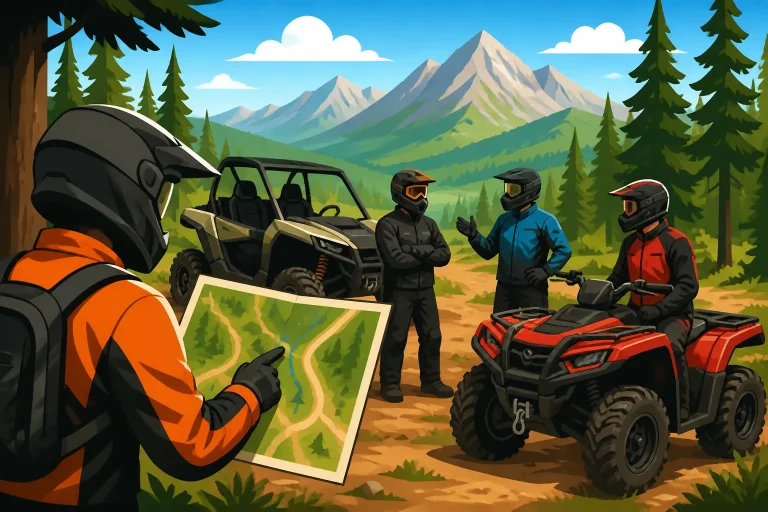
Keep a map or saved official information available, especially if cell service is limited. A map is useful for navigation, but it is not a substitute for route authorization. For help interpreting land-management maps, see Wyoming Trail Maps and MVUMs.
Common situations that cause confusion
The area is open to the public, so the ATV must be allowed. Not necessarily. Public access can be limited to certain activities or routes. Confirm motorized use specifically.
The road is on my map. A mapped road may be closed, restricted, private, or intended for management access. Confirm that the route is currently open to public motorized travel.
There are tracks leading off the road. Tire tracks are not permission. Other riders may have gone off-route, or the tracks may have been made by authorized staff or land users.
I have a Wyoming decal. The decal addresses the permit requirement where it applies. It does not override a property closure or make a restricted route legal to ride.
My machine is registered in another state. Do not assume that out-of-state registration or a home-state sticker provides reciprocity for Wyoming riding. Check Wyoming’s current permit requirements before the trip.
A gate is open. An open gate does not necessarily mean a road is open to public ATV use. Read nearby signs and verify access. Close gates as directed so livestock cannot escape.
The map and the sign conflict. Don’t ride the disputed route until you have confirmed its status with the managing agency. A map may be outdated, or a sign may reflect a newer restriction.
The safest approach is to treat each wildlife habitat area as its own set of access rules: confirm permission to ride, stay on confirmed routes, check current closures, and handle the Wyoming permit requirement separately. If reliable information is not available, choose a route or riding area with clearly stated motorized access.
Disclaimer
This article is for general informational purposes only and does not constitute professional advice. Laws, prices and regulations vary by location and change over time. Consult a qualified professional for guidance on your specific situation.