Wyoming Rules for Riding in a National Park
Wyoming’s national parks can look like ideal ATV and UTV country, but their roads and trails follow different rules from nearby public riding areas. The key point: a Wyoming ORV permit does not authorize off-road riding inside a national park. Know where park boundaries begin, and confirm whether your particular machine can use any park road before you go.
The basic rule for ATVs and UTVs in national parks
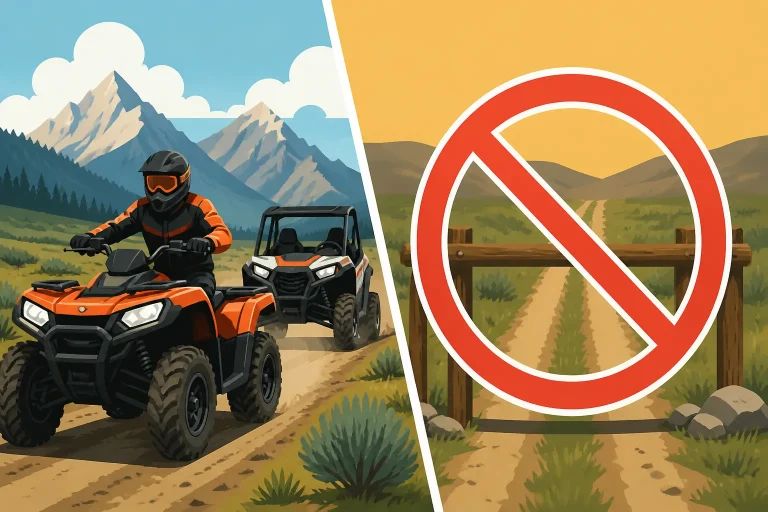
National parks are not general-purpose off-highway vehicle areas. Motorized travel is limited to routes open to motor vehicles, and riding off those routes is generally prohibited. A trail that looks suitable for an ATV is not open just because it is unpaved or appears on a map. The park’s signs, rules, and current route information control.
For a typical recreational ATV or UTV, the practical answer is to plan on no trail riding or cross-country riding inside a national park. Do not use a shoulder, two-track, maintenance road, or parking area as an extension of an ATV route unless park staff specifically confirm that your vehicle and that route are allowed.
Public park roads are a separate question. A road open to cars is not automatically open to every type of motorized machine. A Wyoming permit, a plate, or equipment that makes a vehicle road-legal in Wyoming does not guarantee that the National Park Service will allow that vehicle on a particular park road. Vehicle classification and park-specific rules matter. Before taking an ATV or UTV to a park entrance, ask the park whether that exact machine may be operated on the roads you intend to use.
| Situation | What to assume |
|---|---|
| Riding off a road or designated motor route | Not allowed unless the park explicitly authorizes it |
| Riding a standard recreational ATV or UTV | Do not assume it is permitted, even on a park road |
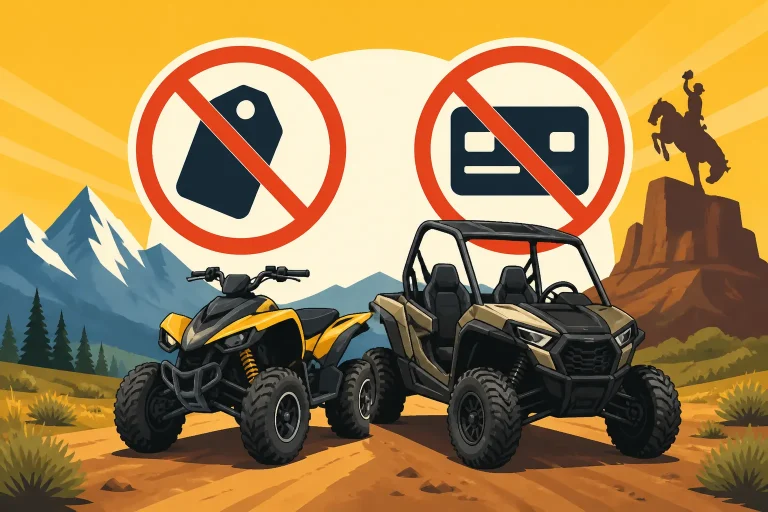
| Using a Wyoming ORV decal as park authorization | It does not grant access |
| Driving a vehicle that is street-legal in Wyoming | Confirm the park accepts that vehicle on the intended road |
| Riding near a park boundary | Check which land manager controls the route |
This distinction can be confusing because Wyoming has riding opportunities on other kinds of public land. National forests and Bureau of Land Management lands may have designated motor routes, but those routes have their own maps, closures, and vehicle limits. A route being open on nearby federal land does not mean it continues into a national park. See Wyoming Rules for Riding Federal Land, Wyoming Rules for Riding a National Forest, and Wyoming Rules for Riding BLM Land for how those areas differ.
What the rule means in Wyoming’s national parks
Yellowstone and Grand Teton are the Wyoming parks most riders are likely to encounter. In both, treat the park as a destination for travel on approved roads and for nonmotorized activities, not as an ATV trail network. Do not plan a recreational ride on park trails or assume that a route outside the boundary carries through the park.
A machine’s status outside the park does not settle the question inside it. For example, a rider may have a valid Wyoming permit for a machine used on an eligible route elsewhere. That does not make the machine eligible for park roads, and it does not create an exception to park restrictions. Likewise, a county road, forest road, or route marked for motorized travel on a nearby map may change status at the park boundary.
If you are considering taking a road-capable side-by-side into a park, verify the details before you travel. Give park staff the vehicle’s type and configuration, and ask about the specific roads you want to use. A general answer about “street-legal vehicles” may not address whether an off-highway model, an ATV, or a particular UTV is allowed. Do not rely on the fact that the machine has a plate or can be insured.
It also helps to separate getting to the park from riding within it. A trailer can carry your ATV or UTV to a legal staging area outside the boundary, but you must still confirm that the staging location allows parking and that the route you choose is open to your machine. Do not unload and ride from a roadside pullout or trailhead unless the land manager allows it.
Park boundaries can be hard to spot on the ground. Check an official park map and the map for the adjoining land manager, then look for signs where the route changes jurisdiction. If signs and maps appear to conflict, stop and ask before continuing. Wyoming’s Enrolled Roads and Trails explains why enrollment matters on Wyoming routes; a route’s status is not transferable to land managed under a different system.
Why a Wyoming ORV permit does not provide park access
Wyoming’s ORV permit is not a general license to ride anywhere in the state. It applies to eligible use under Wyoming’s permit system, not to every road, trail, or public land parcel. National parks have their own rules and route controls, so a Wyoming decal cannot override them.
The same is true for a permit or registration from another state. Reciprocity is not a substitute for checking the rules of the land you plan to enter. A visitor should not assume that a home-state sticker, plate, or registration authorizes ATV use in a Wyoming national park. Wyoming ORV Permit for Nonresidents and Wyoming ORV Reciprocity Rules cover the state permit question, but park access remains a separate issue.
It is useful to think of three separate checks:
- Does the machine need a Wyoming ORV permit for the route? This depends on the type of land and the route.
- Is the route open to motorized travel? The land manager’s current maps, signs, and closures determine that.
- Is your particular machine allowed on that route? Width, vehicle class, equipment, and local restrictions may matter.
Passing one check does not automatically pass the others. A decal answers neither whether a road is open nor whether a national park allows your vehicle. For the distinction between a riding permit and permission to use a public road, see Why an ORV Permit Is Not a Road License.
Park admission is another separate matter. If a park charges an entrance fee, that fee is not an ORV permit, and paying it does not authorize off-road travel. Check the park’s current entry and vehicle information directly before arrival.
How to plan a trip without an access surprise
A little route checking can prevent a costly mistake, especially when a trip combines a national park visit with ATV riding on nearby public land.
- Mark the park boundary on your route plan. Do not rely only on a phone navigation app or a trail line downloaded from an unofficial source.
- Identify who manages each segment. A route may cross from a national park to a national forest, BLM land, or private property. Rules can change at each boundary.
- Check the official map and current closures. Confirm that the exact route is open for motorized use and that your machine meets any width or vehicle limits.
- Ask the park about the vehicle, not just the road. If you hope to use a road in an ATV or UTV, describe the machine and ask whether that type is permitted. Get clarity before hauling it to the entrance.
- Choose a legal riding area outside the park if needed. Use a designated staging area and make sure the route from it does not cross into restricted land.
- Recheck before riding. Seasonal closures, construction, weather, or wildlife protections can change access. Follow posted signs even when an older map suggests the route is open.
If you discover that a planned ATV route enters a national park, turn around at the boundary rather than trying to find a way around a closure. Riding off-route can harm sensitive ground and can lead to enforcement action. A route that is closed to motor vehicles is not made legal by riding slowly, having a permit, or traveling only a short distance.
The simplest planning rule is to treat national parks as no-go areas for recreational ATV and UTV trail riding unless the park confirms an exception for your exact vehicle and route. Then plan the motorized portion of the trip on land with routes expressly open to your machine. Where to Ride an ATV in Wyoming can help you look for other riding options, but always confirm current access with the land manager.
Disclaimer
This article is for general informational purposes only and does not constitute professional advice. Laws, prices and regulations vary by location and change over time. Consult a qualified professional for guidance on your specific situation.