What a BLM Ranger Can Write You Up For
A BLM ranger may stop an ATV or UTV ride for more than a missing permit. On Wyoming public land, route restrictions, temporary closures, fire rules and damage to soil or vegetation can all matter. The key is knowing which routes are open to your machine and what the rules require before you unload. Here’s what may lead to a citation—and what to do if you receive one.
The route you ride can be the problem
BLM land is not open to unrestricted off-road travel. A road or track’s appearance does not tell you whether motorized use is allowed. Routes may be open to particular vehicle types, closed seasonally, limited by width, or reserved for specific uses. Driving around a barrier or leaving an approved route to explore can expose you to enforcement even when you are still on public land.
Before setting out, check the current BLM travel-management information for the area and look for signs at the trailhead and along the route. Wyoming includes both large expanses of BLM land and many different local travel plans; a rule that applies in one area may not apply in another. A route shown on an old map, a downloaded track or a riding app is not necessarily open today.
A map and a sign can appear to disagree. Treat that as a reason to stop and confirm the route’s status, not as permission to carry on. A sign may reflect a temporary closure or a newer restriction, while a map may be out of date or too general to show every limitation. For more on checking route information, see Which Travel Map You Must Carry in Wyoming, When a Map Marks a Route Open and When a Sign on the Ground Says Closed.
| Situation | Why it can lead to enforcement | What to do |
|---|---|---|
| Riding beyond a route’s end | The continuation may not be open to motor vehicles | Turn around at the signed or mapped endpoint |
| Taking a shortcut across open ground | Cross-country travel may be prohibited in the area | Stay on a route confirmed as open |
| Driving around a closure sign or barrier | The closure applies even if the ground looks passable | Stop and find an open alternative |
| Using a route closed for the season | A road’s status can change with conditions or resource needs | Check current notices before the ride |
| Riding a machine too wide for a restricted trail | Some trails have vehicle-width limits | Confirm the route’s limit against your machine |
A well-used two-track is not automatically a public route. It could be an unauthorized track, a private road, a route closed to motorized use, or a route intended for a different class of vehicle. Do not assume that tire marks or another rider’s presence establish legal access.
The same caution applies to route boundaries. A trail can end at a fence, a private parcel, a grazing area or a land-management boundary. Public access to one side does not automatically give you permission to cross the other. Wyoming riders also need to distinguish BLM land from nearby private property and state trust land, which can have separate access rules. See Wyoming Rules for Crossing Private Ground and Wyoming Trust Land and Its Own Permit before planning a route that crosses different land types.
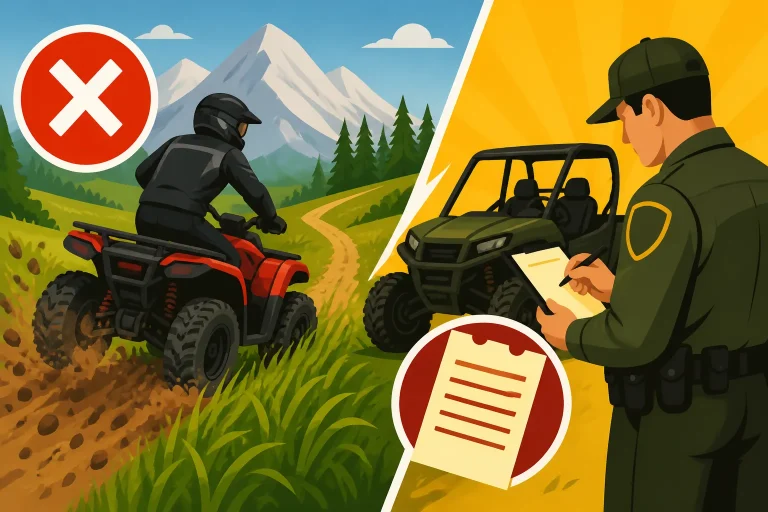
A ranger may issue a citation for riding a closed route, leaving an authorized route where cross-country travel is prohibited, or ignoring a temporary restriction. In addition to a citation, unauthorized travel can contribute to ruts, erosion and damage to plants, and may prompt the land manager to close or further restrict an area. Wyoming Penalties for Leaving a Route explains why staying on the approved route matters.
Permits, decals and machine requirements
Wyoming’s off-road permit system can be confusing because a state decal is not a blanket license to ride anywhere. It does not make a closed route legal, replace a land manager’s travel rules or authorize riding on private property. It also does not function as a road registration for every situation.
Check whether the specific BLM route or riding area requires a Wyoming ORV permit, and make sure the decal is valid and attached as directed. Requirements can depend on where you are riding and how the area is designated. Do not rely on a permit from another state as a substitute: Wyoming’s reciprocity rules are a separate issue from route access. Wyoming Rules for Riding BLM Land, Wyoming ORV Reciprocity Rules and Why Your Home State Sticker Means Nothing in Wyoming offer useful context.
If you are not sure whether the decal applies to a route, confirm the requirement with the land manager or the Wyoming permit program before riding. Carry the receipt or other proof of purchase if available, but do not assume that a phone image alone will satisfy every inspection. The decal itself may need to be displayed on the machine. Wyoming ORV Decal Placement covers placement, while Does a Permit Receipt on Your Phone Count? addresses what to keep with you.
A BLM ranger may check that a machine meets conditions tied to public-land use. Depending on the area and applicable rules, these can include requirements for a spark arrester or a muffler. A machine that is excessively loud or has equipment that does not meet a stated requirement can attract attention, even if its rider has the right permit and stays on an open route. Requirements may differ by machine and location, so verify the rule for your riding area rather than assuming that a part suitable for one trip is suitable everywhere. See Wyoming Spark Arrester Requirement and Wyoming Sound Limits on Public Land.
A permit also does not make a non-road-legal machine legal on a public road. Road access depends on the road’s designation and the machine’s legal status, not simply on having an off-road decal. If your ride plan uses an enrolled road or involves connecting between routes, check the applicable rules before treating the route like a regular public road. Wyoming’s Enrolled Roads and Trails and Why an ORV Permit Is Not a Road License explain that distinction.
The practical takeaway is to check three things separately:
- The machine: Is it equipped and configured to meet the requirements that apply to the area?
- The permit: Does the route or riding area require a Wyoming ORV decal, and is yours displayed correctly?
- The route: Is this specific road or trail open to your type of machine on the day you ride?
One answer does not settle the other two. A valid decal cannot cure a route violation, and an open route does not necessarily mean every machine or permit situation is acceptable.
Closures, fire rules and damage to public land
Route access can change because of fire danger, weather, wildlife needs, road conditions or resource protection. A route that was open on your last trip may be closed now. Temporary signs, gates, posted notices and current land-manager updates should take priority over memory or an old route file.
Fire restrictions are a common reason to check conditions close to departure. A ranger may enforce restrictions that apply to the area and activity, including rules affecting campfires or other sources of ignition. Riders should not assume that a restriction applies only to people camping. A hot machine parked in dry vegetation, careless handling of fuel, or ignoring a posted fire restriction can create serious problems. Check current local notices and follow signs at the site. For related planning, see Wyoming Rules for Riding During Fire Season and Wyoming Stage Restrictions in a Dry Summer.
Damage to land or facilities can also lead to enforcement. Examples include widening a trail by riding around a muddy section, driving through vegetation to avoid an obstacle, creating a new track, damaging a gate or sign, or leaving trash behind. A short detour may seem harmless, but repeated detours create wider scars and make it harder for managers to keep routes open. If a section is too wet, blocked or difficult to pass, turn back instead of making a new path around it.
Riders should also respect gates and livestock. A gate may control access to a working range or protect animals from moving between pastures. Follow posted instructions, and close a gate if it was closed when you arrived. Do not treat a grazing allotment as an invitation to roam off-route. Which Gates You Are Required to Close and Wyoming Rules for Riding Near Cattle cover these common situations.
Fire restrictions and closures may be posted at a trailhead, on a local notice, or at another access point. A sign farther along the route still matters. If you encounter a closure during a ride, do not go around it simply because you are already on the route or have traveled a long way. Turn back and use a route confirmed as open.
Riding with a group does not change the rules. Each operator is responsible for following route restrictions, and a group leader should make sure everyone understands the plan. Avoid letting a line of machines continue through a closure just because the first rider did. If the group is unsure whether a route is open, stop in a safe place and confirm before proceeding.
What to do during a stop or after a citation
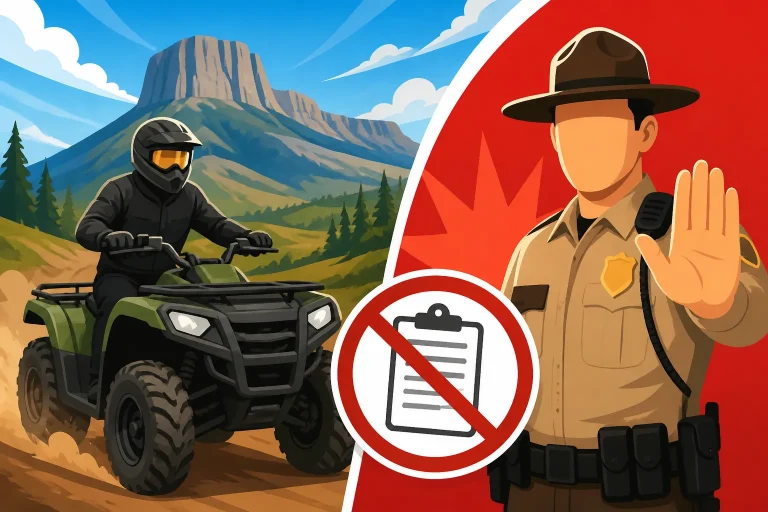
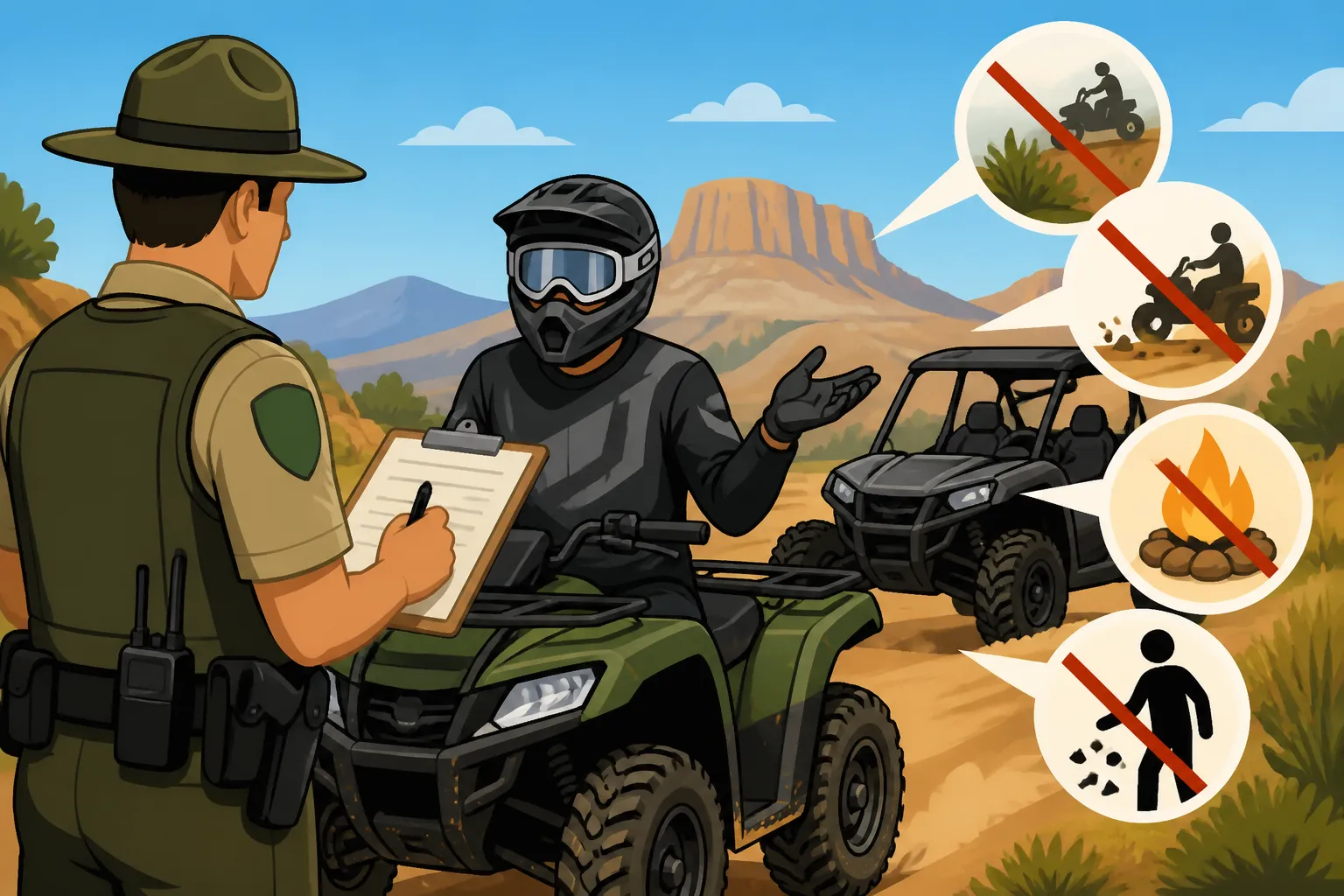
If a BLM ranger signals you to stop, pull over safely, switch off the machine and follow lawful instructions. Keep your hands visible and avoid reaching suddenly into a pack or storage compartment. The ranger may ask where you have been, request identification or ask to see permit information. Stay calm and answer clearly. If you do not know the answer to a question, say so rather than guessing.
A ranger may explain the concern, issue a warning or write a citation, depending on the circumstances and the applicable rules. Do not argue beside the trail or try to settle the matter by riding away. If you think the route was open or that a rule does not apply, you can preserve that point for the process described on the citation.
Read the notice carefully before you leave. It should explain what rule or violation is alleged and provide instructions for responding. Deadlines and procedures depend on the kind of notice, so use the instructions printed on it rather than relying on a general assumption about how long you have. Keep the citation, any paperwork you receive and relevant records together.
If you plan to contest the citation, write down what happened while details are fresh. Record the date, approximate location, route name or nearby landmark, the signs you saw, and the direction you were traveling. Save current maps or route information that may help explain what you understood at the time. Photos can help document signs, barriers or the condition of the route, but take them only when it is safe and lawful to do so. Do not alter or delete relevant material.
If you believe the ranger misunderstood the route or your actions, use the response or hearing process specified on the notice. A disagreement with an officer at the scene does not replace that process. If the alleged violation could have significant consequences, consider seeking legal advice from a qualified professional familiar with federal land matters.
For future rides, use the stop as a reason to improve your pre-trip checks. Confirm the route’s current status with the responsible BLM office, check for temporary restrictions, inspect the machine’s permit and equipment, and agree on a turnaround plan with your group. For a broader view of land access and route use, see Wyoming Rules for Riding a Designated Route and What a BLM Ranger Can Write You Up For is not a substitute for checking the rules that apply at the specific riding area.
Disclaimer
This article is for general informational purposes only and does not constitute professional advice. Laws, prices and regulations vary by location and change over time. Consult a qualified professional for guidance on your specific situation.