Snow in September at Elevation
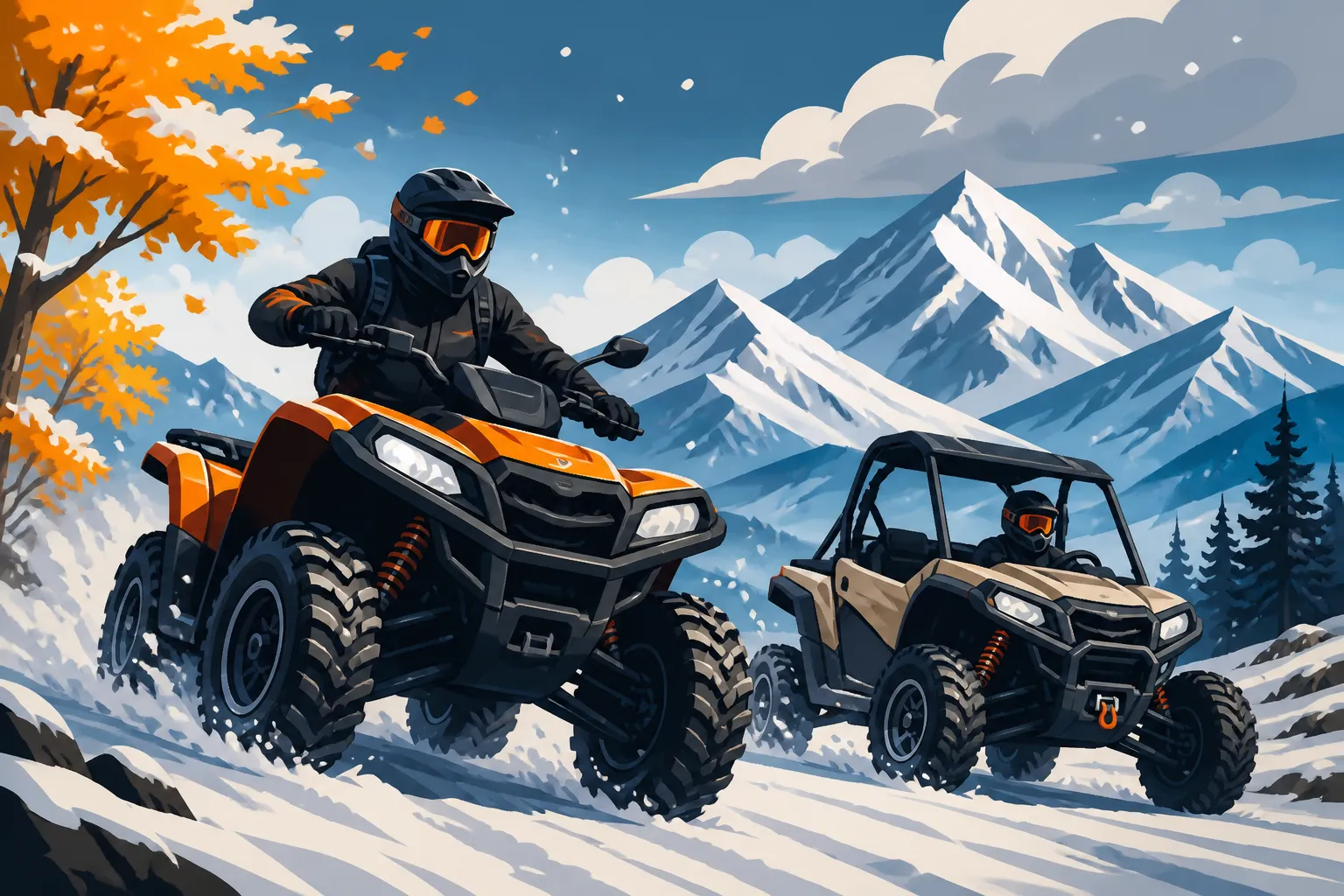
A September ATV or UTV ride in Wyoming can start under clear skies and end at a snow-covered pass. At elevation, a light overnight snowfall may hide ice, soften into mud, or deepen into a drift that blocks your route. This guide explains how to check conditions, prepare your machine and crew, and decide when turning around is the safer call.
Why September snow changes a Wyoming ride
Elevation makes conditions unpredictable
September weather can feel like late summer in a valley and early winter on a high ridge. A trail that looks dry near town may climb into colder air, shaded timber, or an exposed pass where snow lingers. Even within one riding area, sunny slopes can be bare while north-facing sections hold snow and ice.
That contrast matters because the trail surface can change quickly. On a dry stretch, your tires may grip normally; around the next bend, packed snow or wet leaves may cover rocks, ruts, and drainage channels. A small amount of snow can make a familiar route feel unfamiliar, especially when it hides the edge of a trail or makes a steep descent slick.
Elevation also affects how quickly you get cold and tired. You may be working harder than expected while breathing thinner air, then stop in wind or wet clothing and cool down fast. Before heading out, read Wyoming Riding at Altitude and plan for the cold, not just the forecast for the nearest town.
Snow can create more than a traction problem
Snow on the trail is not automatically a reason to continue or to turn around. The important questions are how deep it is, what lies beneath it, whether you can see the route, and whether your machine can safely travel over it. A thin dusting over firm ground may be manageable for an experienced rider with suitable tires. Snow covering rocks, ruts, or a drop-off is a different situation.
The hidden surface is often the real hazard. Meltwater can refreeze overnight, creating a slick patch beneath fresh snow. A thaw can turn the same trail into sticky mud, where tires lose steering and braking control. In a shaded hollow, a few inches of snow may conceal a rut deep enough to jolt or tip a machine.
Snowdrifts are especially deceptive on open, windy roads. They can build across a route even when nearby ground looks clear. If you encounter a drift, do not assume it is shallow just because its surface looks smooth. Snowdrifts on a High Forest Road offers a useful reminder that a blocked road can be a serious obstacle, not a minor inconvenience.
Trail access can change with weather and land management
A route being shown on a map does not guarantee it is open or passable that day. Land managers may close roads or trails for seasonal conditions, resource protection, or safety. A sign at the trail entrance may also reflect a more recent change than an older map.
Check official land-manager information and posted notices before you leave, then look again at the trailhead. If the route is marked closed, do not ride around a closure or use a nearby track as a workaround. Wyoming Trail Closures to Check First and Wyoming Trails Closed by Snow can help you think through why conditions and access need to be checked close to the ride.
If you use onX Offroad to review route options, treat it as a planning aid rather than proof that a trail is open. Confirm access with the relevant land manager, compare the map with current signs, and be ready to change plans. A mapped route may show where a road or trail runs without telling you whether snow has made it unsafe today.
How to check conditions before you leave
Look beyond the town forecast
A forecast for a nearby community does not describe every ridge, forest road, or high-elevation trail. Check weather for the general riding area and pay attention to overnight lows, wind, precipitation, and any change in conditions expected during your trip. Snow can fall at elevation while lower ground receives rain—or little precipitation at all.
Think about the timing of your ride, too. A shaded section may remain icy in the morning and soften later, while a sunny slope can become wet and muddy as the day warms. Afternoon storms can bring a sudden change in visibility and temperature. For a broader look at how quickly high-country weather can shift, see Afternoon Thunderstorms in the High Country.
Recent reports can be useful, but do not treat a rider’s experience on one route as a guarantee for another. Snowfall, wind, sunlight, and elevation vary over short distances. A report that says a road was clear last weekend may not reflect conditions after a new storm or a freeze-thaw cycle.
Check maps, closures, and route alternatives
Before loading the machine, identify the route you intend to ride, possible turnarounds, and a lower-elevation alternative. Check whether the route is designated for your type and width of machine, and confirm that it is open to motorized use. In Wyoming, a road or trail’s appearance on a map does not by itself mean every vehicle may use it.
A tool such as onX Offroad can help you review route layouts and keep track of your planned ride, but compare that information with the current travel-management map and land-manager notices. Wyoming Trail Maps and MVUMs explains why the correct map matters. Carry an offline option or a paper map as well; cell service can disappear well before you reach a remote riding area.
Use this simple comparison when deciding how much uncertainty your group can accept:
| Condition | What it may mean for the ride | Sensible response |
|---|---|---|
| Clear trail and mild forecast | Lower risk, though conditions can still change | Ride within your group’s skill and machine limits |
| Light snow over a visible, firm surface | Traction may be reduced, especially in shade | Slow down, increase following distance, and reassess often |
| Snow hiding ruts, rocks, or trail edges | Obstacles and drop-offs may be difficult to judge | Turn around unless the route can be safely assessed |
| Deep drift or blocked route | A machine may become stuck or unable to turn safely | Do not push through blindly; backtrack if it is safe |
| Ice, heavy wet snow, or worsening weather | Braking, steering, and visibility may deteriorate | End the ride or use a safer route back |
Make a plan that still works if you turn back
A good plan includes more than a destination. Tell someone where you expect to ride and when you expect to return. Agree with your group that anyone can call for a turnaround without being pressured to continue. Decide in advance which junctions or trail conditions will trigger a change of plan.
Estimate fuel range conservatively. Cold, climbing, soft ground, and repeated efforts to move through snow can use more fuel than an easy ride on dry, level terrain. Keep enough reserve for a detour or a slow return, and avoid building a plan that depends on reaching the far end of a route.
If you record your planned route in onX Offroad, share the plan with your group and keep another way to navigate if your phone battery runs down or the screen becomes difficult to use in cold weather. The app can support preparation; it cannot remove the need to judge the conditions in front of you.
Preparing riders and machines for cold conditions
Dress for wet weather and a long stop
Wear layers that can handle wind and moisture. A warm base layer, insulating middle layer, and wind-resistant outer layer are more useful than relying on one bulky garment. Gloves that are comfortable on the controls matter, but bring a dry backup pair if you have room. Add eye protection that works in wind and light snow.
Pack clothing for the possibility that you will be stopped longer than expected. A machine that needs attention, a blocked route, or a slower rider can turn a short pause into a cold wait. Carry water, food, a basic first-aid kit, and a way to contact help that does not depend entirely on mobile coverage.
Wet clothing and wind can make a rider dangerously cold even when the calendar still says summer. Learn the warning signs and sensible prevention steps in Hypothermia on a Summer Ride. If someone is shivering hard, confused, unusually clumsy, or getting very drowsy, treat the situation seriously and focus on getting them warm and safe.
Inspect the machine for slippery, rough conditions
Check tire condition, brakes, throttle response, lights, and steering before leaving. Snow and mud can pack around components, while cold can make small problems more noticeable. Carry tools suited to your machine and the repairs you are realistically able to handle. Do not depend on a quick roadside fix for a serious mechanical issue far from assistance.
Keep your cargo secure and balanced. Loose gear can shift when a machine climbs, drops into a rut, or brakes on a slippery descent. If you use a winch or recovery equipment, make sure you know how it operates and that everyone in the group understands basic safety around it. Recovery attempts on snow-covered slopes can create additional risks, so avoid pulling a machine in a way that could drag it toward a drop-off or into unstable ground.
Ride slowly enough to stop within the distance you can see. Leave extra room between machines, because the rider in front may brake suddenly or lose control on hidden ice. Avoid sharp steering and abrupt throttle or brake inputs when traction is uncertain. If your machine starts sliding, fighting it with sudden movements can make the situation worse.
Match the ride to the least experienced person
A route that feels manageable to a confident driver may be stressful for a newer rider or a passenger. Before the trip, talk honestly about experience, cold tolerance, and comfort with changing plans. Make sure each person knows how to stop, communicate, and regroup.
Keep the group together without crowding. Choose a pace that allows the least experienced rider to maintain control, and stop at safe locations rather than waiting on a narrow slope or exposed section. If one person is uncomfortable with the surface or visibility, the group should take that seriously. It is better to shorten a ride than turn a small concern into a recovery problem.
For a family or mixed-skill group, set a conservative turnaround point before the ride begins. Explain that turning around is part of the plan, not a failure. That small conversation can prevent the familiar pressure to “just see what’s around the next bend” when the weather or trail has already deteriorated.
When to turn around or choose another ride
Treat poor visibility and hidden terrain as hard warnings
Turn around if snow makes it difficult to see the trail edges, identify obstacles, or judge the slope. Do the same if you find ice on a descent, a drift you cannot safely assess, or wet snow that is accumulating faster than expected. A route that looks passable from the machine may conceal a soft shoulder or a deep rut just beyond the visible track.
Do not ride through a closure, bypass a barrier, or continue onto a route because the group has already invested time getting there. The time spent driving to a trailhead is not a reason to accept a hazard. If backing up is unsafe, stop in a stable place, regroup, and work out the safest way back rather than making a rushed maneuver.
Sometimes the best choice is to ride a lower route or end the day. Wyoming Riding in Late Autumn offers additional context for adjusting expectations as the season changes. You can also check whether another designated area has clearer conditions, but verify that alternative before moving the group.
Watch riders, not just the snow
A trail may look manageable while a rider is already getting cold, fatigued, or anxious. Watch for slower reactions, poor coordination, repeated mistakes, and an inability to stay warm. Those signs can matter more than whether the snow itself seems deep.
Pause in a sheltered, safe place and check in with everyone. Offer dry layers, food, and water, and make the decision together. If a rider is chilled or tired, continuing farther from the trailhead can make the eventual return harder. A shorter route is the better choice when the group’s condition is slipping.
Keep the decision practical: Can everyone ride back safely? Can the machine maintain traction on the route ahead? Is visibility still adequate? Is the weather expected to worsen? If you cannot answer those questions confidently, do not continue farther into the high country.
Leave room in the trip for a change of plan
September riding is more enjoyable when the itinerary has flexibility built in. Avoid stacking a long route, a tight return schedule, and a single high pass into one day. Start early enough to make decisions before daylight fades, but do not assume an early start means every high section will be clear.
If snow blocks your intended route, use only an open, designated alternative. Do not create a new track around a drift or travel cross-country where that is not allowed. Keep your route plan and map available, and let someone know if your expected return time changes.
The most memorable Wyoming rides are not always the longest ones. Sometimes the best day is the one where you recognize that conditions have changed, turn around while everyone is warm and safe, and come back for the high route when it is passable.
Disclaimer
This article is for general informational purposes only and does not constitute professional advice. Laws, prices and regulations vary by location and change over time. Consult a qualified professional for guidance on your specific situation.