Carrying an Insurance Card in Wyoming
Picture this: you've finally got your side-by-side or ATV geared up for some incredible Wyoming road adventures, maybe even legally plated as a Multipurpose Vehicle (MPV). You've added all the right lights, mirrors, and maybe even a horn from a brand like SuperATV, feeling confident that you're ready for the open road. But then a thought sneaks in – what about insurance? And more importantly, do you actually need to carry that little card, or is it just something to keep tucked away at home? This guide is going to walk you through exactly why carrying proof of insurance is not just a good idea, but a vital part of staying legal and stress-free on Wyoming's diverse roads and trails.
The Crucial Role of Insurance for Wyoming's Road-Legal ATVs and UTVs
It's easy to think of your ATV or UTV as purely an off-road machine, meant for dirt, mud, and wide-open spaces far from asphalt. Many riders might assume that if they're only riding on designated trails or private land, insurance is optional or perhaps only covers damage to their own machine. However, the moment your off-road vehicle steps onto a public road in Wyoming – whether it's a county road, a designated Forest Service route, or even just crossing a state highway – the rules change dramatically. This transition from off-road toy to a street-legal vehicle, especially for those machines registered as [Wyoming's Multipurpose Vehicle Class], brings with it a whole new set of responsibilities, and chief among them is liability insurance.
Why Liability Coverage is Non-Negotiable on Public Roads
When you're out on the trail, a fender bender might mean a dented bumper and a good story. On a public road, however, the stakes are significantly higher. Liability insurance isn't about protecting your machine; it's about protecting you from the financial fallout if you cause an accident that injures another person or damages their property. Imagine an unfortunate incident where you misjudge a turn on a gravel county road and collide with another vehicle, or worse, injure a pedestrian. Without liability coverage, you'd be personally responsible for medical bills, vehicle repairs, and potential lawsuits, which can quickly amount to hundreds of thousands of dollars. This is precisely why Wyoming, like most states, makes it a legal requirement for any vehicle operating on public roads to carry a minimum amount of liability insurance. It's a safety net, not just for you, but for everyone else sharing those roads.
The Connection to Wyoming's MPV Status
For many modern side-by-sides, the dream of being street legal in Wyoming is a reality through the Multipurpose Vehicle (MPV) designation. This classification allows certain ATVs and UTVs to be registered and licensed for road use, provided they meet specific criteria like weight limits, seat height, and essential road equipment such as headlights, taillights, mirrors, and a horn. You can learn more about this by reading [Wyoming's MPV Path to the Road]. But here’s the kicker: with the privilege of road use comes the responsibility of adhering to all vehicle laws, including insurance. When you apply for that MPV title and plate, you're essentially telling the state that your machine is ready for the same public roads as any car or truck, and as such, it must carry the same fundamental protections. Without proper insurance, that MPV status is effectively meaningless in the eyes of law enforcement if you're pulled over on a road.
Understanding Wyoming's Minimum Insurance Requirements for MPVs
So, you understand why you need it, but what exactly does "insurance" mean in Wyoming for your road-legal ATV or UTV? It's not just any old policy. The state has specific minimums that all drivers, including those operating MPVs on public roads, must meet. This often causes confusion, as off-road policies might be different, and some riders mistakenly believe their general auto insurance automatically extends to their side-by-side once it’s street legal. Unfortunately, that's rarely the case, and diving into the specifics is key to staying compliant.
Bodily Injury and Property Damage Minimums
Wyoming law mandates specific minimums for liability coverage. This typically breaks down into three main components: bodily injury liability per person, bodily injury liability per accident, and property damage liability per accident. These figures represent the maximum amount your insurance company will pay out for these types of damages if you are at fault in an accident. It's crucial to verify with your insurance provider that your policy for your MPV meets these current state minimums. Don't just assume; a quick call can save you a world of trouble down the line. Many riders opt for higher coverage limits than the minimums, recognizing that the cost of an accident can far exceed basic state requirements. Thinking about just how expensive medical care or vehicle repair can be, those minimums often feel quite low when push comes to shove.
How MPV Insurance Differs from Standard ORV Policies
It's common for off-road riders to have a basic ORV (Off-Road Vehicle) insurance policy. This kind of policy often covers theft, damage to your machine, and sometimes even offers personal injury protection for you as the rider. However, these policies are typically designed for off-road use only and might not include the specific liability coverage required for operation on public roads. When you get your machine registered as an MPV, you'll likely need to either upgrade your existing ORV policy to include road-legal liability or secure a completely separate policy that specifically covers your vehicle for street use. This is where many riders get caught out, believing their trail-only policy suffices for their newly plated side-by-side. Always confirm with your agent that your policy explicitly covers "street-legal" or "on-road" use for your MPV. For example, some insurance companies might have specific endorsements or entirely different policy types for vehicles like side-by-sides that qualify for road use. You might also want to look into [Wyoming ATV Insurance Requirement] for more specific guidance.
The Practicality of Carrying Your Insurance Card in Wyoming
You've got the right insurance, congratulations! That's a huge step toward responsible riding. But having the policy in force is only half the battle. The other half is being able to prove it when asked. Just like with a traditional car or truck, Wyoming law enforcement can request proof of insurance if they pull you over on a public road. This isn't just a formality; it's a critical piece of information that officers need to verify your compliance with state law. And while technology makes many things easier, there are still some old-school considerations when it comes to proof.
Physical Card vs. Digital Proof
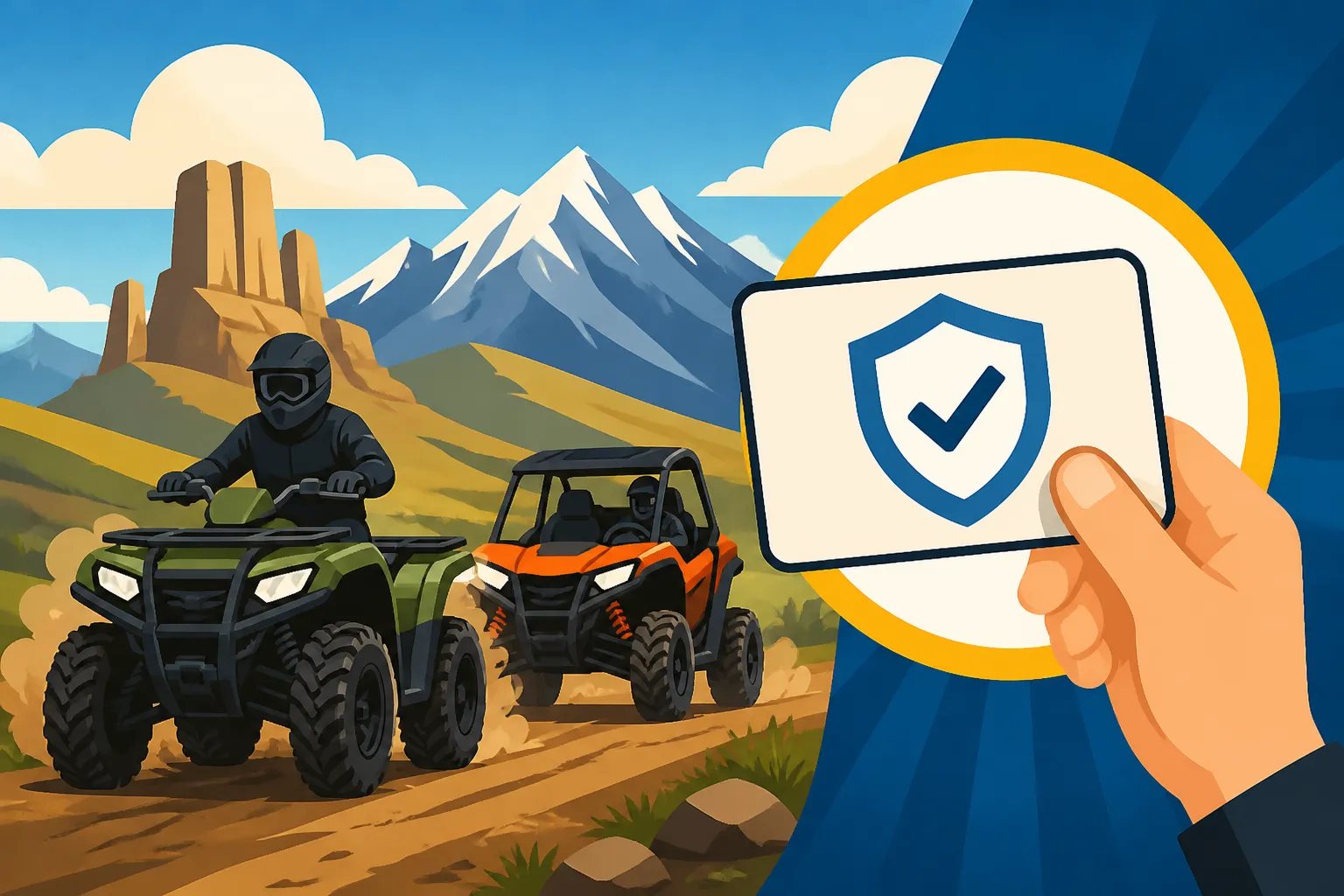
For years, the little paper insurance card was the undisputed champion of proof. You tucked it in your wallet, in your glove box, or maybe even laminated it and kept it on your machine. Today, most insurance companies offer digital proof, accessible on your smartphone. Wyoming, like many states, generally accepts digital proof of insurance. This is incredibly convenient, especially if you're riding a side-by-side with minimal storage space. However, don't let convenience override practicality. What happens if your phone battery dies out in the middle of nowhere? Or if you drop it in a creek? Or if there's no cell signal where you're stopped? These are real-world scenarios.
Many experienced riders choose to carry both: a digital copy on their phone and a laminated physical card. The physical card can be stored in a waterproof bag, a small storage compartment (some SuperATV storage bags are perfect for this), or even a sealed pouch on your person. This redundancy ensures that no matter what the trail throws at you, you'll always have proof of insurance readily available. It’s always better to be overprepared than caught without.
What to Do When Stopped by Law Enforcement
Being pulled over is never fun, especially when you're out enjoying a ride. However, knowing how to handle the situation calmly and correctly can make all the difference. If a Wyoming trooper or county sheriff's deputy signals you to stop, pull over safely to the side of the road. Turn off your machine and remove your helmet if it's safe to do so. Have your driver's license (or [Wyoming Driver's License Rules for ORVs] if you're a younger rider), your machine's registration, and your proof of insurance ready. You'll also need your ORV permit if you're on a designated trail. If you're operating an MPV, you'll need the appropriate [Wyoming Motorcycle Endorsement for an MPV] if required. Be polite and cooperative. Present your proof of insurance when asked. If you're using a digital copy, politely inform the officer that you have it on your phone before handing it over. This makes the process much smoother and demonstrates your compliance. A quick scan of the officer's flashlight across your documents is common, especially if it's evening or a cloudy day. You can read more about what might get checked by law enforcement in [What a Wyoming Trooper Checks Roadside].
Consequences of Not Having or Not Presenting Proof of Insurance
Riding without the proper insurance, or simply being unable to produce proof when requested, isn't just a minor inconvenience; it carries significant legal and financial repercussions in Wyoming. The state takes its vehicle insurance laws seriously, understanding the potential for catastrophic financial harm that uninsured motorists can cause. For those embracing the freedom of riding a road-legal ATV or UTV, ignoring these requirements can quickly turn a fun outing into a costly headache.
Fines, Penalties, and Legal Trouble
If you're caught operating a road-legal ATV or UTV on public roads in Wyoming without the required liability insurance, you can face substantial fines. These penalties aren't trivial and can quickly escalate, especially for repeat offenses. Beyond monetary fines, you could also face other consequences, such as suspension of your driving privileges. Imagine losing your ability to drive your primary vehicle just because you overlooked the insurance for your side-by-side! The legal system doesn't differentiate much between a car and a road-legal MPV when it comes to these core requirements. An officer might issue a citation on the spot, and you could be required to appear in court. This process is not only stressful but can also involve court fees and potentially higher insurance premiums in the future, as it becomes part of your driving record. It's a stark reminder that while the trails feel miles away from the legal world, once you hit the pavement, you're firmly within its jurisdiction.
What Happens in an Accident Without Insurance?
This is where the rubber truly meets the road, or perhaps more accurately, where the lack of insurance can truly derail your life. If you are involved in an accident on a public road and are found to be at fault, but you don't have the legally required liability insurance, you are in a very vulnerable position. First, you'll face all the legal penalties mentioned above. Second, and potentially far more devastating, you will be personally responsible for all damages and injuries you caused. This means medical bills for anyone you injure, repair costs for any vehicles or property you damage, and potentially extensive legal fees if the injured parties decide to sue you. These costs can easily run into the tens or hundreds of thousands of dollars, an amount that could take years, if not a lifetime, to repay. Property liens, wage garnishments, and even bankruptcy are real possibilities. This isn't just a hypothetical scenario; it's a very real risk that every rider choosing to operate an MPV on Wyoming's roads must consider. It's the ultimate reason why carrying that insurance card, both literally and figuratively, is an act of self-preservation.
Here's a quick summary of what to carry and why:
| Document Type | Purpose | Where to Carry It | Why It's Important |
|---|---|---|---|
| Proof of Liability Insurance | Required for all road-legal MPVs | Wallet, waterproof bag, digital on phone, storage box | Avoids fines, covers damages in an accident, legal compliance |
| Driver's License/Permit | Verifies your legal eligibility to operate on roads | Wallet, secured on person | Required by law, proves you're a qualified operator |
| Vehicle Registration | Proves ownership and that the machine is registered for road use | Waterproof bag, storage box | Legal requirement, confirms machine's identity and status |
| Wyoming ORV Permit (Decal) | Required for designated ORV trails, even if MPV-plated | Affixed to machine (visible), receipt in storage (optional) | Access to enrolled trails, Wyoming Fines for No ORV Permit can be costly |
| MPV Title | Proof of ownership, but not usually required to carry | Home in a secure place | Establishes ownership, needed for selling or major transactions |
Keeping these documents organized and accessible will ensure your Wyoming ATV and UTV adventures are not only thrilling but also fully compliant with state law.
Disclaimer
This article is for general informational purposes only and does not constitute professional advice. Laws, prices and regulations vary by location and change over time. Consult a qualified professional for guidance on your specific situation.