Cattle Guards on a Ranch Road
Riding your ATV or UTV across Wyoming’s vast, beautiful landscapes often means encountering a piece of rural infrastructure that can give new riders pause: the cattle guard. These clever barriers are an essential part of ranching life, but they require a bit of know-how and respect to navigate safely, especially when you’re on two or four wheels. This guide will help you understand what cattle guards are, how to cross them, and the unspoken rules that come with riding on roads where they're present.
Understanding Cattle Guards on Wyoming's Rural Routes
When you're out exploring the miles of two-tracks, county roads, and forest service routes that crisscross Wyoming, you're going to come across cattle guards. They're ubiquitous in ranching country, and for good reason. Understanding their purpose and construction is the first step to confidently riding over them.
What Exactly is a Cattle Guard, and Why Are They Used?
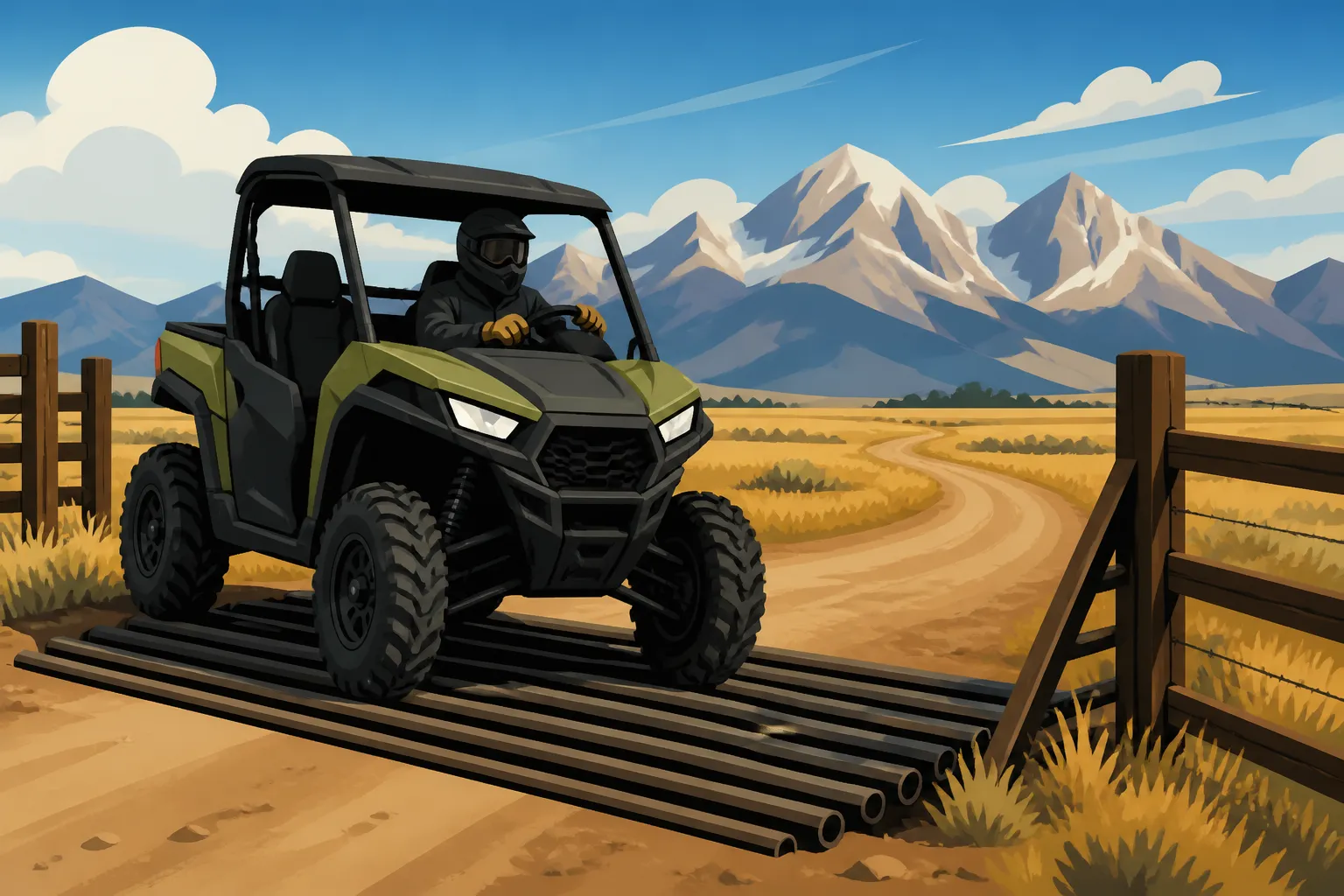
A cattle guard, at its core, is a simple yet ingenious barrier designed to prevent livestock—like cattle, horses, or sheep—from crossing a boundary, while allowing vehicles and people to pass freely. Think of it as an "invisible gate" for animals. Ranchers use them to manage their herds, keeping them contained within certain pastures or allotments without the constant hassle of opening and closing physical gates every time someone drives through. Before cattle guards became common, every fence line crossing meant a physical gate that someone had to open, drive through, and then close, often several times a day. This was not only time-consuming but also prone to human error—an open gate means lost livestock and a huge headache for the rancher.
The design relies on the fact that most hoofed animals are reluctant to walk on uneven, unstable surfaces where they can’t get solid footing. The gaps between the rails or pipes are wide enough that an animal’s foot might slip through or get caught, making them instinctively avoid stepping onto the guard. For your ATV or UTV, it’s a quick transition, but for a cow, it’s a psychological and physical deterrent. This system dramatically improves efficiency for ranchers and helps maintain the integrity of their grazing areas, making them an indispensable part of the rural landscape across Wyoming and beyond.
Different Types of Cattle Guards You'll Encounter
While the basic principle remains the same, cattle guards come in a few different forms, and each can feel a little different under the tires of your machine. The most common type features a series of parallel metal pipes or rails, often round or square, set into a concrete or steel frame over a shallow pit. These are robust and effective. You might also encounter guards made from heavy timber or concrete forms, sometimes with pre-cast rumble strips that create a similar disorienting effect for animals. The material and design can vary depending on the local resources, the expected vehicle weight, and the type of livestock being contained.
Some newer designs might even use a painted grid pattern on a solid surface, relying purely on the visual deterrent for animals, though these are less common in areas with serious livestock management needs. As you ride, you'll learn to recognize the subtle differences. Metal pipe guards often produce a distinct "clunk-clunk-clunk" sound as your tires roll over each bar, while concrete guards might offer a heavier, duller thud. It's always a good idea to approach cautiously, as the condition of these guards can vary wildly depending on how old they are and how much traffic they see.
Where You're Most Likely to Spot a Cattle Guard
Cattle guards are typically found at the boundaries of private ranches, where a road crosses from public land into private property, or where different pastures within a ranch are separated. You'll also encounter them frequently on grazing allotments managed by the Bureau of Land Management (BLM) or the Forest Service, especially where a public road or [Wyoming Rules for Riding a Ranch Road] passes through an area leased for cattle or sheep. These are often areas where public access is permitted, but the land managers still need to facilitate livestock control.
It's common to see a cattle guard at the entrance to a long ranch driveway or at the point where a county road transitions from paved to gravel and enters a more rural, agricultural zone. Sometimes, they even mark the beginning or end of an [Wyoming Rules for Riding a Grazing Allotment]. Always be aware of your surroundings and keep an eye out for these structures, especially when riding in areas known for ranching or public lands with grazing leases. Understanding that a cattle guard signifies a boundary, often with livestock nearby, helps you ride responsibly and respectfully.
Mastering the Art of Crossing Cattle Guards Safely on Your ATV or UTV
Crossing a cattle guard on an ATV or UTV isn't inherently dangerous, but it does require a specific approach to ensure both your safety and the longevity of your machine. Rushing them or ignoring their presence can lead to a jarring experience, potential damage, or even a loss of control.
Pre-Ride Inspection and Approach Strategy
Before you even get close to a cattle guard, it’s smart to practice a bit of defensive riding. As you approach, scan ahead to identify the guard. Look for any visible damage, missing bars, or large debris that might have accumulated on or around it. If it’s raining or has recently rained, assume the metal bars might be slick. In winter, ice and snow can turn a cattle guard into a genuine hazard.
Reduce your speed well in advance. There’s no need to hit a cattle guard at full throttle. A controlled, moderate speed is key. You want to maintain enough momentum to smoothly roll over it, but not so much that you're bouncing or losing contact with the ground. Imagine it like a small set of speed bumps—you wouldn't hit those fast, either. Take a moment to assess the condition, choose your line, and then proceed deliberately. This pre-ride check and careful approach strategy will make all the difference in a smooth crossing.
Proper Crossing Technique for Off-Road Vehicles
Once you've assessed the guard and slowed down, the actual crossing is fairly straightforward. Keep your ATV or UTV pointed straight, aiming to cross the guard perpendicular to its bars. Avoid any sudden braking, acceleration, or steering inputs while your tires are on the guard, as this can cause your machine to skip, slide, or become unstable. Maintaining a consistent, light throttle, or even just letting off the gas and coasting, is often the best approach.
For ATVs, keep your weight centered and balanced, using your body to absorb some of the bumps. Side-by-sides offer a bit more stability due to their wider stance and roll cages, but the principle is the same: maintain control, keep your steering wheel straight, and let the suspension do its work. Some riders prefer to roll over them a little slower, allowing each wheel to articulate over the bars, while others find a slightly brisker pace smooths things out. Experiment carefully to see what feels best for your machine and riding style, always prioritizing control. Remember, the goal is a gentle, stable transition, not a jump or a jarring jolt.
Common Hazards and How to Mitigate Them
Despite their robust construction, cattle guards can present various hazards. Loose or broken bars are a serious concern; if a tire catches one, it could cause a sudden jolt, damage your machine, or even throw you off balance. Always keep an eye out for these. Mud, snow, and ice can accumulate between the bars or on the approach, making the surface extremely slick. This is particularly dangerous for ATVs, which have less stable footing than a UTV on such surfaces. When conditions are wet or icy, slow down even further and be extra cautious.
Sharp edges from worn or damaged bars can also be a threat to tires. Beyond immediate safety, the constant jarring from cattle guards can take a toll on your machine's suspension components, steering parts, and frame over time. This is where quality aftermarket protection, like skid plates and A-arm guards from companies like SuperATV, can really pay off, helping to absorb impacts and protect vital components from underneath. A well-maintained suspension system and appropriate tire pressure will also help mitigate the bumps and vibrations, making for a much more comfortable and safer crossing.
Here's a quick reference for common cattle guard types and hazards:
| Type of Cattle Guard | Common Materials | Typical Sound Under Tire | Potential Hazards | Recommended Approach |
|---|---|---|---|---|
| Pipe/Rail | Steel, sometimes concrete | "Clunk-clunk-clunk" | Loose bars, rust, ice, mud | Slow, steady, straight |
| Concrete Slab | Pre-cast concrete | "Thud-thud-thud" | Cracked sections, uneven wear, debris | Moderate speed, look for cracks |
| Rumble Strip | Rubber, plastic, asphalt | Low rumble/vibration | Less common, usually smoother; still watch for debris | Standard cautious approach |
Navigating the Legalities and Etiquette Around Ranch Gates and Guards
Riding in Wyoming means you'll often be on a mix of public and private lands, and cattle guards are a key indicator of these transitions. Understanding the rules, both written and unwritten, is crucial for responsible riding.
Public Access vs. Private Property: Knowing the Difference
Many public roads and trails, including those managed by the Forest Service or BLM, pass through private lands via easements, or they might border private grazing allotments. A cattle guard doesn't necessarily mean you're entering private land where you can't ride. It simply means you're entering an area where livestock are present and need to be contained. The key is knowing if the route you're on is an [Wyoming's Enrolled Roads and Trails] or if it’s subject to private land restrictions.
Always consult current maps, such as Motor Vehicle Use Maps (MVUMs) for national forests, or BLM travel management maps, to confirm legal access. These maps clearly designate public routes. If you see "No Trespassing" signs in conjunction with a cattle guard, that's a clear indicator that the land beyond is private and not open to public access without explicit permission. Respecting [Wyoming Rules for Riding Private Land] isn't just about avoiding a fine; it's about maintaining good relationships with landowners who might otherwise close off access entirely. When in doubt, turn around.
The "Close the Gate" Rule and Other Essential Rancher Etiquette
Sometimes, you'll encounter a cattle guard that also has a physical gate next to it, often a wire gate or a wooden one. These gates serve various purposes, such as allowing large equipment to pass or providing additional security for specific livestock. The most critical rule, an unspoken law of the West, is this: if you open a gate, you must close it behind you. This isn't just polite; it's vital for the rancher's livelihood. An open gate can lead to livestock escaping, mingling with other herds, or wandering onto highways—all costly and dangerous situations. Even if it looks like the gate has been left open, and you're the first one through, it's always best practice to ensure it's securely closed. Familiarize yourself with [Wyoming Rules for Opening a Gate] so you know what's expected.
Beyond gates, remember that you are a guest in these working landscapes. Ride only on designated routes, avoid riding too close to livestock, and minimize dust and noise when near homes or corrals. A little courtesy goes a long way in ensuring continued access for all riders. Understanding [Wyoming Rules for Riding Near Livestock] and practicing general [Wyoming Trail Etiquette With Ranchers] will make your experience better and help preserve access for everyone.
Consequences of Disregarding Rules or Damaging Property
Ignoring rules related to private land, gates, or cattle guards can have serious repercussions. The most immediate is often a fine for trespassing or for riding off a designated route. [Wyoming Fines for Riding Off a Route] can be substantial, and rangers or sheriffs do patrol these areas. More broadly, damaging a cattle guard or leaving a gate open can result in legal action from the landowner, who may seek compensation for damages or lost livestock.
Beyond legal penalties, there’s the impact on the wider riding community. A few careless riders can lead to entire areas being closed off to public access, ruining opportunities for everyone else. Ranchers and private landowners are often generous in allowing access across their lands or adjacent to them, but that goodwill can quickly evaporate with irresponsible behavior. Always ride as if you're representing all off-road enthusiasts—respectful, responsible, and appreciative of the access you have. Understanding [Wyoming Trespass Rules for Riders] is your responsibility as a rider in the state.
Equipping Your Machine for Wyoming's Diverse Terrain, Including Cattle Guards
Wyoming's terrain is rugged and varied, and cattle guards are just one of many challenges your machine will face. Proper equipment and setup are essential not only for safely traversing these obstacles but for enjoying your ride overall.
Essential Modifications for Enhanced Durability
If you plan on spending a lot of time on Wyoming's ranch roads and two-tracks, where cattle guards are a common feature, investing in some key modifications for durability is a smart move. Underbody protection is paramount. Skid plates made from robust materials like UHMW or aluminum protect your frame, engine, transmission, and differential housings from impacts with rocks, roots, and, yes, the unforgiving edges of cattle guards. A-arm guards are also crucial, safeguarding your suspension components from direct hits. Brands like SuperATV offer a wide range of these protective accessories designed to fit most popular ATV and UTV models, providing peace of mind when the terrain gets rough.
Beyond underbody protection, consider rock sliders or tree kickers for side-by-sides. While they won't directly help with cattle guards, they protect the sides of your machine from impacts encountered on narrow trails or when navigating tight spots common on [Wyoming Rules for Riding a Two-Track]. These modifications aren't just for extreme off-roading; they're practical investments for any serious trail rider looking to protect their investment from the wear and tear of continuous use on rough, unimproved roads.
Suspension Setup and Tire Choices for a Smoother Ride
Your suspension setup plays a significant role in how comfortably and safely you cross a cattle guard. Properly adjusted shocks and springs will absorb the impact of the bars, preventing a jarring jolt that can rattle both you and your machine. If your suspension is too stiff, you'll feel every bump more acutely; if it's too soft, you might bottom out. Take the time to dial in your suspension settings based on your machine, your weight, and the typical terrain you ride. Many aftermarket suspension components and lift kits from companies like SuperATV can offer superior adjustability and performance over stock setups, greatly improving ride quality over varied terrain, including cattle guards.
Tire choice also matters. While aggressive mud tires might be great for deep gunk, their heavy lugs can sometimes feel unstable or "grab" on the metal bars of a cattle guard, especially if they are wet. A good all-terrain tire with a more continuous contact patch can offer a smoother transition and better grip on hard, uneven surfaces. Also, ensure your tire pressure is set correctly. Too much pressure can make your ride harsh and increase the risk of punctures on sharp objects, while too little can lead to rim damage or bead separation. Finding the right balance will make your machine more forgiving over obstacles like cattle guards and enhance your overall riding experience.
What to Carry in Your Tool Kit for Trailside Emergencies
Even with the best preparation and equipment, things can go wrong on the trail. A well-stocked tool kit can be the difference between a minor inconvenience and a stranded situation, especially when you're miles from cell service or paved roads. For issues related to cattle guards or other rough terrain, consider packing:
- Tire repair kit: Plugs, patch kit, and a small air compressor or CO2 cartridges for unexpected flats.
- Basic hand tools: Wrench set, socket set, screwdrivers, pliers, and zip ties for minor repairs or tightening loose components.
- Duct tape and electrical tape: Versatile for temporary fixes.
- Small shovel: Useful for clearing debris or getting unstuck.
- First-aid kit: For personal injuries.
- Communication device: A satellite messenger or GPS unit, especially if you venture into areas without cell signal.
- Tow strap: For getting yourself or a friend unstuck.
- Knife or multi-tool: Always handy.
While a cattle guard itself might not cause a mechanical breakdown, the forces involved in crossing them, combined with other rough terrain, can loosen bolts or cause unexpected issues. Being prepared means you can handle small problems on the spot and continue your ride safely. Remember to always inform someone of your route and estimated return time, particularly if you are heading out during hunting season or other busy times on the trails.
Disclaimer
This article is for general informational purposes only and does not constitute professional advice. Laws, prices and regulations vary by location and change over time. Consult a qualified professional for guidance on your specific situation.