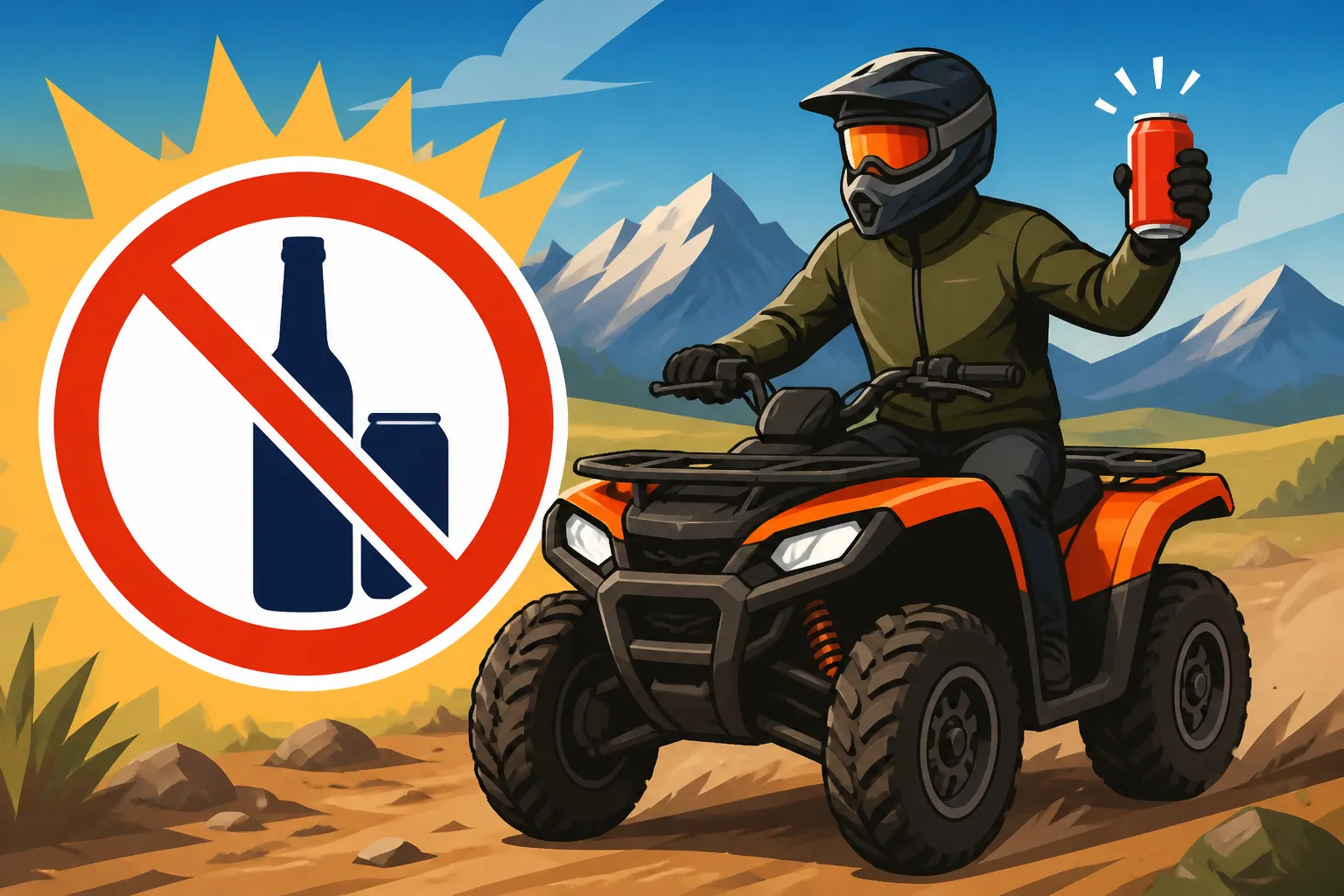
Wyoming Open Container Rules on an ATV
There's nothing quite like the freedom of exploring Wyoming's vast landscapes on your ATV or UTV, feeling the wind and soaking in the incredible scenery. But let's be honest, sometimes the rules about what you can and can't do can feel like a tangled mess, especially when you're transitioning from a remote trail to an enrolled road. One common point of confusion that often catches riders off guard is the state's open container law. It's a real bummer to have a fantastic ride spoiled by an unexpected fine because you weren't fully aware of the regulations. This guide is here to untangle those rules, specifically focusing on Wyoming's open container laws for ATVs and UTVs, helping you ride legally and responsibly, and avoid any headaches.
The Basics of Wyoming's Open Container Law and Why Your ATV Isn't Exempt
It's easy to assume that because you're out in the wilds, perhaps on a dirt road or a designated trail, the same rules that apply to a paved highway don't quite fit. Unfortunately, when it comes to open container laws, that assumption can land you in hot water. Wyoming has clear statutes about possessing open containers of alcohol in vehicles, and yes, that often includes your ATV or UTV, especially when you're operating it on public roads.
What "Open Container" Really Means in Wyoming
Let's get down to brass tacks: what exactly constitutes an "open container" in the eyes of Wyoming law? It's pretty straightforward, but the implications are broad. An open container is defined as any bottle, can, or other receptacle containing an alcoholic beverage that has been opened, has a broken seal, or has had some of its contents removed. It doesn't matter if you're actively drinking from it at that moment. If it's open, partially consumed, or the seal is broken, it's considered an open container. This also includes drinks with caps that can be easily removed, like a half-empty bottle of wine, even if the cap is back on.
The critical factor isn't necessarily consumption, but presence and accessibility. If that open can of soda or beer, or that partially finished flask, is within the passenger area of your ATV or UTV, and it's readily accessible to the driver or any passenger, you're looking at a potential violation. This is where many riders get tripped up. They might think, "I'm just moving it from the cooler to the camp," or "I wasn't drinking while driving, I just had it there." The law, however, is often less concerned with intent to consume while driving and more concerned with the mere presence of the open container in an accessible space. Always err on the side of caution.
Why Your ATV or UTV is Treated Like a Car on Roads
This is perhaps the most crucial point for ATV and UTV riders to understand. While your machine might feel like a recreational vehicle built for rugged terrain, when you operate it on a public road in Wyoming, it generally falls under the same traffic laws as a car or truck. This means if you're riding your side-by-side down a county road, a U.S. Forest Service road, or even a Bureau of Land Management (BLM) road that is designated for vehicle travel, the state's open container law applies to you just as it would to someone in a sedan.
Wyoming has specific pathways for making some ATVs and UTVs "street legal" or, more accurately, able to operate on designated public roads as Multipurpose Vehicles (MPVs). If you've gone through the process of getting an MPV plate and title for your machine, you're explicitly agreeing to abide by all the rules of the road. But even if your machine isn't fully plated as an MPV, and you're just using an enrolled ORV trail that utilizes segments of public road, the open container rules still kick in. [Wyoming's MPV Path to the Road] is a designation many riders seek, and with that privilege comes the responsibility of adhering to all traffic laws.
Imagine you're pulling your ATV off a private property access road onto a [Wyoming Rules for Riding a County Road] or a [Wyoming Rules for Riding a Forest Road]. The moment your tires hit that public right-of-way, you are subject to road laws. This is not about where your adventure started or where it's going; it's about where you are right now. A game warden or a state trooper isn't going to differentiate between your ATV and a pickup truck when it comes to an open container offense on a public thoroughfare.
Where the Rules Get Tricky: On-Trail vs. On-Road Scenarios
The distinction between public roads and dedicated off-road trails can be a little blurry, and that's where many riders find themselves scratching their heads. It’s not always a clear-cut case of pavement versus dirt. Often, trails crisscross public roads or share easements, making it essential to know when one set of rules applies over another.
Public Trails and Designated Off-Road Areas
Generally speaking, Wyoming's state open container law is primarily concerned with public roads and public highways. Dedicated off-road trails and designated OHV parks that are entirely off the public road system might operate under different specific regulations. However, this doesn't mean it's a free-for-all when it comes to alcohol.
Federal lands, such as National Forests and Bureau of Land Management (BLM) areas, often have their own specific rules regarding alcohol consumption and possession. While these might not always be framed as "open container" laws in the same way the state statute is, they can include prohibitions on public intoxication, disorderly conduct, or even restrictions on alcohol in certain recreation areas or campgrounds. It's vital to check the local rules for the specific area you're visiting. For instance, a designated play area like the [Killpecker Sand Dunes in Southwest Wyoming] or an OHV park like [Poison Spider OHV Park Outside Casper] might have very clear rules posted at their entrances regarding alcohol. Even if the state's open container law doesn't directly apply, a federal ranger could still cite you for other alcohol-related infractions if you're not careful.
The best practice on any public land, whether state or federal, is to be incredibly mindful. An open container in an accessible location on your machine, even if not on a "road," could still lead to questions, especially if combined with any perception of impaired operation. Always keep alcoholic beverages sealed and stored away until you're safely at a designated camp, not operating your machine, and adhering to all local regulations.
The "Gray Area" of Private Property and Guest Ranches
Riding on private property with the owner's explicit permission offers a bit more leeway when it comes to open container laws. Typically, state open container laws that apply to public roads do not extend to privately owned land. So, if you're exclusively riding on a friend's ranch or a private off-road park, the specific open container statute may not apply to your machine there.
However, this absolutely does not mean that you can drink and ride without consequence. [Wyoming DUI Rules for ATV Riders] are very clear: you can absolutely still be charged with driving under the influence (DUI) on private property if the land is accessible to the public, or if you later transition your impaired operation onto a public road. A guest ranch or a private riding area might have its own internal policies regarding alcohol consumption, which you'd be wise to follow. They want to ensure the safety of all their guests and preserve their property. You wouldn't want to get ejected from a great riding spot because you weren't respectful of their rules.
So, while the letter of the open container law might be different on private land, the spirit of responsible riding remains the same. Enjoy adult beverages responsibly, and never operate your ATV or UTV while impaired, regardless of where you are riding. The consequences for impairment are severe and far-reaching, regardless of land ownership.
| Location Type | Wyoming Open Container Law Applicability (Driver/Passenger Accessible) | General Alcohol Rules (Beyond Open Container) |
|---|---|---|
| Enrolled Public Roads | YES (Applies to all vehicles, including ORVs/MPVs) | DUI laws apply. Public intoxication/disorderly conduct laws apply. |
| Designated OHV Trails | Typically NO (State open container law focuses on roads) | Federal land rules may prohibit. DUI laws apply if public access. Disorderly conduct. |
| Federal Lands (Forest/BLM) | Typically NO (State law focuses on roads) | Specific federal agency rules may apply. DUI laws apply. Public intoxication/disorderly conduct. |
| Private Property | Typically NO (Unless specifically designated as public access) | DUI laws still apply if public access or moving onto public roads. Owner's rules apply. |
| Guest Ranches | Typically NO (Unless specifically designated as public access) | DUI laws still apply. Ranch's own alcohol policies. |
Practical Advice for Responsible Riding and Avoiding Fines
Navigating the rules can feel like a minefield, but it doesn't have to be. With a bit of common sense and a proactive approach, you can enjoy your Wyoming ATV and UTV adventures without the worry of running afoul of open container laws or, more importantly, DUI regulations. It's all about preparation and making smart choices before you even turn the key.
Storing Beverages Safely and Legally
The easiest way to avoid an open container violation is simply not to have any open alcoholic beverages readily accessible in your ATV or UTV while operating it on public roads or trails where such laws might apply. "Readily accessible" is the key phrase here. If it's within reach of the driver or passengers, it's a problem.
For any alcoholic beverages you might be transporting – even if they are sealed and for later consumption at camp – store them securely and out of the immediate passenger area. A dedicated cargo box, a sealed cooler strapped down in the bed of your UTV, or a locked compartment on your ATV are ideal locations. The goal is to make it clear that the container is not intended for consumption while the machine is in operation. Many aftermarket accessories, like those from SuperATV, offer fantastic storage solutions specifically designed for ATVs and UTVs. A durable, lockable cargo box or a securely mounted cooler can make all the difference, not just for legality but for keeping your drinks cold and your gear organized.
Think of it this way: if a law enforcement officer pulls you over, they shouldn't see or easily reach an open container. A sealed six-pack tucked away in a closed, strapped-down cooler in the cargo area is vastly different from a single open can rattling around in a cup holder between the seats. When you're driving a [Wyoming Permits for a Side-by-Side] on an enrolled route, treat it with the same respect for the law as you would your pickup truck.
Understanding DUI Rules on ATVs/UTVs (The Bigger Picture)
While open container laws are important, the absolute paramount rule for anyone operating an ATV or UTV in Wyoming is to never do so under the influence of alcohol or drugs. This is not just a legal recommendation; it's a safety imperative. The consequences of an ATV or UTV DUI are severe, mirroring those for driving a car while impaired. We're talking substantial fines, potential jail time, suspension of your driver's license (yes, even if you were on an ATV!), and even impoundment of your machine. [Wyoming DUI Rules for ATV Riders] apply to anyone operating an off-road vehicle, whether on public roads, public trails, or even on private land if there's public access.
Operating an ATV or UTV requires focus, quick reflexes, and sound judgment. Introducing alcohol into that equation dramatically increases the risk of accidents, injuries, and fatalities – not just for you, but for your passengers and anyone else on the trail. It's simply not worth the risk to yourself, your riding companions, or your legal standing. Have fun, but make sure your fun doesn't put anyone in danger or lead to a life-altering mistake. Designate a sober driver if necessary, or better yet, save the alcoholic beverages for after the ride, when your machine is parked for the night and you're safely at camp.
Being Prepared for a Roadside or Trailside Stop
Even if you're doing everything right, you might still encounter a warden or state trooper while out riding. It's part of the territory when enjoying public lands. If you're pulled over, the most important thing is to remain calm, cooperative, and polite.
First, pull over to a safe spot, turn off your engine, and keep your hands visible. Have your identification, [Wyoming's Annual ORV Permit] (or permit receipt, if recent), and any machine registration handy. If asked about alcohol, be honest. If you have sealed beverages stored legally, calmly explain where they are and their status. If, by some oversight, you do have an open container that's accessible, acknowledge it without arguing. Trying to hide it or dispose of it can make matters much worse. The best way to avoid this scenario, of course, is to ensure no open containers are in an accessible part of your machine when you're riding.
Remember, wardens and law enforcement officers are primarily concerned with safety and compliance. By being prepared, respectful, and understanding the rules, you can often turn a potentially stressful stop into a brief, professional encounter. Understanding rules about [Wyoming Fines for Riding Without a Permit] or [Wyoming Fines for Riding a Closed Road] can also help you avoid other common violations. Always respect the officers, their role, and the importance of keeping Wyoming's trails and roads safe for everyone.
Disclaimer
This article is for general informational purposes only and does not constitute professional advice. Laws, prices and regulations vary by location and change over time. Consult a qualified professional for guidance on your specific situation.