Wyoming Rules for Crossing an Interstate
It's incredibly frustrating when you're out exploring Wyoming's vast and beautiful backcountry on your ATV or UTV, only to find an interstate highway suddenly chopping your trail in half. You're trying to connect one amazing riding area to another, or perhaps just get from one side of a town to the other, and that ribbon of high-speed traffic seems like an insurmountable barrier. We've all been there, staring at the map, wishing there was an easy, legal way across. This guide is here to shed light on Wyoming's very specific and limited rules for crossing an interstate, helping you understand how to navigate these formidable roadways safely and legally.
The Core Challenge: Why Crossing an Interstate Isn't Like Crossing a County Road
When you're out on your off-road machine, whether it's a nimble ATV or a robust side-by-side, you're used to navigating all sorts of terrain and, often, a mix of dirt roads, gravel paths, and even some county roads that allow ORV traffic. But interstates? That's a whole different animal, and the rules are far stricter for a very good reason. It's not just about a sign; it's about physics, safety, and the fundamental design of these high-speed arteries.
The General Rules Against ATVs on Interstates
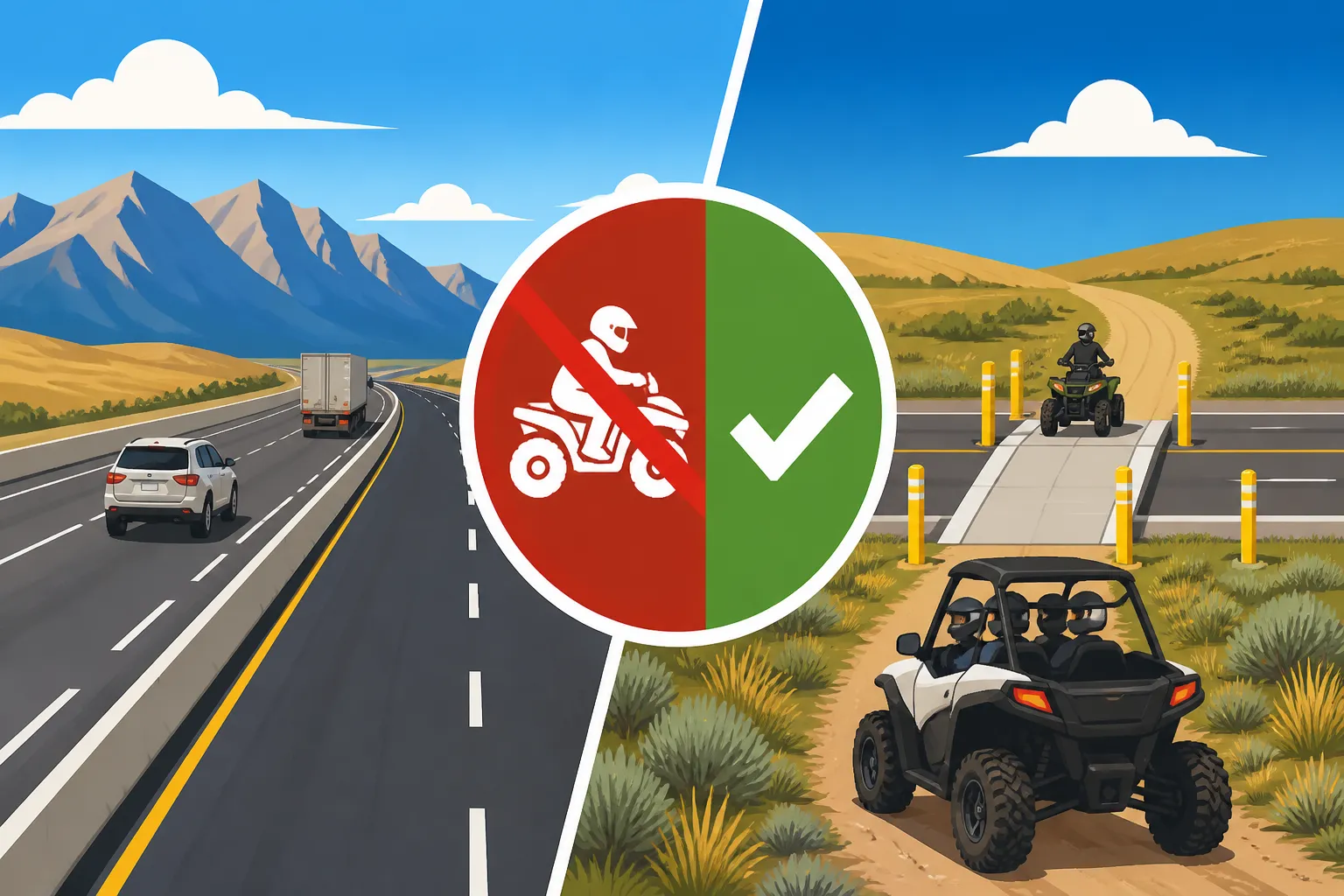
Generally speaking, you cannot just hop on an interstate highway with your ATV or UTV in Wyoming, or pretty much anywhere else for that matter. Interstates are designed for vehicles traveling at high speeds, often 70 mph or more, with multiple lanes of traffic. Off-road vehicles, even those capable of decent speeds, are simply not built for this environment. Their tires, suspension, and overall stability are optimized for rugged terrain, not sustained high-speed pavement travel. Imagine trying to keep up with semi-trucks and cars zipping by at freeway speeds while you're on a machine built for trails. It's a recipe for disaster.
Furthermore, most off-road machines lack the specific safety features and legal designations required for interstate travel. We're talking about things like fully enclosed cabs, advanced crumple zones, and specific lighting and signaling requirements that differentiate them from road-legal cars or even [Wyoming's MPV Path to the Road] vehicles. The legal framework simply doesn't recognize an average ORV as suitable for interstate travel, and attempting to ride one there is not only illegal but profoundly dangerous.
The Dangers of Unofficial Crossings
It might be tempting to think, "Oh, I'll just zip across the shoulder quickly," or "I'll use an on-ramp and then the next off-ramp." Please, resist that urge with every fiber of your being. The dangers associated with attempting an unofficial crossing of an interstate are immense and cannot be overstated. You're putting yourself and others at extreme risk.
Interstate drivers are not expecting to see an ATV or UTV in their lane or on the shoulder. Their reaction times are calibrated for freeway speeds and typical vehicle behavior. An off-road machine, with its different acceleration, braking, and maneuverability, presents an unexpected hazard that can lead to catastrophic accidents. Beyond the obvious risk of collision, you could face severe legal consequences, including hefty fines, citations, and even the impoundment of your machine. A Wyoming Trooper [What a Wyoming Trooper Checks Roadside] won't hesitate to enforce these rules. It's simply not worth the risk, both to your safety and your wallet.
Wyoming's Unique Approach: Grade-Separated Crossings
While direct interstate travel is a no-go, Wyoming has recognized the very real need for riders to connect across these major divides. They've implemented a specific, limited solution that allows for the safe and legal crossing of interstates in designated areas. This isn't about riding on the interstate, but over or under it.
What Exactly is a Grade-Separated Crossing?
A grade-separated crossing is precisely what it sounds like: a crossing point where off-road vehicle traffic is physically separated from the main interstate traffic lanes. Think of it as a dedicated underpass or overpass specifically designed and approved for ATVs and UTVs. You're not sharing the same road surface with freeway traffic; you're using a separate structure that carries you safely across or beneath the interstate.
These aren't just any old farm underpass or bridge; they are specific points that have been officially designated and marked for ORV use. Riders approach these crossings on established [Wyoming's Designated ORV Roads] or trails that lead directly to the crossing structure. Once through, you continue on another designated trail or road on the other side. The key here is "designated." If it's not clearly marked and part of an official ORV route, it is not a legal grade-separated crossing for your machine. It’s an innovative solution that allows for seamless trail connections, such as the ones you might find near Evanston, where Interstate 80 once created a significant barrier.
The Legal Framework: WYDOT and Local Consent
The ability to create these grade-separated crossings for off-road vehicles comes from a specific legislative framework in Wyoming. A crucial piece of this puzzle is the [WYDOT Chapter 33 Rule of 2025], which outlines the process and requirements for establishing these crossings. This rule allows for ORV access across interstates at certain points, but it's not a free-for-all. The process is collaborative and requires agreement from multiple agencies.
Specifically, for an interstate crossing to be opened for ORV use, it requires a joint effort between the Wyoming Department of Transportation (WYDOT) and the local county government. You see, [Why a Road Opens Only When Two Agencies Agree] isn't just a suggestion; it's the law. The local county must first say "yes" and initiate the process, demonstrating a local need and commitment to managing the crossing. [Why a County Must Say Yes First] ensures that these decisions are made with local community needs and resources in mind. This collaboration ensures that the crossings are not only structurally sound but also integrated into local trail systems and managed effectively.
The 1,000 Machine Cap: Managing Traffic at Crossings
One of the unique aspects of these grade-separated interstate crossings in Wyoming is a specific cap on usage. To manage the impact and ensure safety, each approved interstate crossing is limited to [Why Each Interstate Crossing Is Capped at 1,000 Machines] per calendar year. This isn't an arbitrary number; it's a carefully considered measure to prevent overuse, minimize environmental impact on approach trails, and maintain safety at these critical junctures.
This cap is a direct response to the need to balance recreational access with responsible land management. For instance, in areas like [Evanston and the Interstate That Split It], where I-80 created a significant divide between popular riding areas, the desire for crossings was strong. The cap ensures that while riders can now connect these areas, the crossings don't become overwhelmed. It also allows agencies to monitor usage patterns and adjust management strategies if needed. Riders should be aware that once a crossing reaches its 1,000-machine limit for the year, it will be closed to ORV traffic until the next calendar year, underscoring the importance of planning your rides, especially in popular areas or later in the season.
Finding and Utilizing Legal Interstate Crossings
Now that you understand why and how these crossings exist, the next crucial step is knowing where to find them and how to use them properly. You can't just assume any underpass or overpass is fair game; it has to be officially designated.
How to Identify Approved Crossing Points
Identifying legal interstate crossing points requires a bit of homework, but it's absolutely essential for a safe and legal ride. The most reliable way to find these designated crossings is by consulting official maps and resources from the land management agencies. This includes:
- Forest Service Travel Management Maps: If you're riding in one of Wyoming's National Forests, their MVUMs (Motor Vehicle Use Maps) will clearly show all designated routes, including any ORV-approved crossings of interstates. These maps are your bible for riding in federal lands.
- BLM Maps: The Bureau of Land Management also provides maps of their managed areas, outlining designated roads and trails. Look for specific markings indicating an interstate crossing.
- County and State Parks Maps: Some counties or [Wyoming State Parks, Historic Sites and Trails] may also have their own maps or information about ORV routes that include interstate crossings.
Always look for explicit signage on the ground as well. A legal crossing will be clearly marked. If you don't see signs or if it's not on an official map, assume it's not an approved crossing. Don't rely on word-of-mouth or outdated information. Technology, like GPS units with preloaded trail maps, can be helpful, but always cross-reference with official paper maps or online resources from the managing agency. Remember, these designated routes are part of [Wyoming's Enrolled Roads and Trails] system. If it's not enrolled, it's not legal for your ORV.
What to Expect When Using a Designated Crossing
When you approach a designated interstate crossing, it's important to understand that you won't be suddenly merging onto the freeway. Instead, you'll be on a designated ORV trail or an enrolled public road that guides you to the underpass or overpass structure. The experience itself will typically involve:
- Approach Roads: You'll likely be riding on a dirt or gravel road that funnels you directly to the crossing structure. These approach roads are part of the designated ORV route. Keep an eye out for any specific speed limits or cautionary signs on these approaches. For machines that might be riding on some public roads to reach these crossings, having proper mirrors and lighting from a company like SuperATV can enhance visibility and safety, even if the machine isn't fully street-legal for sustained road travel.
- The Crossing Structure: Whether it's an underpass (a tunnel beneath the interstate) or an overpass (a bridge over the interstate), the structure is designed to keep you completely separate from the high-speed traffic. These sections might be paved, gravel, or dirt, depending on the location.
- Signage: Expect clear signs indicating the crossing, often with rules, seasonal closures, or information about the 1,000-machine cap. Pay close attention to these signs.
- Staying on Route: It is absolutely critical to stay on the marked path throughout the entire crossing. Do not deviate from the designated route, even if it looks like a shortcut or seems more convenient. Straying off route can lead to penalties and could endanger wildlife or sensitive habitats.
These crossings are designed to be efficient and safe, allowing you to seamlessly connect different riding areas. Think of it as a brief, regulated interlude in your off-road adventure, designed to keep you moving without putting you in harm's way.
Consequences of Ignoring the Rules
While Wyoming has made an effort to provide legal crossing options, it's vital to respect the rules and designations. Ignoring them can lead to serious repercussions that can quickly turn an enjoyable ride into a costly headache.
Penalties for Illegal Interstate Entry or Crossing
Attempting to ride an ATV or UTV on an interstate highway or using an undesignated crossing is a serious offense in Wyoming. The penalties can be significant, ranging from substantial fines to the impoundment of your machine. A citation for riding a [Wyoming Fines for Riding a Closed Road] segment, which an interstate would certainly be for an ORV, can be quite costly. Enforcement officials, whether it's the Wyoming Highway Patrol or a local county sheriff, take these violations very seriously due to the extreme safety risks involved.
Beyond the immediate financial penalties, you could also face charges for reckless endangerment or other serious violations, especially if your actions create a hazard for other motorists. The state's focus is on safety, and anyone who undermines that by disregarding basic traffic laws on such high-speed roadways will face the full weight of the law. It's a risk that no rider should ever contemplate taking.
Prioritizing Safety and Legal Riding
Ultimately, understanding and adhering to Wyoming's rules for interstate crossings isn't just about avoiding fines; it's about prioritizing your safety, the safety of other road users, and the longevity of responsible off-road riding in the state. Planning your route, consulting official maps, and only utilizing designated grade-separated crossings are fundamental responsibilities of every rider.
Wyoming offers an incredible amount of diverse and breathtaking terrain for ATVs and UTVs. By riding legally and responsibly, you help ensure that these trails and the privilege to ride them remain accessible for everyone. A little bit of planning upfront can save you a lot of grief and ensure your Wyoming off-road adventure is memorable for all the right reasons. Always ride smart, know your route, and respect the regulations that keep us all safe on the trails and near the roads.
Disclaimer
This article is for general informational purposes only and does not constitute professional advice. Laws, prices and regulations vary by location and change over time. Consult a qualified professional for guidance on your specific situation.